
Bonefish in Belize: Protected · catch-and-release only · possession prohibited — Belize marine waters.
It is illegal for any person to be in possession of any Bonefish (Albula vulpes), Tarpon (Megalops atlanticus), or permit Fish (Trachinotus falcatus). These species are protected and are for CATCH-and-RELEASE only (sport fishing).
Quoted from Belize Fisheries Department — Fisheries Regulations
Listed on the department's regulations page under the protected species section.
Regulation guide
Official sourcesHow Belize manages bonefish
Bonefish (Albula vulpes) is managed by the Belize Fisheries Department, which administers the Fisheries Act and the subsidiary regulations that set the country's fishing rules. In the department's published list of regulated species, bonefish appears in the protected section rather than among the fish that carry a size limit, a bag limit or a season.
The department groups bonefish with tarpon and permit as sport-fishing species that are protected throughout Belize. That classification is the foundation of every rule an angler meets on a flat, because it removes bonefish from the category of fish that may be kept at all.
The protection covers bonefish, tarpon and permit
The regulation states that it is illegal for any person to be in possession of bonefish, tarpon or permit, and that these species are for catch-and-release only. The same page describes them as protected and links them to sport fishing rather than to the commercial catch.
The Special Regulations 2024 repeat the rule in the negative: no person shall take, buy or sell bonefish, permit or tarpon, and possession is prohibited. Because the three species are treated as one protected group, a trip that expects to encounter any of them should be planned around release from the outset.
Source: Belize Fisheries Department: Fisheries Regulations · Belize Fisheries Department: Special Regulations 2024
What possession means at the boat
Because the offence is possession rather than capture, the practical boundary is the boat. A bonefish held in a livewell, kept on a stringer, laid on the deck for a photograph or handed to a kitchen is in someone's possession, and the regulation contains no exception for a fish that is about to be released.
The general filleting provision requires any fish landed as fillet to carry a skin patch of at least two inches by one inch so that inspectors can identify it. That provision governs species that may lawfully be landed; it does not create a route for possessing a protected fish.
Marine reserves add a second layer of rules
Much of Belize's bonefish water lies inside marine reserves managed by the Fisheries Department, and reserve zoning applies on top of the national protection. At South Water Caye Marine Reserve, conservation zones prohibit all fishing and collection of marine items, while preservation zones prohibit fishing, sport fishing, diving and other water activities.
General use zones are less restrictive but still regulated: sport fishing is allowed only under licence from the Fisheries Department, and the reserve bans longlines, gillnets and spear fishing, and forbids anchoring.
South Water Caye Marine Reserve was established by the Fisheries Department in 1996 under statutory instrument SI 118 and covers 117,875 acres. That scale matters on the water, because the zoning covers a large share of the southern flats rather than a small sanctuary.
Source: Belize Fisheries Department: South Water Caye Marine Reserve
Licences, guides and gear
The reserve licence is an operator requirement, not a right to keep fish. Boat captains must check with the reserve station before using the area, and the reserve's rules bind everyone on board, including visiting anglers who hold no Belizean document of their own.
Within marine reserves the department also prohibits gill nets, spear guns and the use of SCUBA for fishing. Those bans remove the methods most likely to injure a bonefish before it can be released, and they operate alongside the national possession ban rather than replacing it.
Source: Belize Fisheries Department: South Water Caye Marine Reserve · Belize Fisheries Department: Fisheries Regulations
Why there is no bonefish bag limit
Belize's licensing system is built around commercial fishing: fisherfolk licences, vessel licences, colour coding by fishing area and a mandatory catch log submitted after every trip. A species that cannot be sold or possessed has no place in that system, which is why the department regulates bonefish through protection rather than through a daily quota.
For the same reason, the regulations do not set a minimum size or a season for bonefish. A fish that must be released has no legal size to reach, and the only relevant question is whether it went back into the water.
Source: Belize Fisheries Department: Licenses and Permits · Belize Fisheries Department: Fisheries Regulations
What to check before you cast
Before casting, confirm that the flat is not inside a conservation or preservation zone, and that the boat or guide holds whatever licence the reserve requires. The Fisheries Department publishes a violation hotline for illegal fishing and asks the public to use it.
The department states that fisheries violations incur fines and/or incarceration. Because bonefish may not be possessed in any form, the safe practice on the water is to release the fish without retaining it, and to treat any photograph as part of the release rather than as a landing.
Source: Belize Fisheries Department: South Water Caye Marine Reserve · Belize Fisheries Department: Fisheries Regulations
Official pages: Belize Fisheries Department: Fisheries Regulations · Belize Fisheries Department: Special Regulations 2024 · Belize Fisheries Department: South Water Caye Marine Reserve · Belize Fisheries Department: Licenses and Permits
Bonefish regulations at a glance
1 jurisdictions| Jurisdiction | Area | Size | Bag | Season / closure | Closed area | Other |
|---|---|---|---|---|---|---|
| Belize | Belize marine waters | — | — | — | — | Protected species: Protected · catch-and-release only · possession prohibited |
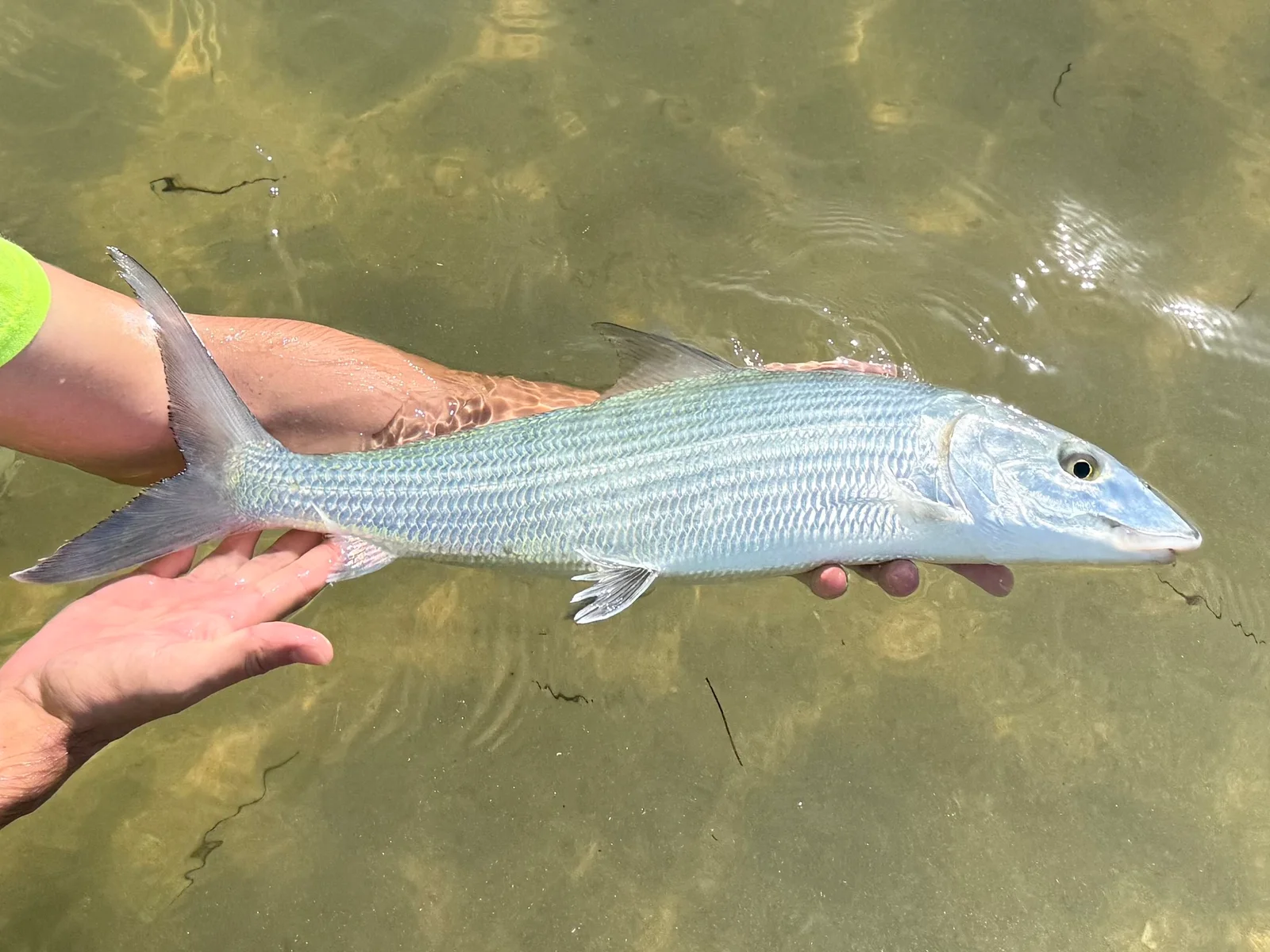
Bonefish
Albula vulpes · Albulidae
Adults inhabit shallow coastal waters, estuaries and bays, over sand and mud bottoms. Often in schools, except large individuals which are solitary. Dorsal fin may show above surface. More or less pelagic but feed on benthic worms, crustaceans, and mollusks; that are picked from mud and sand bottoms. They can tolerate oxygen poor water by inhaling air into a lung-like airbladder.
- Family
- Albulidae
- Max length
- 104 cm TL
- Max weight
- 10 kg
- Depth
- 0–84 m
- IUCN
- Near Threatened (NT)
- Climate
- Tropical
Adults inhabit shallow coastal waters, estuaries and bays, over sand and mud bottoms (Ref. 3237). Often in schools, except large individuals which are solitary (Ref. 7251). Dorsal fin may show above surface (Ref. 42064). More or less pelagic but feed on benthic worms, crustaceans, and mollusks (Ref. 2850); that are picked from mud and sand bottoms (Ref. 27549). They can tolerate oxygen poor water by inhaling air into a lung-like airbladder (Ref. 9710). Flesh is bony and not esteemed (Ref. 9268). One of the most important game fishes worldwide (Ref. 26938).
Open the full species pageOther BZ regulations
Same jurisdictionBefore you keep a fish
- Read the recorded value. It is copied from the notice; if the number and the notice disagree, the notice wins.
- Check the area. Federal, state and local waters can set different limits for the same fish.
- Check the date. Seasons, quotas and closures change; confirm the current notice before you go.
Common questions
- What is the protected species for Bonefish in Belize?
- Protected · catch-and-release only · possession prohibited
- Where does this regulation apply?
- Belize marine waters
- When was it checked?
- 2026-11-18, against Belize Fisheries Department — Fisheries Regulations.