
European eel in Portugal: Capture and retention prohibited — Portugal (mainland).
É proibida a captura e retenção das seguintes espécies: … Enguia (Anguilla anguilla) …
Quoted from DGRM — Pesca lúdica: espécies (Portaria n.º 14/2014, articles 10 and 13)
The 22 cm figure in the commercial minimum-size table does not create a recreational keep rule.
Regulation guide
Official sourcesPortugal prohibits recreational eel fishing
European eel (Anguilla anguilla) is on Portugal's list of species whose capture and retention are prohibited in recreational fishing. The list is in Annex I of Portaria n.º 14/2014, and the Directorate-General for Natural Resources, Security and Maritime Services republishes it on its recreational-fishing species page under the heading of prohibited species.
The prohibition is not a minimum-size rule with an exemption for large fish. Article 10 of the ordinance prohibits the capture and retention of the listed species and requires any accidentally caught specimen to be released immediately.
This applies across the recreational modalities covered by the ordinance: fishing from shore, from a boat, and spearfishing, in oceanic waters, inland maritime waters and non-maritime inland waters under the maritime authority. There is no Portuguese recreational eel fishery that an angler can lawfully target.
Source: Portaria n.º 14/2014, de 23 de janeiro, regime da pesca lúdica · DGRM: Pesca Lúdica — Espécies
The 22 cm figure is a commercial minimum, not a keep rule
Portugal's minimum-size table lists enguia (Anguilla anguilla) at 22 cm. That table is the national schedule of minimum conservation reference sizes used for commercial fishing, and it is also the reference that Article 10(2) of the recreational ordinance uses for species that may be retained.
The 22 cm entry cannot be read as permission to keep an eel of 22 cm or more. The prohibition in Annex I is a separate and absolute rule: a listed species may not be captured or retained at any size. The size table only becomes relevant if the species is not prohibited, which is not the case here.
A 22 cm figure therefore exists in the Portuguese size schedule, but it does not create an angling rule. The operative recreational rule is prohibition, and there is no keepable 22 cm eel limit.
Source: DGRM: Tabela de Tamanhos Mínimos de Captura (26/02/2026) · DGRM: Pesca Lúdica — Espécies · Portaria n.º 14/2014, de 23 de janeiro, regime da pesca lúdica
What the ban covers in practice
The prohibition is on capture as well as retention. That means an angler should not target eel, even with the intention of releasing it, because the regulated act of capture is itself prohibited. A fish that takes a bait incidentally must be returned immediately and with as little injury as possible.
The ban also removes the usual defences that apply to other species. There is no bag limit to stay within, no minimum size to satisfy and no trophy allowance. An eel in the cooler, in a bucket or in a keepnet is a retained eel, and retention is prohibited.
The same logic applies at the point of landing and transport. Because retention is prohibited, an eel cannot lawfully be carried away from the water, kept for a photograph and then released, or stored for later identification.
Source: Portaria n.º 14/2014, de 23 de janeiro, regime da pesca lúdica · DGRM: Pesca Lúdica — Espécies
The EU context behind the Portuguese ban
The European Commission describes the eel as being in a critical state at all stages of its life cycle. Since 2018 the EU has applied a fishing closure for eels in marine and brackish waters, covering both commercial and recreational fishing at all life stages in the Atlantic, North Sea, Baltic Sea and Mediterranean.
The species is also listed in Appendix II of CITES, which means trade must be controlled to ensure it does not harm the survival of the species. The EU has prohibited trade in European eel outside the EU since 2010, and the Eel Regulation, Council Regulation (EC) No 1100/2007, provides the framework for national eel management plans.
Portugal's recreational prohibition is consistent with that framework and goes further for anglers by naming eel in the Annex I prohibited list. The national rule, rather than the EU closure alone, is the provision an inspector would apply to a recreational fisher.
Source: European Commission: Eel · Portaria n.º 14/2014, de 23 de janeiro, regime da pesca lúdica
Licence, daily limit and marking
A recreational licence is still required for the fishing trip, even though eel cannot be kept. The licensing requirement comes from the framework law, Decreto-Lei n.º 246/2000, and licences are issued by DGRM through its electronic system, Multibanco, regional agriculture and fisheries offices, or the BMar portal.
The general daily catch limit is 10 kg per practitioner, or 15 kg for spearfishing, with the heaviest fish excluded. That limit applies to the fish that may lawfully be retained; it does not create an allowance for eel, because eel is outside the retainable catch.
Retained fish must be marked with a cut in the caudal fin before the angler leaves the fishing site or lands the catch. The marking rule does not apply to eel in practice, because there should be no retained eel to mark.
Source: Portaria n.º 14/2014, de 23 de janeiro, regime da pesca lúdica · Decreto-Lei n.º 246/2000, de 29 de setembro, quadro legal da pesca lúdica · DGRM: Licenciamento da Pesca Lúdica · DGRM: Pesca Lúdica — Espécies
Before you fish for anything else
Because eel is prohibited, the practical question is how to avoid catching one. Eel takes worms, fish baits and dead baits in estuaries, lagoons and rivers, often at night, and it can be a frequent bycatch for anglers targeting other species in those waters.
If an eel is hooked, release it immediately without retaining it for a photograph or a weigh-in. Do not place it in a keepnet, bucket or cooler, and do not move it to another waterbody. The prohibition is on capture and retention, so the sooner the fish is back in the water the better.
The same Annex I list includes other species that are often encountered in the same fisheries, including lamprey, salmon, allis and twaite shad, and several sharks and rays. Checking the full list before a trip is more useful than checking a single size table, because the prohibited species are the ones that cannot be kept at any size.
Source: Portaria n.º 14/2014, de 23 de janeiro, regime da pesca lúdica · DGRM: Pesca Lúdica — Espécies
Official pages: DGRM: Pesca Lúdica — Espécies (prohibited species list) · Portaria n.º 14/2014: regime da pesca lúdica · DGRM: Tabela de Tamanhos Mínimos de Captura · European Commission: Eel · DGRM: Licenciamento da Pesca Lúdica · Decreto-Lei n.º 246/2000, de 29 de setembro, quadro legal da pesca lúdica
European eel regulations at a glance
1 jurisdictions| Jurisdiction | Area | Size | Bag | Season / closure | Closed area | Other |
|---|---|---|---|---|---|---|
| Portugal | Portugal (mainland) | — | — | — | — | Protected species: Capture and retention prohibited |
European eel
Anguilla anguilla · Anguillidae
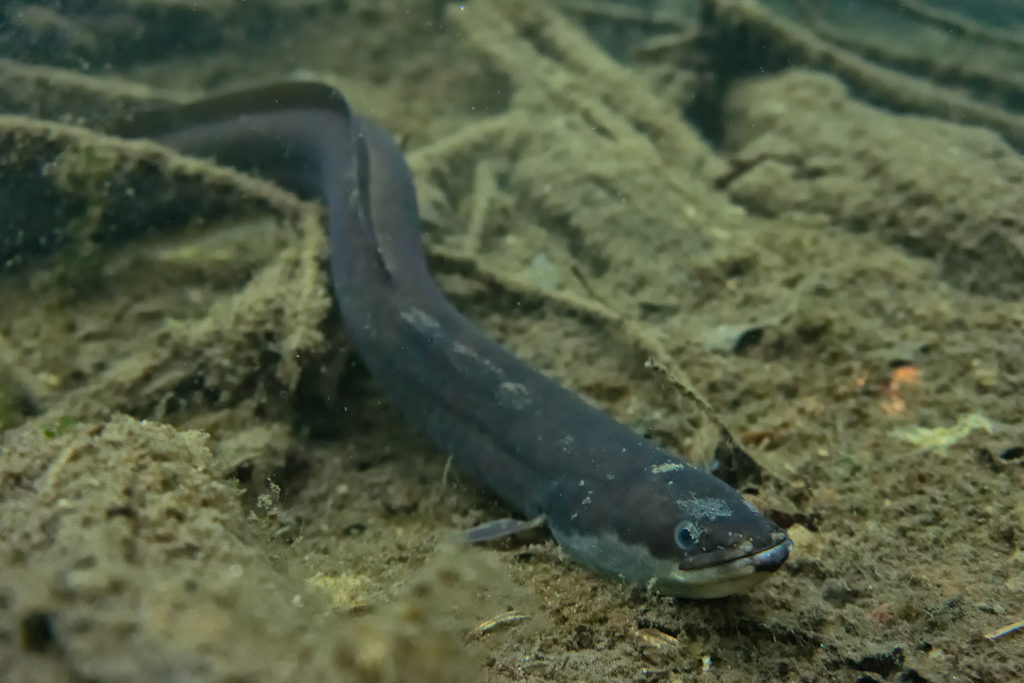
European eel is a snakelike fish of the eastern Atlantic and Mediterranean that lives in fresh water, estuaries and coastal seas from Scandinavia to Morocco. It reaches 122 cm and 6.6 kg, feeds on worms, and is fished at night or on the bottom. The season runs January to July in water of 4 to 20 °C.
- Family
- Anguillidae
- Max length
- 122 cm TL
- Max weight
- 6.6 kg
- Max age
- 23 years
- Depth
- 0–700 m
- IUCN
- CR
- Climate
- Temperate · 4–20 °C
- Diet
- worms
European eel (Anguilla anguilla) is a fish of the family Anguillidae. FishBase gives its range as: Atlantic Ocean: Atlantic coast from Scandinavia to Morocco; Baltic, Black and Mediterranean Seas; rivers of North Atlantic, Baltic and Mediterranean seas. Continuous to Asia and South and Central America. It is recorded from 0 to 700 m, in temperate water at 4–20 °C. The recorded maxima are 122 cm TL, 6.6 kg, 23 years. Common length is recorded at 35 cm. Diet includes worms. IUCN status: Critically Endangered (CR). Chinese name: .
Techniques
- Night fishing —
- Bottom fishing —
Seasonality
Other PT regulations
Same jurisdictionBefore you keep a fish
- Read the recorded value. It is copied from the notice; if the number and the notice disagree, the notice wins.
- Check the area. Federal, state and local waters can set different limits for the same fish.
- Check the date. Seasons, quotas and closures change; confirm the current notice before you go.
Common questions
- What is the protected species for European eel in Portugal?
- Capture and retention prohibited
- Where does this regulation apply?
- Portugal (mainland)
- When was it checked?
- 2026-11-18, against DGRM — Pesca lúdica: espécies (Portaria n.º 14/2014, articles 10 and 13).