
Deepwater longtail red snapper in Australia — Queensland: 5 fish possession limit — Queensland tidal waters.
Flame snapper | Min: 38cm | Limit: 5
Quoted from Queensland Government — Size and possession limits in tidal waters
A possession limit is the total number of fish you may keep at any time, including fish at home or in the freezer; it is not a daily take limit.
Regulation guide
Official sourcesHow this deepwater snapper is managed
Etelis coruscans appears in Queensland's recreational fishing rules under the common name flame snapper. The species page places it with the tropical snappers and sea perches and gives a minimum size of 38 cm and a possession limit of 5.
The species is a regulated coral reef fin fish under Schedule 7 of the Fisheries (General) Regulation 2019. That listing adds the combined coral reef fin fish possession limit and the two annual coral reef spawning closures to the species figures.
The name used in this dossier, deepwater longtail red snapper, is not the name used in the Queensland table. Anglers checking the rule should match the scientific name Etelis coruscans rather than rely on the common name alone. The controls are Queensland rules for tidal waters.
Source: Queensland Government: Flame snapper species page · Queensland Government: Size and possession limits in tidal waters · Queensland Fisheries (General) Regulation 2019, Schedule 7
Queensland: 38 cm and a possession limit of 5
The tidal-water table lists flame snapper at a minimum size of 38 cm and a limit of 5. The species page repeats both figures.
The 5 is a possession limit, not a daily bag limit. Queensland defines a possession limit as the total number of fish a person may legally take and keep at any single time, and states that fish held at home, including in the freezer, count towards it.
A fisher who already holds 5 flame snapper at home therefore has no flame snapper allowance left. The figure does not reset with a new fishing day.
Source: Queensland Government: Size and possession limits in tidal waters · Queensland Government: Flame snapper species page
The 20-fish coral reef fin fish ceiling
Queensland applies a combined possession limit of 20 in total for all coral reef fin fish. The flame snapper allowance of 5 sits inside that ceiling rather than on top of it.
A fisher holding flame snapper with ruby snapper, coral trout, jobfish or other reef species must keep the total at 20 or below. Five flame snapper and five ruby snapper use 10 of the 20.
Both figures are possession limits, so fish at home count against the combined ceiling as well as against the species limit.
Source: Queensland Government: Flame snapper species page · Queensland Government: Size and possession limits in tidal waters
Two five-day closures in October and November
Coral reef fin fish are closed for two five-day periods each year, in October and November. For 2026 the dates are 8 to 12 October and 6 to 10 November.
The species page lists dates for 2025, 2027 and 2028 as well, and states that dates beyond the current year are indicative and subject to change. Anglers should check the current dates before travelling.
In a closure, a person must not take coral reef fin fish, or possess coral reef fin fish taken in the regulated waters. The species page describes a narrow exception for fish taken outside those waters and eaten on a boat, or on a charter trip of at least 24 hours.
Source: Queensland Government: Flame snapper species page · Queensland Department of Primary Industries: Closed seasons in tidal waters
How to measure a flame snapper
Queensland measures fish from the tip of the snout to the end of the tail. The fish must not be manipulated to increase or decrease its length.
Despite the longtail name, the Queensland reading runs to the end of the tail, not to the fork. A fish kept as 38 cm must reach that figure on the snout-to-tail-tip basis, measured flat.
Using a fork-length measurement would give a shorter reading than the state rule requires, so the tail tip is the relevant point.
Filleting and on-board rules
Coral reef fin fish may be kept on board whole, gilled, gutted or filleted. Fillets must be at least 40 cm long and must keep the skin and scales on.
A live fish may be kept on board only if it is going to be displayed in an aquarium; the tidal-water page notes exceptions for coral trout and redthroat emperor.
Fish may be divided into portions only if an inspector can easily count the number of fish in the fisher's possession.
Source: Queensland Government: Size and possession limits in tidal waters
Before keeping a flame snapper
There is no recreational fishing licence in Queensland for ordinary tidal-water fishing. A permit is required only when line fishing in stocked impoundments under the Stocked Impoundment Permit Scheme.
Before keeping a fish, confirm the coral reef closure dates, measure the fish on the snout-to-tail basis, and count both the 5-fish limit and the 20-fish reef ceiling, including fish stored at home.
Deepwater snappers can be difficult to separate on a boat. The Queensland species guide and the Qld Fishing 2.0 app are the state's identification tools, and the scientific name should be used when the common name differs.
Source: Queensland Government: Fishing rules and licensing · Queensland Government: Size and possession limits in tidal waters · Queensland Government: Flame snapper species page
Official pages: Queensland Government: Size and possession limits in tidal waters · Queensland Government: Flame snapper species page · Queensland Department of Primary Industries: Closed seasons in tidal waters
Deepwater longtail red snapper regulations at a glance
1 jurisdictions| Jurisdiction | Area | Size | Bag | Season / closure | Closed area | Other |
|---|---|---|---|---|---|---|
| Australia — Queensland | Queensland tidal waters | ≥38 cm | 5 fish possession limit | — | — | — |
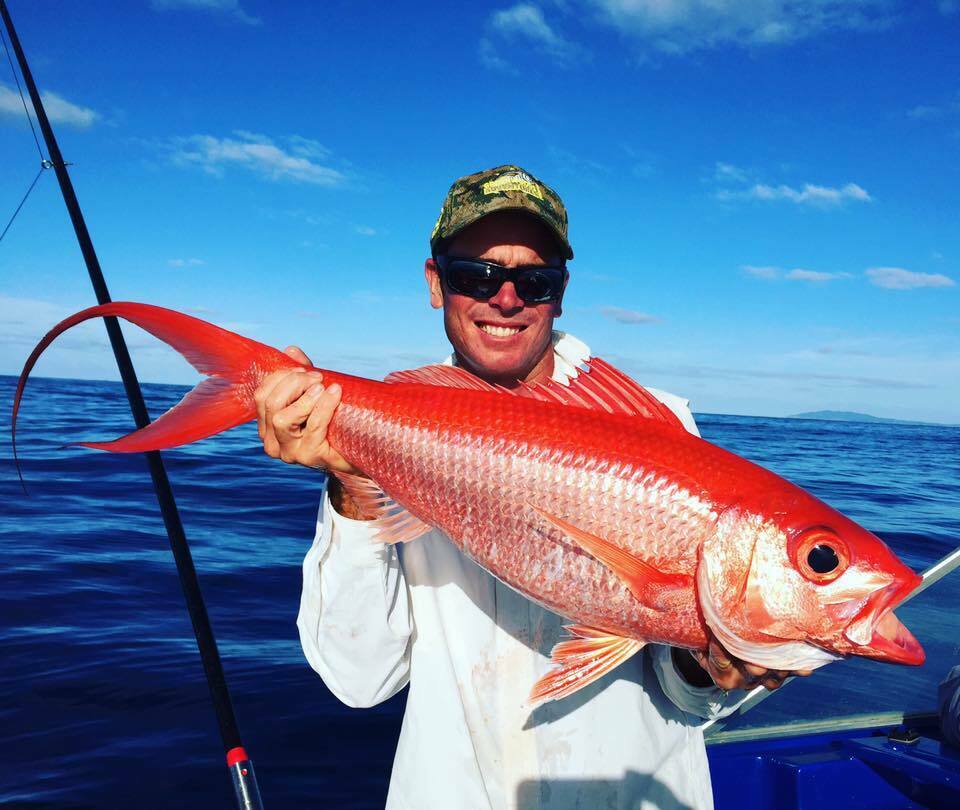
Deepwater longtail red snapper
Etelis coruscans · Lutjanidae
Deepwater longtail red snapper is a large lutjanid of the Indo-Pacific, from East Africa across to Hawaii, north to the Sea of Japan and south through Queensland, New South Wales and Lord Howe Island. It lives deep, between 45 and 400 m, grows to 120 cm TL and feeds on crustaceans and fish. A maximum recorded age of 20 years underlines how long-lived this deep-water snapper is.
- Family
- Lutjanidae
- Max length
- 120 cm TL
- Max age
- 20 years
- Depth
- 45–400 m
- IUCN
- LC
- Climate
- Deep-water
- Diet
- crustaceans, fishes
Deepwater longtail red snapper (Etelis coruscans) is a fish of the family Lutjanidae. FishBase gives its range as: Indo-Pacific: East Africa eastward to the Hawaiian Islands, north to Sea of Japan, south to Australia (Queensland and New South Wales) and Lord Howe Island; off Kermadec Islands, northeast of New Zealand. Reported from the Marquesas. The name Etelis carbunculus has been misapplied to this species by some previous authors. Body fusiform, oval in cross-section; the anal fin has three spines and eight soft rays. It is recorded from 45 to 400 m, in deep water. The recorded maxima are 120 cm TL, 20 years. Diet includes crustaceans and fishes. IUCN status: Least Concern (LC). Chinese name: .
Seasonality
Other AU-QLD regulations
Same jurisdictionBefore you keep a fish
- Read the recorded value. It is copied from the notice; if the number and the notice disagree, the notice wins.
- Check the area. Federal, state and local waters can set different limits for the same fish.
- Check the date. Seasons, quotas and closures change; confirm the current notice before you go.
Common questions
- What is the bag limit for Deepwater longtail red snapper in Australia — Queensland?
- 5 fish possession limit
- Where does this regulation apply?
- Queensland tidal waters
- When was it checked?
- 2026-11-18, against Queensland Government — Size and possession limits in tidal waters.