
European squid in Portugal: ≥10 cm — Portugal (mainland).
Lula-vulgar (Loligo vulgaris) | 10 cm
Quoted from DGRM — Tabela de Tamanhos Mínimos de Captura
Measured as mantle length along the dorsal midline, from the posterior tip of the mantle to its anterior edge.
Regulation guide
Official sourcesHow common squid is managed in Portugal
Common squid (Loligo vulgaris), lula-vulgar in Portuguese, is a cephalopod covered by the Portuguese recreational framework. Portaria n.º 14/2014 sets the permitted gear, the licensing system and the daily catch limits, and it permits line gear including the toneira used for squid.
There is no separate recreational size table for squid. Article 10 of the ordinance prohibits retaining fish, crustaceans and molluscs below the minimum sizes in force for commercial fishing, so the commercial minimum is the recreational minimum.
The current minimum-size table issued by the Directorate-General for Natural Resources, Security and Maritime Services lists lula-vulgar at 10 cm. The same table supplies the measurement basis in a footnote, which is essential because a cephalopod cannot be measured like a fish.
Source: Portaria n.º 14/2014, de 23 de janeiro, regime da pesca lúdica · DGRM: Tabela de Tamanhos Mínimos de Captura (26/02/2026) · DGRM: Pesca Lúdica — Espécies
10 cm is a mantle length, not a total length
The footnote attached to the squid entry defines the measurement as the distance along the dorsal midline from the posterior tip of the mantle to the anterior edge of the mantle. That is a mantle length, not a total length including the arms or tentacles.
The distinction is large on a squid. A 10 cm mantle length corresponds to an animal whose arms and tentacles extend well beyond 10 cm, and measuring from the tip of the head or the end of the tentacles would overstate the size.
Lay the squid on its side, locate the rear tip of the mantle and the front edge where the mantle meets the head, and measure along the midline between those two points. The arms and tentacles are not part of the measurement.
Source: DGRM: Tabela de Tamanhos Mínimos de Captura (26/02/2026) · Portaria n.º 14/2014, de 23 de janeiro, regime da pesca lúdica
Does the 10 cm rule apply to recreational fishing?
Yes, through the cross-reference in Article 10(2). The recreational ordinance does not reproduce a squid measurement table; it adopts the commercial minimum sizes and requires undersized specimens to be returned to the water.
The DGRM recreational page states the same rule in plain language: it is prohibited to capture fish, crustaceans, molluscs and echinoderms below the minimum sizes fixed in the legislation in force for commercial fishing. Squid is a mollusc, so the 10 cm mantle length reaches the recreational angler through that provision.
There is no Portuguese recreational-specific size for squid and no separate bag limit expressed in numbers of squid. The controls are the minimum size, the daily weight limit and the licence.
Source: Portaria n.º 14/2014, de 23 de janeiro, regime da pesca lúdica · DGRM: Pesca Lúdica — Espécies
Bag limit and licence
The Portuguese recreational daily limit is 10 kg per practitioner, and the heaviest specimen is not counted towards that weight. For spearfishing the limit is 15 kg, again excluding the largest specimen. When more than three practitioners are on a recreational boat, the total catch may not exceed 25 kg, with one heaviest specimen per practitioner excluded.
Squid counts towards the 10 kg limit as a cephalopod. There is no separate squid allowance, so a good squid session can use up the whole daily limit before any fish are added to the box.
A recreational licence is required and is issued by DGRM through its electronic system, Multibanco, regional agriculture and fisheries offices, or the BMar portal. The licence is recorded electronically and can be checked by inspectors by SMS.
Source: Portaria n.º 14/2014, de 23 de janeiro, regime da pesca lúdica · DGRM: Licenciamento da Pesca Lúdica
Gear and fishing method
Portuguese recreational gear is limited to the handline, rod, corrico or trolling line, and toneira, plus support equipment. The toneira is defined in the ordinance as a handline with a fusiform weight, optionally carrying up to three fusiform floats, with one or two rings of barbless hooks at the lower end. That is the gear commonly used for squid.
The ordinance allows artificial light when fishing with toneiras from shore or from a boat, and for buoy and rod indicators. Baits and groundbait may be natural or artificial, but fish roe and poisonous, toxic or explosive substances are prohibited.
Spearfishing gear is limited to the speargun, diving knife, hook and short-handled scraper. A spearfisher cannot use baits or groundbait, and cannot carry scuba equipment at the same time as a speargun.
Source: Portaria n.º 14/2014, de 23 de janeiro, regime da pesca lúdica · DGRM: Pesca Lúdica — Espécies
Before you keep one
Measure the mantle, not the whole animal. A squid with a 10 cm mantle is legal, while a squid whose arms reach 10 cm but whose mantle is shorter is not. Keep the measurement simple and consistent, because the footnote defines a specific dorsal-line measurement.
Check the total weight against the 10 kg daily limit, remembering that the heaviest specimen may be excluded. If the catch includes fish as well as squid, the combined weight is what counts.
Carry the licence and keep the catch for personal use. Recreational fishing in Portugal is defined as non-commercial, and the framework law prohibits exposing, offering or selling recreationally caught specimens.
Source: Portaria n.º 14/2014, de 23 de janeiro, regime da pesca lúdica · Decreto-Lei n.º 246/2000, de 29 de setembro, quadro legal da pesca lúdica · DGRM: Tabela de Tamanhos Mínimos de Captura (26/02/2026) · DGRM: Licenciamento da Pesca Lúdica
Official pages: Portaria n.º 14/2014: regime da pesca lúdica · DGRM: Tabela de Tamanhos Mínimos de Captura · DGRM: Pesca Lúdica — Espécies · DGRM: Licenciamento da Pesca Lúdica · Decreto-Lei n.º 246/2000, de 29 de setembro, quadro legal da pesca lúdica
European squid regulations at a glance
1 jurisdictions| Jurisdiction | Area | Size | Bag | Season / closure | Closed area | Other |
|---|---|---|---|---|---|---|
| Portugal | Portugal (mainland) | ≥10 cm | — | — | — | — |
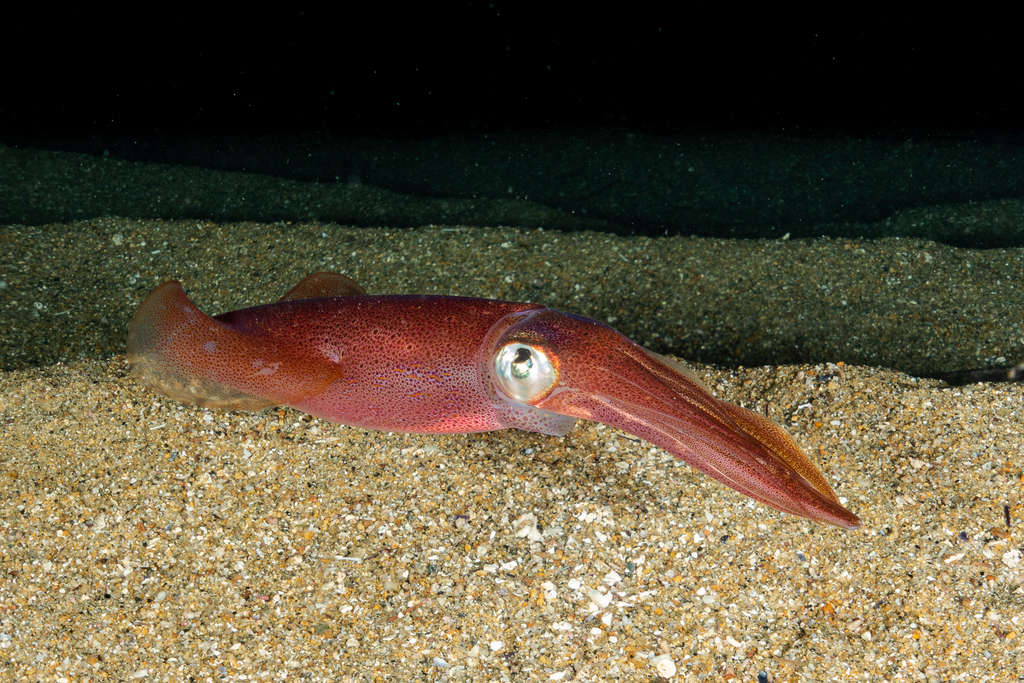
European squid
Loligo vulgaris · Loliginidae
European squid is a loliginid of the eastern Atlantic and Mediterranean, from the North Sea and British Isles to southwest Africa. It lives from the surface to 500 m in water of 13 to 20 °C, reaches 64 cm mantle length and 1.5 kg, and feeds on crustaceans, fish, molluscs and zooplankton. Boat fishing or handline is the usual approach, and it is present year-round.
- Family
- Loliginidae
- Max length
- 64 cm ML
- Max weight
- 1.5 kg
- Depth
- 0–500 m
- IUCN
- DD
- Climate
- Temperate · 13–20 °C
- Diet
- crustaceans, fishes, molluscs, zooplankton
European squid (Loligo vulgaris) is a cephalopod of the family Loliginidae. SeaLifeBase gives its range as: Eastern Atlantic and the Mediterranean: from North Sea and British Isles to southwest Africa and the Mediterranean. It is recorded from 0 to 500 m, in temperate water at 13–20 °C. The recorded maxima are 64 cm ML, 1.5 kg. Diet includes crustaceans, fishes, molluscs and zooplankton. IUCN status: Data Deficient (DD). Chinese name: .
Techniques
- Boat fishing —
- Handline —
Seasonality
Other PT regulations
Same jurisdictionBefore you keep a fish
- Read the recorded value. It is copied from the notice; if the number and the notice disagree, the notice wins.
- Check the area. Federal, state and local waters can set different limits for the same fish.
- Check the date. Seasons, quotas and closures change; confirm the current notice before you go.
Common questions
- What is the minimum size for European squid in Portugal?
- ≥10 cm
- Where does this regulation apply?
- Portugal (mainland)
- When was it checked?
- 2026-11-18, against DGRM — Tabela de Tamanhos Mínimos de Captura.