
Malabar snapper in Australia — Queensland: ≥40 cm — Queensland tidal waters.
Saddletail snapper (large-mouth nannygai) | Min: 40cm | Combined limit: 9 in total of crimson and saddletail snapper
Quoted from Queensland Government — Size and possession limits in tidal waters
Queensland lists this species as saddletail snapper (large-mouth nannygai). The 9-fish combined possession limit covers crimson and saddletail snapper inside the 20 reef fin fish cap, with two five-day closures (8–12 October and 6–10 November 2026).
Regulation guide
Official sourcesHow Malabar blood snapper is managed in Queensland
Malabar blood snapper (Lutjanus malabaricus) is a tidal-water species managed by Queensland's recreational fishing rules, published by the Queensland Government with supporting material from the Department of Primary Industries. The rules cover size and possession limits, closed seasons and closed waters, and protected and no-take species.
Queensland does not use the name Malabar blood snapper in its public catch table. The species appears there as saddletail snapper, also given as large-mouth nannygai, and the department's stock pages confirm saddletail snapper as Lutjanus malabaricus.
That naming difference matters at the cleaning table. An angler who looks for Malabar snapper will not find the row, while the entry under saddletail snapper carries the size and possession limits that legally apply to the fish.
Source: Queensland Government: Size and possession limits in tidal waters · Queensland Department of Primary Industries: Saddletail snapper stock
The 40 cm minimum
Saddletail snapper carries a minimum size of 40 cm, the same figure as crimson snapper. The limit is a size limit applying in Queensland tidal waters.
Queensland measures from the tip of the snout to the end of the tail, and the fish must not be manipulated to change its length. Measuring to the fork instead of the tail tip will produce a short reading on a fish close to the line.
Undersized fish must be returned immediately. The rules ask anglers to put undersized, oversized, no-take or closed-season species back in the water straight away to improve their chance of survival.
Source: Queensland Government: Size and possession limits in tidal waters · Queensland Government: Measure your catch
Nine fish shared with crimson snapper
The possession limit is a combined limit of nine in total of crimson and saddletail snapper. The two species share one allowance, so a mixed bag of four crimson and five saddletail already reaches the cap.
Queensland's possession limit is not a daily limit. It is the total number of fish a person may legally take and keep at any single time, and it includes fish at home, including those in the freezer.
An angler holding saddletail at home therefore has less room on the water. Counting the freezer before a trip is part of complying with the combined limit, not a formality.
Source: Queensland Government: Size and possession limits in tidal waters
The 20-fish coral reef fin fish cap
Saddletail snapper is a coral reef fin fish, and Queensland applies a combined possession limit of 20 in total across all coral reef fin fish. That figure is a ceiling over the whole reef catch, and the nine-fish snapper limit operates inside it.
The reef cap is counted across species rather than per species. A box containing saddletail, crimson snapper, coral trout and red emperor is measured against the single total of 20, and each species limit still applies within that total.
The rules page links to the complete list of coral reef fin fish species in the Fisheries Regulation. That list settles whether an unfamiliar reef fish is inside the 20-fish cap.
Source: Queensland Government: Size and possession limits in tidal waters
Closed seasons for reef fin fish
Two five-day coral reef fin fish closed seasons are held in October and November each year. The scheduled closures are 8 to 12 October and 6 to 10 November in 2026, and 26 to 30 October and 25 to 29 November in 2027.
The closed area follows the east coast from the northern tip of Cape York south to the mainland shore at latitude 24 degrees 50 minutes south, along a line of published coordinates, and the department provides a closure map.
Queensland's guidance is that anglers should not target closed species during a closed season. A separate 15 July to 15 August closure applies to snapper and pearl perch on the east coast, and that entry is for the species listed as snapper rather than for saddletail snapper.
Source: Queensland Department of Primary Industries: Closed seasons in tidal waters · Queensland Government: Closed seasons and waters
What the stock assessment says
The Department of Primary Industries rates the east coast Queensland saddletail snapper stock as sustainable in its 2023 status table, with the Gulf of Carpentaria stock also listed as sustainable.
The 2026 east coast stock assessment estimated biomass at between 19% and 42% of unfished levels, with a median of about 28%. The department notes that a sustainable classification under the national framework does not by itself mean the stock is meeting Queensland harvest strategy targets.
The assessment used biological data together with commercial and recreational catch data, and it feeds into the reef line harvest strategy that sets the management response.
Source: Queensland Department of Primary Industries: Saddletail snapper stock
Before you keep a saddletail snapper
Reef fin fish may be kept whole, gilled, gutted or filleted, but fillets must be at least 40 cm long with skin and scales left on. A live fish may be kept on board only for aquarium display, with exceptions for coral trout and redthroat emperor.
The Qld Fishing 2.0 app carries the current rules, and the department's Your Catch Counts program records recreational catches that support stock assessments.
The checks are the same for both nannygai species: confirm the fish is saddletail or crimson, measure snout to tail against 40 cm, count the combined bag against nine and the reef total against 20, and check the calendar for an October or November closure.
Source: Queensland Government: Size and possession limits in tidal waters · Queensland Department of Primary Industries: Your Catch Counts
Official pages: Queensland Government: Size and possession limits in tidal waters · Queensland Government: Measure your catch · Queensland Department of Primary Industries: Closed seasons in tidal waters · Queensland Department of Primary Industries: Saddletail snapper stock
Malabar snapper regulations at a glance
1 jurisdictions| Jurisdiction | Area | Size | Bag | Season / closure | Closed area | Other |
|---|---|---|---|---|---|---|
| Australia — Queensland | Queensland tidal waters | ≥40 cm | — | — | — | — |
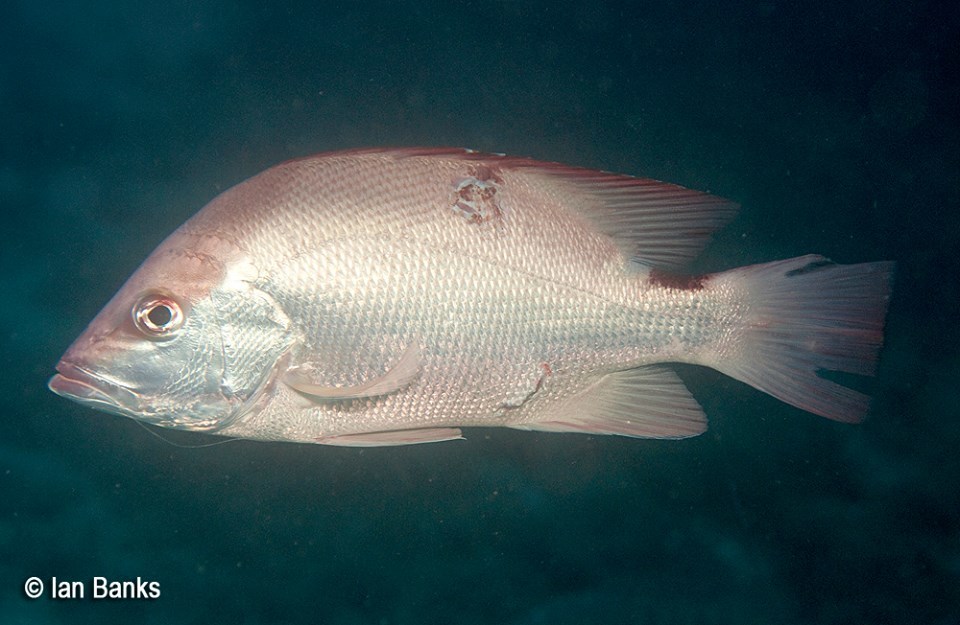
Malabar snapper
Lutjanus malabaricus · Lutjanidae
Malabar snapper is a large lutjanid of the Indo-West Pacific, from the Persian Gulf and Arabian Sea to Fiji, Japan and Australia. It lives from 12 to 100 m in tropical water, reaches 100 cm and 7.9 kg, can live 48 years, and feeds on crustaceans, fish and molluscs. Boat bottom fishing is the usual approach, and fish are present year-round.
- Family
- Lutjanidae
- Max length
- 100 cm TL
- Max weight
- 7.9 kg
- Max age
- 48 years
- Depth
- 12–100 m
- IUCN
- LC
- Climate
- Tropical
- Diet
- crustaceans, fishes, molluscs
Malabar snapper (Lutjanus malabaricus) is a fish of the family Lutjanidae. FishBase gives its range as: Indo-West Pacific: Persian Gulf and Arabian Sea to Fiji, north to southern Japan, south to Australia. This species has been frequently misidentified as Lutjanus sanguineus. It is recorded from 12 to 100 m, in tropical water. The recorded maxima are 100 cm TL, 7.9 kg, 48 years. Common length is recorded at 50 cm. Diet includes crustaceans, fishes and molluscs. IUCN status: Least Concern (LC). Chinese name: .
Techniques
- Boat bottom fishing —
Seasonality
Other AU-QLD regulations
Same jurisdictionBefore you keep a fish
- Read the recorded value. It is copied from the notice; if the number and the notice disagree, the notice wins.
- Check the area. Federal, state and local waters can set different limits for the same fish.
- Check the date. Seasons, quotas and closures change; confirm the current notice before you go.
Common questions
- What is the minimum size for Malabar snapper in Australia — Queensland?
- ≥40 cm
- Where does this regulation apply?
- Queensland tidal waters
- When was it checked?
- 2026-11-18, against Queensland Government — Size and possession limits in tidal waters.