
Blue marlin in United States — North Carolina: 1 fish per vessel per trip (blue or white marlin combined) — North Carolina coastal and joint waters.
Blue Marlin (G) | 99" LJFL | 1 per vessel per trip, either blue or white marlin
Quoted from North Carolina DEQ — Division of Marine Fisheries, Recreational Size and Bag Limits
The vessel limit combines blue and white marlin; the 99-inch LJFL minimum applies to blue marlin.
Regulation guide
Official sourcesHow Atlantic blue marlin is managed
Atlantic blue marlin (Makaira nigricans) is a shared stock. ICCAT Recommendation 19-05 sets the minimum sizes that members must apply to recreational retention — 251 cm lower jaw fork length for blue marlin, 168 cm for white marlin and roundscale spearfish — and requires fish that are not kept to be released in a way that causes the least harm, with sale prohibited. NOAA Fisheries implements those obligations through the Atlantic Highly Migratory Species rules at 50 CFR part 635.
U.S. recreational landings of blue marlin, white marlin and roundscale spearfish are capped at 250 fish a year combined. NOAA removed Atlantic blue marlin from the overfishing list in its 2025 Status of Stocks report, the first time since 1998, but the minimum size and the landings cap were unchanged.
Source: ICCAT Recommendation 19-05: Rebuilding Programs for Blue Marlin and White Marlin/Roundscale Spearfish · NOAA Fisheries: Recreational Atlantic Billfish Fishery Statuses, Minimum Sizes, and Bag Limits · NOAA Fisheries: 2025 Status of Stocks report release
The federal minimum is 99 inches
Section 635.20(d)(1) prohibits taking, retaining or possessing a blue marlin taken from its management unit that is less than 99 inches (251 cm) lower jaw fork length. The rule is written against retention and possession, so a short fish cannot be kept for the table, a weigh-in or a photograph on deck.
Lower jaw fork length is a straight line from the anterior tip of the lower jaw to the fork of the caudal fin. NOAA's compliance guide illustrates the straight-line method, which is not a curved measurement over the body.
The minimum can be raised. Section 635.20(d)(5) allows NOAA Fisheries to set the blue marlin minimum between 117 and 138 inches (297.2 and 350.5 cm) to stay within the annual landings limit, with at least 14 days' notice in the Federal Register, so the current figure should be confirmed on the HMS billfish status page before a trip.
Source: 50 CFR 635.20: Size limits (eCFR) · NOAA Fisheries: HMS Recreational Compliance Guide (billfish measurement and limits)
Release, handling and gear
A blue marlin that will not be retained must be released in a way that gives it the greatest chance of survival, and it may not be removed from the water. For billfish, section 635.21(a)(2) requires the line to be cut near the hook or a dehooking device to be used, in either case without lifting the fish aboard.
Recreational billfish are taken by rod and reel. In a registered HMS tournament, natural bait must be fished with non-offset circle hooks, while artificial bait may be fished with J-hooks or offset circle hooks; secondary gear such as a gaff or tail rope may be used only at boatside. NOAA's handling advice adds that the fish should stay in the water even for a photograph and that heavy tackle shortens the fight.
Source: 50 CFR 635.21: Gear operation and deployment restrictions (eCFR) · NOAA Fisheries: HMS Recreational Compliance Guide (handling and release)
Permits, sale and reporting
A vessel fishing for billfish needs an HMS Angling or HMS Charter/Headboat permit, which covers everyone aboard; tournament vessels may use an Atlantic Tunas General category or Swordfish General Commercial permit instead.
Blue marlin taken under recreational rules may not be sold or transferred for a commercial purpose under 50 CFR 635.22(a)(1). A retained fish must be reported to NOAA Fisheries within 24 hours through the HMS website, the HMS Catch Reporting App or the toll-free number, unless a registered tournament operator reports it.
Source: NOAA Fisheries: Recreational Atlantic Billfish Fishery Statuses, Minimum Sizes, and Bag Limits · 50 CFR 635.22: Recreational retention limits (eCFR) · NOAA Fisheries: HMS Recreational Compliance Guide (reporting)
France: 251 cm in the Atlantic
France sets a minimum catch size through the Arrêté du 26 octobre 2012 on minimum sizes for maritime recreational fishing. Annexe I, in force since 14 January 2026, lists "MAKAIRE BLEU — Makaira nigricans — 251 cm (LJFL)" under section I, which covers the North Sea, the Channel and the Atlantic.
The French figure is the same length as the federal U.S. minimum: 251 cm is 99 inches, measured lower jaw to fork, and the annexe defines LJFL. The Mediterranean table in the same annexe has no blue marlin entry, so the 251 cm figure is the Atlantic rule.
Source: Légifrance: Arrêté du 26 octobre 2012, Annexe I (minimum catch sizes)
Mexico: one fish per angler per day
Mexico regulates sport fishing through NOM-017-PESC-1994. Section 4.7.1 sets a daily limit of ten fish per angler, with no more than five of one species, and provides that marlin, sailfish, swordfish and shark are limited to one fish per angler per day, counted as five against the total.
The norm also allows one rod or handline per angler (4.6.1), prohibits filleting on board (4.14) and keeps boats 250 metres from swimming beaches (4.12); service providers must carry the vessel and angler permits and a logbook (4.15). Minimum sizes are left to notices published in the Diario Oficial (4.11), so the bag limit and any size notice must be read together.
Source: NOM-017-PESC-1994: Pesca deportivo-recreativa (official text, FAOLEX copy) · PROFEPA (Mexico): enforcement notice restating the one-per-day billfish limit
North Carolina: 99 inches and one per vessel
North Carolina lists blue marlin at 99 inches lower jaw fork length, the federal figure, and records the species as federally managed. Its bag entry is one fish per vessel per trip, either blue marlin or white marlin, which is tighter than the federal table.
State rules sit on top of the federal ones: the HMS permit, the 24-hour report and the sale prohibition still apply, and North Carolina also requires a Coastal Recreational Fishing License under G.S. 113-174.2. Because white marlin is listed at 66 inches, a vessel that keeps one has used the shared allowance.
Source: NC DEQ Division of Marine Fisheries: Recreational Size and Bag Limits · NOAA Fisheries: Recreational Atlantic Billfish Fishery Statuses, Minimum Sizes, and Bag Limits
Official pages: NOAA Fisheries: Recreational Atlantic Billfish Fishery Statuses, Minimum Sizes, and Bag Limits · 50 CFR 635.20: Size limits (eCFR) · Légifrance: Arrêté du 26 octobre 2012 (minimum catch sizes) · NC DEQ Division of Marine Fisheries: Recreational Size and Bag Limits
Blue marlin regulations at a glance
3 jurisdictions| Jurisdiction | Area | Size | Bag | Season / closure | Closed area | Other |
|---|---|---|---|---|---|---|
| France | France — North Sea, Channel and Atlantic | ≥251 cm lower-jaw–fork length | — | — | — | — |
| Mexico | Mexican federal waters | — | 1 fish per angler per day · counts as 5 fish against the 10-fish daily limit | — | — | — |
| United States — North Carolina | North Carolina coastal and joint waters | 99 in lower jaw fork length | 1 fish per vessel per trip (blue or white marlin combined) | — | — | — |
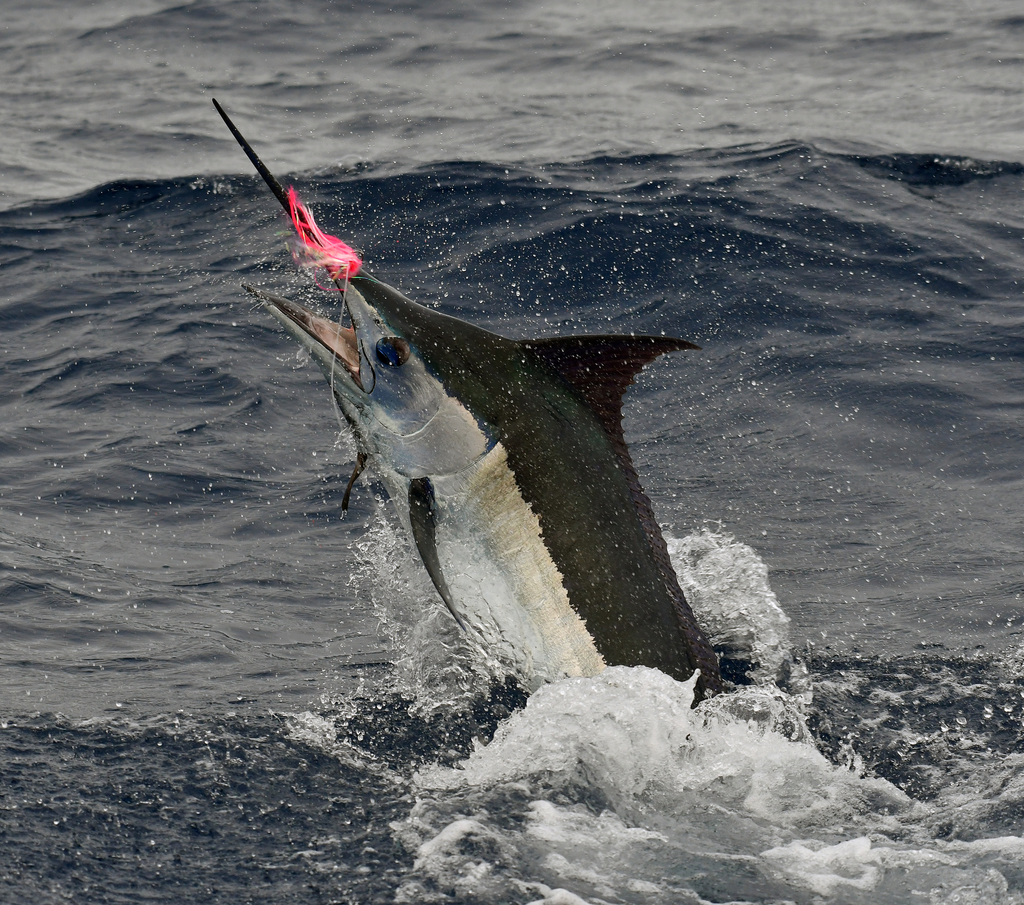
Blue marlin
Makaira nigricans · Istiophoridae
The two length figures in this record are 500 cm and 290 cm. They are not a range and they are not a disagreement. The first is the largest specimen the source has accepted; the second is the fish a boat is likely to meet. Almost every practical decision about blue marlin — leader class, release handling, how a photograph is framed — belongs to the second number, while most of the fish's reputation belongs to the first.
- Family
- Istiophoridae
- Max length
- 500 cm TL
- Max weight
- 636 kg
- Max age
- 20 years
- Depth
- 0–1000 m
- IUCN
- VU
- Climate
- Subtropical · 22–31 °C
- Diet
- fishes
The two length figures in this record are 500 cm and 290 cm. They are not a range and they are not a disagreement. The first is the largest specimen the source has accepted; the second is the fish a boat is likely to meet. Almost every practical decision about blue marlin — leader class, release handling, how a photograph is framed — belongs to the second number, while most of the fish's reputation belongs to the first.
Seasonality
Other US-NC regulations
Same jurisdictionBefore you keep a fish
- Read the recorded value. It is copied from the notice; if the number and the notice disagree, the notice wins.
- Check the area. Federal, state and local waters can set different limits for the same fish.
- Check the date. Seasons, quotas and closures change; confirm the current notice before you go.
Common questions
- What is the bag limit for Blue marlin in United States — North Carolina?
- 1 fish per vessel per trip (blue or white marlin combined)
- Where does this regulation apply?
- North Carolina coastal and joint waters
- When was it checked?
- 2026-11-19, against North Carolina DEQ — Division of Marine Fisheries, Recreational Size and Bag Limits.
- Do other jurisdictions set different limits?
- Yes. This register lists 3 jurisdictions for Blue marlin; compare them in the table above.