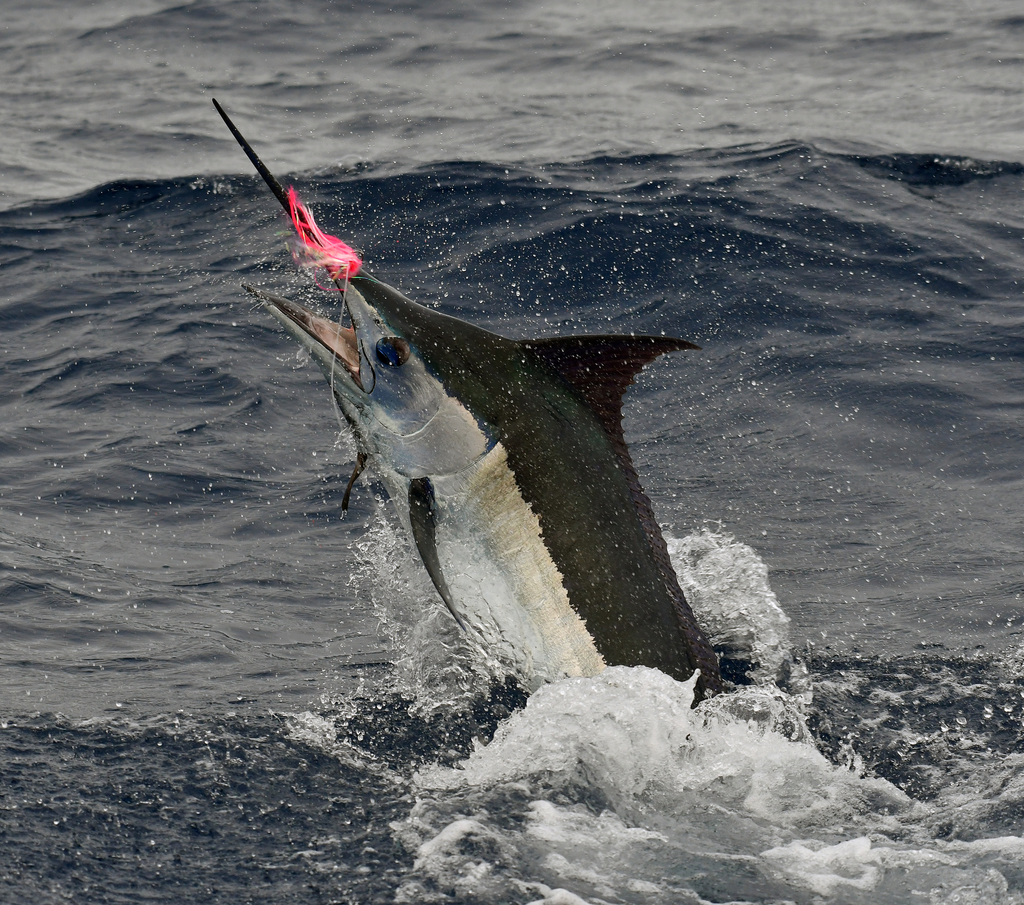
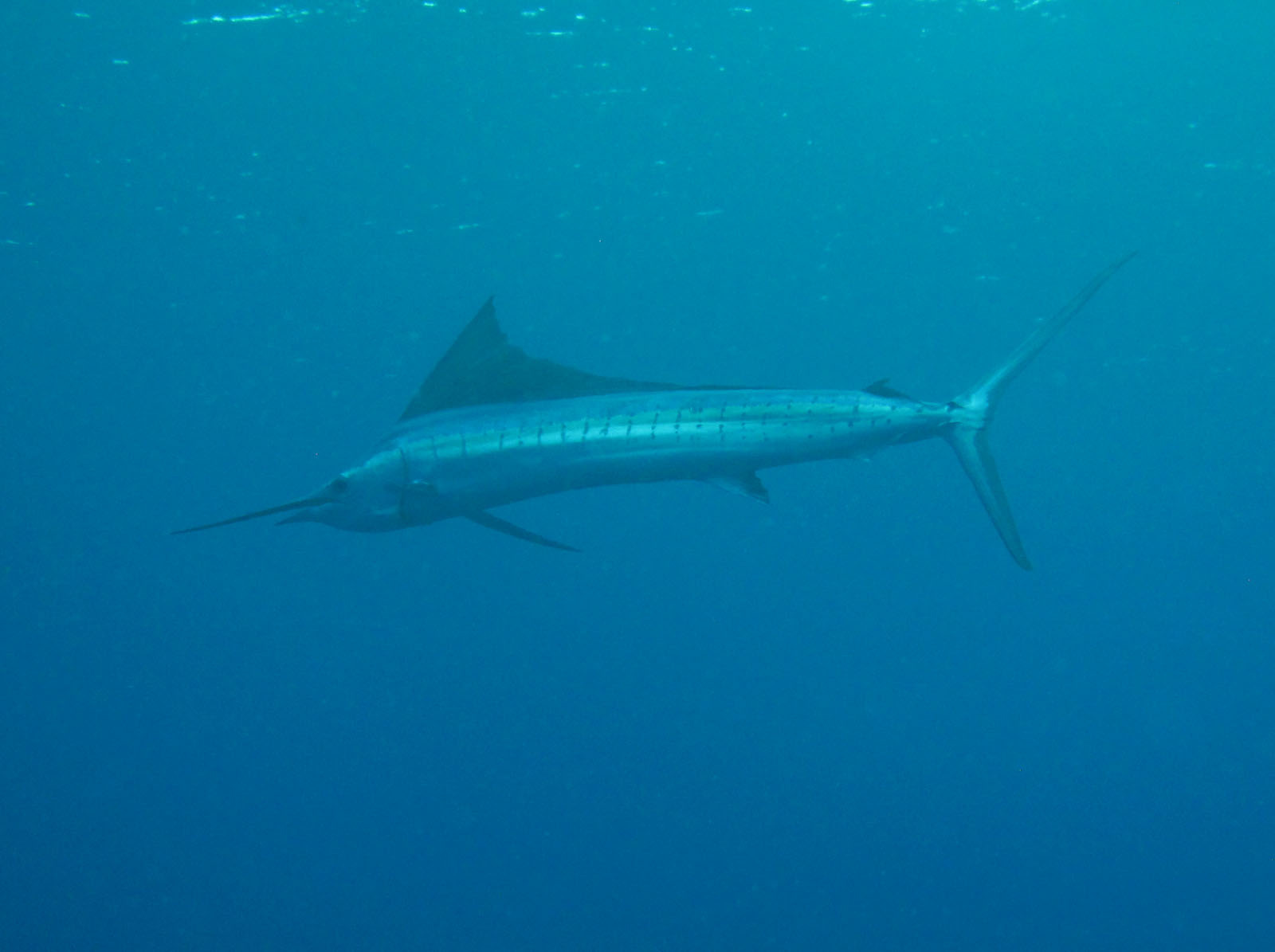
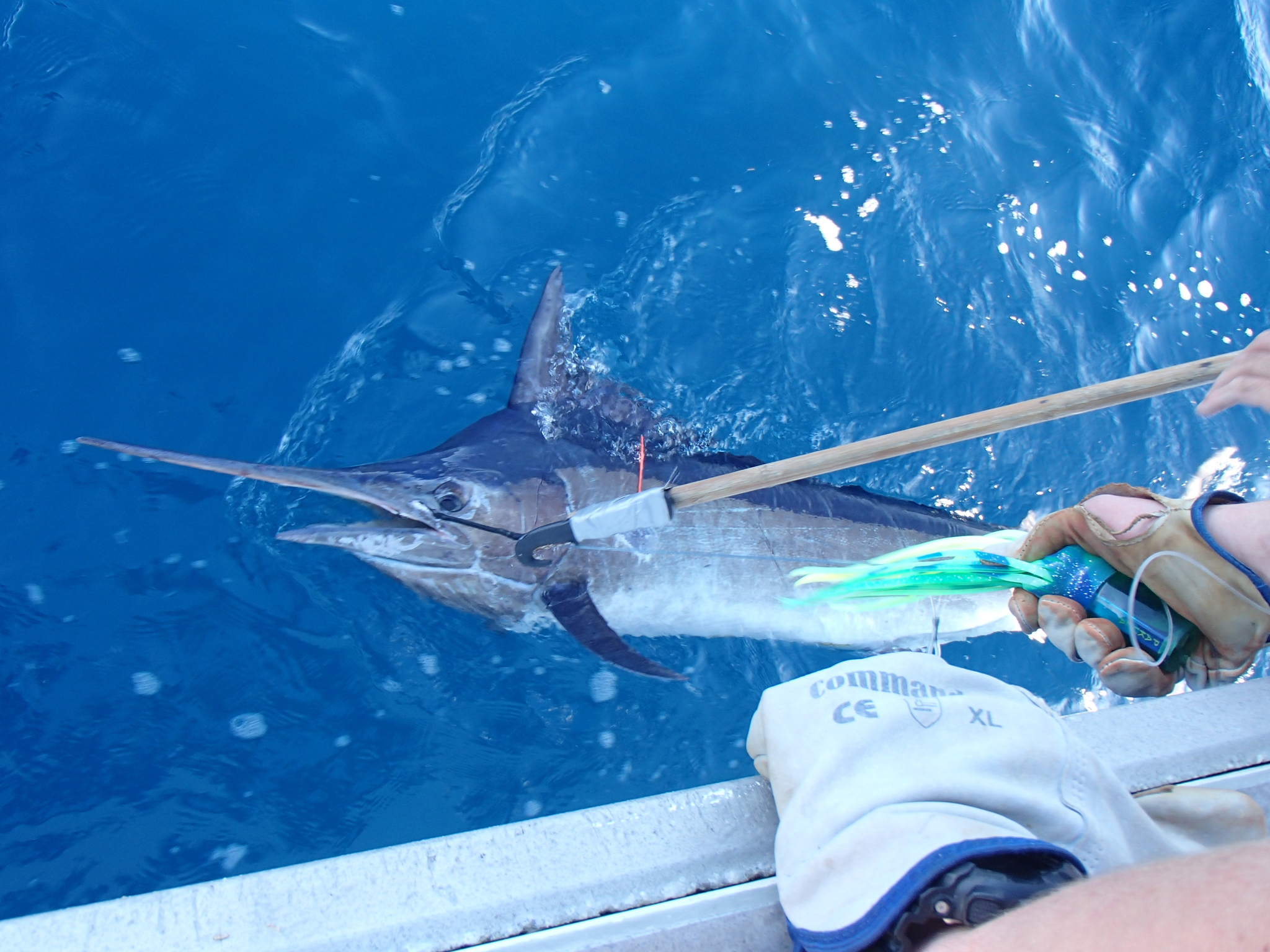
The two length figures in this record are 500 cm and 290 cm. They are not a range and they are not a disagreement. The first is the largest specimen the source has accepted; the second is the fish a boat is likely to meet. Almost every practical decision about blue marlin — leader class, release handling, how a photograph is framed — belongs to the second number, while most of the fish's reputation belongs to the first.
Five hundred is a record, two ninety is the fish
The record maximum is 500 cm TL, quoted once for male/unsexed fish and again for females; a typical specimen is 290 cm. That is a 210 cm gap, or 42% of the maximum, between the record and the ordinary fish.
How many specimens sit at each end of that gap is not stated, and no length-frequency table is given. What the record does establish is that both 500 cm figures — male/unsexed and female — are the same, which means the maximum is not a sexually dimorphic extreme being quoted as a species record. The 290 cm number is the one supported by a reference and is the only figure here that describes a population rather than a trophy.
Six hundred thirty-six kilos
The heaviest published weight is 636 kg. The page gives no length for that specimen and no condition factor, so the weight cannot be tied to the 500 cm maximum or to the 290 cm common length. Treating 636 kg as "what a 500 cm fish weighs" would be an assumption the source does not make.
For release work, that matters. A fish of 290 cm is a large animal already, and the weight figure is evidence that the species can reach a mass far outside the normal encounter. The gap between the two is the reason blue marlin tackle is rated by line class and drag rather than by an average.
Twenty years
The maximum reported age is 20 years. No age at maturity is given, and the growth curve is not in the record. The 20-year figure therefore says only that the species is long-lived relative to a 9-year billfish such as striped marlin, not how fast a 290 cm fish gets there.
That single age is enough to change the meaning of the record maximum. A fish that can live 20 years and reach 500 cm is not producing a 500 cm individual every season; the maximum is the tail of a long life, and the common length is the part of the life most often encountered.
The maturity cell is blank
Maturity is blank, and the raw line behind it reads "range 50 - ? cm", which is not a usable number. This article will not turn that into a maturity length.
The consequence is concrete: the record supports a release decision based on size only through the common length, not through a biological threshold. A 290 cm fish is the typical catch; whether a 250 cm fish is mature is not answered here. Anyone who needs a legal minimum has to take it from a fishery authority, not from this page.
A thousand metres, twenty-two to thirty-one degrees
The environment entry spans 0–1000 metres, a subtropical climate, and a temperature envelope of 22 to 31°C, with a coordinate box from 50°N to 45°S and 180°W to 180°E. Diet is recorded only as "fishes".
The 1000 metre figure is a depth tolerance, not a fishing depth. The fish is oceanic and the practical layer is the surface, where trolling happens; the temperature range is the more useful filter, because 22°C is a hard lower edge and can be read from a chart. The empty habitat-keyword row means the source names no bottom type at all, which is consistent with a fish that never sees one.
One spawning row, eastern Atlantic
The spawning table has a single entry: July to September, with the locality recorded as the eastern Atlantic.
One row and one region is a narrow claim. It does not describe spawning in the western Atlantic, the Gulf of Mexico, or the Indo-Pacific, and it does not establish a peak month. For a species whose range is quoted as the whole Atlantic, a single eastern basin window is a fragment, and the record itself does not present it as more than that.
One name over two oceans
The distribution text follows Nakamura (1985) in treating Makaira mazara and Makaira nigricans as two species, separated chiefly by the pattern of the lateral line, then notes that many scientists do not accept that character as diagnostic and treat the fish as a single pantropical species. The summary says the Atlantic blue marlin is endemic to the Atlantic and usually considered conspecific with the Indo-Pacific form.
GBIF's distribution layer lists 99 records across 71 countries and territories, and its localities include the East Pacific and the Indo-West Pacific as well as the Atlantic. This is not a contradiction for the page to settle; it is the same split shown on a map. A record filed under M. nigricans in the Pacific is exactly what the single-species reading predicts, and exactly what the two-species reading forbids. The sources keep both readings, and so does this page.
iNaturalist holds 226 observations under this name. A photographic sample cannot settle whether those Pacific fish are one species or two; it can only show that observers are filing them under the Atlantic name.
Rig for two ninety
Build the trip around 290 cm, the common length, and treat 500 cm and 636 kg as record-book tails. Keep the spread in the surface layer at 22–31°C and do not read the 1000 metre depth limit as a target.
The maturity blank is a limit on what this record can tell you: it supports release by size, not by a biological line. When a Pacific fish is identified as blue marlin, remember that the name covers one species or two depending on the authority, and that the answer changes the range, not the fish hanging off the leader.
Regulations before you keep it
These are the published regulations for this fish. Read the number first. The notice below it is the actual regulation.
Minimum size2
≥251 cm lower-jaw–fork length
France · FR
France sets a 251 cm lower-jaw-to-fork length minimum for blue marlin.
| MAKAIRE BLEU | Makaira nigricans | 251 cm (LJFL) * |
99 in lower jaw fork length
United States — North Carolina · US-NC
North Carolina applies a 99-inch lower-jaw fork length minimum to blue marlin.
The 1-fish-per-vessel billfish bag is shared with white marlin and is listed under group_only.
Blue Marlin
(G)
99" LJFL
Bag limit2
1 fish per angler per day · counts as 5 fish against the 10-fish daily limit
Mexico · MX
Mexico permits only one marlin per angler per day, counting as five fish of other species against the ten-fish daily limit.
Clause 4.7.1; the quote names marlin generically.
Cuando se trate de marlin, pez vela, pez espada y tiburón, el límite máximo por pescador y día será de un solo ejemplar de cualquiera de estas especies, el cual será equivalente a cinco ejemplares de otras especies.
1 fish per vessel per trip (blue or white marlin combined)
United States — North Carolina · US-NC
North Carolina allows one fish per vessel per trip, either blue marlin or white marlin combined.
The vessel limit combines blue and white marlin; the 99-inch LJFL minimum applies to blue marlin.
Blue Marlin (G) | 99" LJFL | 1 per vessel per trip, either blue or white marlin
Every record above names its source and the date it was retrieved. See the regulation register for the full list, or how to read these regulations.
Where these facts come from
Check these pages before you rely on a size, range or protection status.
-
FishBase — Makaira nigricans
— FishBase · T2
-
GBIF — Makaira nigricans occurrence records
— GBIF · T2
-
IUCN Red List — Makaira nigricans
— IUCN · T1
-
Photo record — iNaturalist
— iNaturalist · T3