
Brown trout in Portugal: ≥30 cm — Portugal (mainland).
Truta-marisca, Truta-comum (Salmo trutta) | 30 cm
Quoted from DGRM — Tabela de Tamanhos Mínimos de Captura
Regulation guide
Official sourcesHow sea trout is regulated
Brown trout (Salmo trutta) is truite de mer in France, trucha marisca or reo in Spain and truta-marisca in Portugal. The anadromous form, the sea trout, is the one taken in coastal waters, and the rules in this dossier are the marine rules that apply to it.
France sets 35 cm, Spain 25 cm on its Atlantic grounds and Portugal 30 cm. No EU minimum conservation reference size exists for the species, so the three figures are national decisions rather than one European standard.
None of these instruments sets out freshwater trout rules. The French order reaches the salt-water parts of rivers and canals, and the Spanish decree is built around marine fishing grounds, so river and lake trout are regulated by other texts.
Source: Légifrance: Arrêté du 26 octobre 2012 (tailles minimales, pêche de loisir) · BOE: Real Decreto 560/1995 (tallas mínimas, texto consolidado) · DGRM: Tabela de Tamanhos Mínimos de Captura (26 February 2026)
France: 35 cm for truite de mer
Annex I of the arrêté of 26 October 2012 lists TRUITE DE MER, Salmo trutta, at 35 cm in part I, which covers the North Sea, the Channel and the Atlantic. Part II, the Mediterranean list, has no trout entry.
The order applies to recreational sea fishing from vessels other than those holding a commercial fishing permit, while swimming or diving, and on foot on the public maritime domain, including the salt-water parts of rivers and canals. That last phrase is what puts a sea trout taken in the tidal reach of a French river inside the 35 cm rule.
The annex adds no bag limit or season for the species, and the version in force dates from 14 January 2026. The 35 cm is the highest of the three national figures in this dossier.
Spain: 25 cm on the Atlantic grounds
Real Decreto 560/1995 lists trucha marisca o reo (Salmo trutta) at 25 cm in Annex I, which covers the Cantabrian/Northwest grounds and the Gulf of Cadiz. Annex II, the Mediterranean table, and Annex III, the Canary table, contain no trout entry.
The decree is a marine minimum-size instrument, and Article 3 prohibits retaining on board, transhipping, landing, transporting, storing, selling, displaying or marketing fish below the required size. The 25 cm follows the fish off the boat as well as covering it on board.
Recreational fishing in external waters is governed by Real Decreto 347/2011: catches are limited to the species authorised in its Annex I, the sizes of the 1995 decree must be respected, the licence comes from a coastal autonomous community, and the sale of catches is prohibited.
Source: BOE: Real Decreto 560/1995, annexes I–III · BOE: Real Decreto 347/2011 (pesca marítima de recreo en aguas exteriores) · MAPA: Pesca marítima de recreo, preguntas frecuentes
Portugal: 30 cm
DGRM's minimum-size table dated 26 February 2026 lists truta-marisca (Salmo trutta) at 30 cm. The table is issued under Portaria n.º 255/2022 and refers to Regulation (EU) 2019/1241 and Regulation (EU) 2026/249.
DGRM's recreational pages state that fish below the minimum sizes fixed for commercial fishing may not be taken, so 30 cm is the floor for an angler as well as for the commercial fleet.
Portugal adds two general requirements that the size table does not contain. The daily catch is capped at 10 kg per angler, with the heaviest fish not counted, and every retained fish must be marked by a cut in the caudal fin before the angler leaves the site or lands the catch.
Source: DGRM: Tabela de Tamanhos Mínimos de Captura (26 February 2026) · DGRM: Pesca Lúdica — Espécies
No EU size and no bag limit
Part A of Annexes V, VI and VII of Regulation (EU) 2019/1241 sets minimum conservation reference sizes for the Atlantic sea basins. Salmo trutta does not appear in any of those tables, and the French Mediterranean list does not include it either.
Article 2(2) of the regulation applies only Articles 7, 10, 11 and 12 to recreational fishing, and allows Part A of the annexes to be extended to anglers by a later act where recreational fishing has a significant impact in a region. With no entry for the species, nothing turns on that provision here.
None of the three instruments sets a bag limit for sea trout. The French order is a minimum-size instrument, the Spanish decree sets sizes and prohibitions, and Portugal's only daily ceiling is the general 10 kg cap.
The absence of a bag limit is not a licence to keep every legal fish. Licence conditions, local rules and any freshwater permit attached to the river being fished are separate requirements.
Source: EUR-Lex: Regulation (EU) 2019/1241, annexes V–VII part A and Article 2 · Légifrance: Arrêté du 26 octobre 2012 · DGRM: Pesca Lúdica — Espécies
Measuring a sea trout
Annex II of the French order measures a fish from the tip of the snout to the end of the caudal fin, and Annex IV of Regulation (EU) 2019/1241 uses the same definition. Fork length is not the measure.
A sea trout has a tail that can look forked when it is dry and spread. Measure to the tip of the longer lobe rather than to the notch, and straighten the body before reading.
Measure the fish wet and on a flat surface, before gutting. A 25 cm Spanish minimum is a short fish, so a centimetre lost to a bent body or a folded tail is enough to change the answer.
Source: Légifrance: Arrêté du 26 octobre 2012, annexe II (mesure de la taille) · EUR-Lex: Regulation (EU) 2019/1241, annex IV (measurement of size)
Before you keep a sea trout
Apply the figure for the water: 35 cm in France, 30 cm in Portugal, 25 cm on the Spanish Cantabrian/Northwest and Gulf of Cadiz grounds. The Spanish Mediterranean and Canary tables have no trout entry, and the French Mediterranean list has none either.
In France the 35 cm covers a fish taken on foot in the salt-water part of a river or canal, because the order expressly reaches those waters. A river trout taken upstream of the salt water is outside the order and inside the freshwater rules instead.
Measure from snout to tail tip and release anything short. No bag limit applies in these instruments, but Portugal's general 10 kg cap and tail-cut marking rule still do, and the licence conditions of the area being fished come on top.
Source: Légifrance: Arrêté du 26 octobre 2012 · BOE: Real Decreto 560/1995 · DGRM: Pesca Lúdica — Espécies
Official pages: Légifrance: Arrêté du 26 octobre 2012 (tailles minimales, pêche de loisir) · BOE: Real Decreto 560/1995 (tallas mínimas) · DGRM: Tabela de Tamanhos Mínimos de Captura · DGRM: Pesca Lúdica — Espécies · EUR-Lex: Regulation (EU) 2019/1241
Brown trout regulations at a glance
3 jurisdictions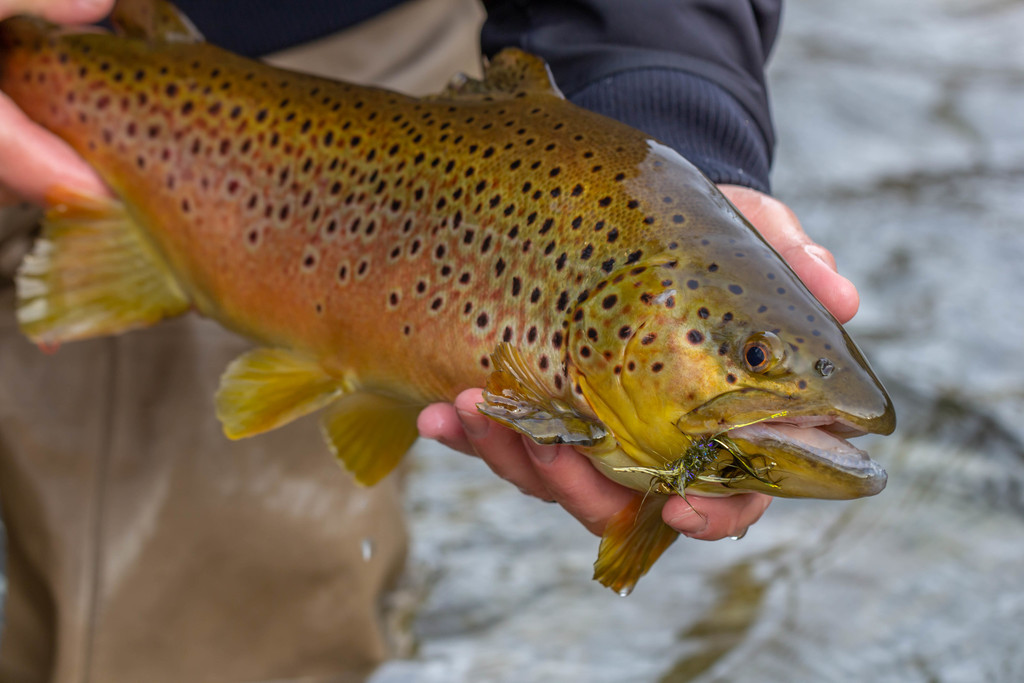
Brown trout
Salmo trutta · Salmonidae
Brown trout is a salmonid native to Europe and Asia, now established in North America, South America, Australia, New Zealand and parts of Asia. It lives from the surface to 28 m in water of 18 to 24 °C, reaches 140 cm SL and 50 kg, can live 38 years, and feeds on crustaceans and fish. Fly fishing or trolling is the usual approach, and it is present year-round.
- Family
- Salmonidae
- Max length
- 140 cm SL
- Max weight
- 50 kg
- Max age
- 38 years
- Depth
- 0–28 m
- IUCN
- LC
- Climate
- Temperate · 18–24 °C
- Diet
- crustaceans, fishes
Brown trout (Salmo trutta) is a fish of the family Salmonidae. FishBase gives its range as: Europe and Asia: Atlantic, North, White and Baltic Sea basins, from Spain to Chosha Bay (Russia). Found in Iceland and northernmost rivers of Great Britain and Scandinavia. It is recorded from 0 to 28 m, in temperate water at 18–24 °C. The recorded maxima are 140 cm SL, 50 kg, 38 years. Common length is recorded at 72 cm. Diet includes crustaceans and fishes. IUCN status: Least Concern (LC). Chinese name: .
Techniques
- Fly fishing —
- Trolling —
Seasonality
Other PT regulations
Same jurisdictionBefore you keep a fish
- Read the recorded value. It is copied from the notice; if the number and the notice disagree, the notice wins.
- Check the area. Federal, state and local waters can set different limits for the same fish.
- Check the date. Seasons, quotas and closures change; confirm the current notice before you go.
Common questions
- What is the minimum size for Brown trout in Portugal?
- ≥30 cm
- Where does this regulation apply?
- Portugal (mainland)
- When was it checked?
- 2026-11-18, against DGRM — Tabela de Tamanhos Mínimos de Captura.
- Do other jurisdictions set different limits?
- Yes. This register lists 3 jurisdictions for Brown trout; compare them in the table above.