
Silver warehou in New Zealand — South East: 15 fish per fisher per day — New Zealand — South-East fishing area.
Warehou | 15 | — | 100
Quoted from MPI — South-East area fishing rules
MPI lists warehou as a group; species.json lists Silver warehou (Seriolella brama).
Regulation guide
Official sourcesThree jurisdictions, three sets of rules
Silver warehou (Seriolella brama) is a southern Australian and New Zealand species, and the three jurisdictions that regulate it for anglers each use a different name. Victoria lists it as warehou (haddock), Seriolella spp.; Tasmania lists warehou with a boat limit that applies to blue warehou; New Zealand lists warehou in its South-East amateur rules.
The three sets of numbers are independent of each other. Victoria sets a bag limit with no minimum size, Tasmania sets a minimum size with bag, possession and boat limits, and New Zealand sets a daily limit inside an overall finfish cap.
For an angler, the practical consequence is that the same fish is measured and counted differently on either side of Bass Strait and again in New Zealand.
Source: Victorian Fisheries Authority: Warehou (haddock) (all species) · Fishing Tasmania: Size and bag limits · MPI: South-East area fishing rules
Victoria: 20 a day, no minimum size
The Victorian Fisheries Authority lists warehou (haddock) at no minimum legal size and a bag limit of a combined total of 20 for one or more species of warehou. The entry covers Seriolella spp. as a group, so blue and silver warehou share the 20.
Victorian scale fish are measured from the tip of the snout with the mouth closed to the end of the tail, and undersized fish must be released at the first opportunity. The default bag limit for an unlisted species is 5, but warehou is listed and takes the higher figure.
A recreational fishing licence is required to take fish from Victorian marine, estuarine and inland waters unless the fisher is exempt, and it covers line fishing as well as bait and shellfish collection.
Source: Victorian Fisheries Authority: Warehou (haddock) (all species) · Victorian Fisheries Authority: Marine and estuarine scale fish · Victorian Fisheries Authority: Fishing licence
Tasmania: 25 cm with bag, possession and boat limits
Tasmania's size and bag limit table lists warehou at a 25 cm minimum, a daily bag of 10, a possession limit of 20 and a boat limit of 30 that applies to blue warehou only. That combination of four limits is the most detailed of the three jurisdictions.
Tasmanian scalefish are measured from the nose to the end of the tail, with exceptions for shark, banded morwong and garfish. A possession limit is the number a fisher may possess anywhere in Tasmania, including at home, while a boat limit is the number that may be on board at any one time, with daily bag and possession limits still applying.
No licence is needed for rod-and-line fishing in Tasmanian marine waters. Licences cover rock lobster pots, abalone, scallops, graball and mullet nets, beach seine nets and set lines.
Source: Fishing Tasmania: Size and bag limits · Fishing Tasmania: Recreational sea fishing licences
New Zealand: 15 a day in the South-East area
In the South-East area, MPI lists warehou at a maximum daily limit of 15 per active fisher, with no minimum length and a minimum set net mesh of 100 mm. The limit applies to warehou as listed, without a separate silver and blue split on the page.
The 15 sits inside a combined daily bag limit of 30 finfish per fisher. A fisher who takes 15 warehou therefore has half of the day's finfish allowance left for other species, and individual species limits still apply within the combined cap.
The South-East area runs from Clarence Point near Kaikoura down the east coast of the South Island to Slope Point. A small area around Kaikoura has different rules, and MPI maintains a separate Kaikoura page for it.
How the three limits compare
Victoria's 20 is a single-species group bag limit with no size floor, so the full limit can legally be made up of small fish. Tasmania's 10 is half that number but comes with a 25 cm floor and a 20-fish possession cap.
New Zealand's 15 is the highest daily number of the three, but it competes with the 30-finfish combined cap, so a full warehou limit uses half the day's allowance rather than standing alone.
Only Tasmania sets a boat limit, and only for blue warehou. In Victoria and New Zealand the catch is controlled through individual bag and possession rules rather than a boat total.
Source: Victorian Fisheries Authority: Warehou (haddock) (all species) · Fishing Tasmania: Size and bag limits · MPI: South-East area fishing rules
Before you keep one
Establish which jurisdiction the boat is in: Victorian marine and estuarine waters, Tasmanian state waters across Bass Strait, or the MPI South-East area in New Zealand. The three limits do not travel with the fish.
Measure nose to tail in Victoria and Tasmania. In Victoria the measurement matters less because there is no size floor, but Tasmania's 25 cm applies to warehou as a group, so an undersized fish cannot be kept even though the bag limit is 10.
On a boat in Tasmania, count the boat limit alongside individual bags, and remember that the 30 applies to blue warehou only. On a multi-day trip in New Zealand, the 15 is a daily figure that also has to fit inside the 30-finfish combined limit.
Source: Fishing Tasmania: Size and bag limits · MPI: South-East area fishing rules
Official pages: Victorian Fisheries Authority: Warehou (haddock) (all species) · Fishing Tasmania: Size and bag limits · MPI: South-East area fishing rules · Fishing Tasmania: Recreational sea fishing licences
Silver warehou regulations at a glance
3 jurisdictions| Jurisdiction | Area | Size | Bag | Season / closure | Closed area | Other |
|---|---|---|---|---|---|---|
| Australia — Tasmania | Tasmania state waters | ≥25 cm | 10 fish per day · 20 in possession · 30 per boat for blue warehou | — | — | — |
| Australia — Victoria | Victorian marine and estuarine waters | — | 20 fish per person per day · no minimum size | — | — | — |
| New Zealand — South East | New Zealand — South-East fishing area | — | 15 fish per fisher per day | — | — | — |
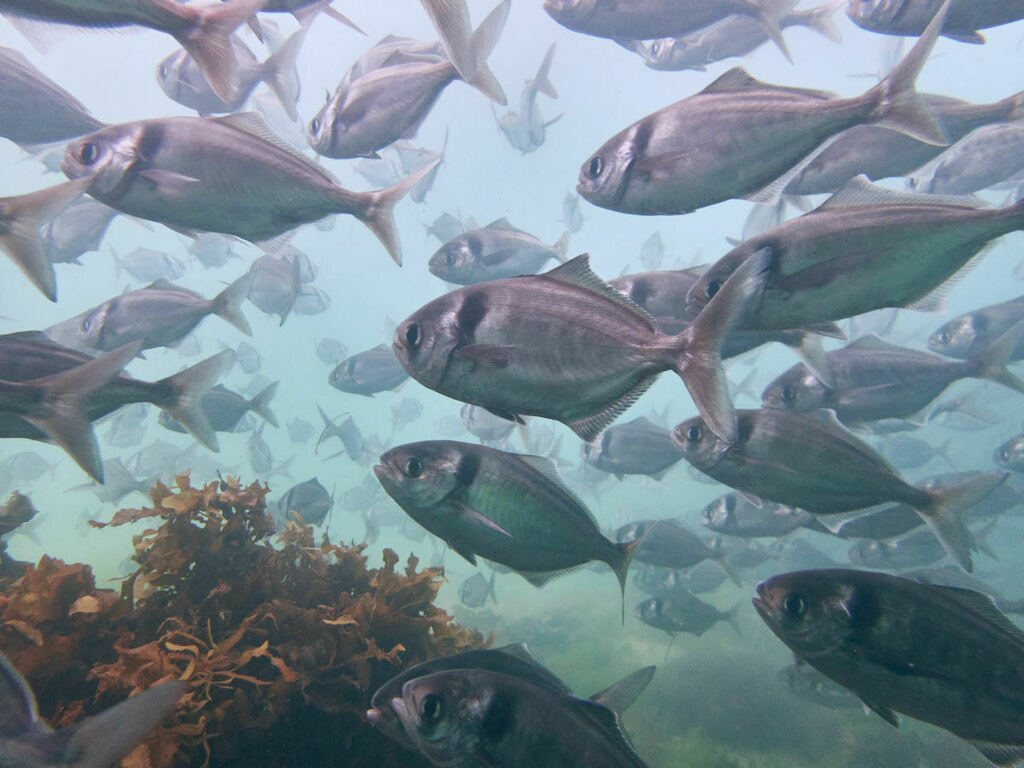
Silver warehou
Seriolella brama · Centrolophidae
Across the Southwest Pacific, from confined to Australian and New Zealand seas, Silver warehou represents the family Centrolophidae. This is a temperate-water fish, recorded from 22 to 400 m. Fish reach 76 cm TL and 4 kg. Anglers target it by boat bottom fishing or trolling. The season runs June to November.
- Family
- Centrolophidae
- Max length
- 76 cm TL
- Max weight
- 4 kg
- Max age
- 15 years
- Depth
- 22–400 m
- IUCN
- NE
- Climate
- Temperate
Silver warehou (Seriolella brama) is a fish of the family Centrolophidae. FishBase gives its range as: Southwest Pacific: confined to Australian and New Zealand seas. It is recorded from 22 to 400 m, in temperate water. The recorded maxima are 76 cm TL, 4 kg, 15 years. Common length is recorded at 50 cm. IUCN status: Not Evaluated (NE). Chinese name: .
Techniques
- Boat bottom fishing —
- Trolling —
Seasonality
Other NZ-SE regulations
Same jurisdictionBefore you keep a fish
- Read the recorded value. It is copied from the notice; if the number and the notice disagree, the notice wins.
- Check the area. Federal, state and local waters can set different limits for the same fish.
- Check the date. Seasons, quotas and closures change; confirm the current notice before you go.
Common questions
- What is the bag limit for Silver warehou in New Zealand — South East?
- 15 fish per fisher per day
- Where does this regulation apply?
- New Zealand — South-East fishing area
- When was it checked?
- 2026-11-18, against MPI — South-East area fishing rules.
- Do other jurisdictions set different limits?
- Yes. This register lists 3 jurisdictions for Silver warehou; compare them in the table above.