
Scup in United States — Rhode Island: 11 in (9.5 in shore) · 30 fish per person per day · May 1 – Dec 31 — Rhode Island state waters.
3.7.1Recreational A.Private and rental: 1.Minimum size: Eleven inches (11”). 2.Season: May 1 through December 31. 3.Possession limit: Thirty (30) fish per person per day. C.Shore: 1.Minimum size: Nine and one half inches (9.5”).
Quoted from 250-RICR-90-00-3 Finfish
Party/charter: 30 fish May 1 – Aug 31, 40 fish Sept 1 – Oct 31, 30 fish Nov 1 – Dec 31.
Regulation guide
Official sourcesWho manages scup
Scup (Stenotomus chrysops), also called porgy, are managed cooperatively north of Cape Hatteras, North Carolina by NOAA Fisheries, the Mid-Atlantic Fishery Management Council and the Atlantic States Marine Fisheries Commission. The federal rules sit at 50 CFR part 648 subpart H and implement the Summer Flounder, Scup, and Black Sea Bass Fishery Management Plan.
The plan divides a coastwide annual quota between the commercial and recreational sectors. Recreational measures are set from a combination of minimum size, bag limit and season, and the Commission coordinates state rules so anglers fishing across state lines meet similar measures.
Scup are a schooling, migratory species found mainly between Cape Cod and Cape Hatteras. They move north and inshore in spring and south and offshore in autumn, so the same stock passes through several states and through federal waters in a single year.
Source: NOAA Fisheries: Scup · ASMFC: Scup · eCFR: 50 CFR Part 648 Subpart H
Federal waters: 10 inches, 40 fish, all year
In federal Atlantic waters the recreational scup season is open all year. The federal minimum size is 10 inches and the possession limit is 40 fish per person per trip, according to NOAA Fisheries.
A for-hire vessel needs a federal permit to fish for scup in federal waters. Where federal and state measures differ, a federally permitted vessel must follow the more restrictive of the two, so the federal 40-fish limit is a ceiling rather than a guarantee.
The federal recreational figures are set annually. NOAA advises anglers to check the state regulations for the water being fished because state measures also apply and can be tighter.
Source: NOAA Fisheries: Scup, Recreational Fishing · NOAA Fisheries: Recreational Fishing Regulations by Species · NOAA Fisheries: Scup
Massachusetts, Rhode Island and New York
Since 2003, Massachusetts, Rhode Island and New York have belonged to a northern region that sets scup recreational measures together. The approach is intended to keep rules consistent where anglers from different states fish alongside each other in the same waters.
Massachusetts applies an 11-inch minimum for private-vessel and for-hire anglers and 9.5 inches for shore anglers, with a 30-fish daily limit and a May 1 to December 31 season. A for-hire vessel may keep 40 fish from May 1 to June 30, dropping to 30 from July 1 to December 31.
Rhode Island uses the same shore and vessel split: 11 inches from private and rental vessels and from licensed party and charter vessels, 9.5 inches from shore, 30 fish per person per day, and a May 1 to December 31 season. Party and charter vessels may keep 40 fish from September 1 to October 31.
New York sets 9.5 inches for shore anglers and 11 inches for vessel anglers, with a 30-fish limit from May 1 to December 31. Anglers aboard licensed party or charter boats may keep 40 fish from September 1 to October 31, and a customer who keeps more than 30 in that period must carry a dated original fare receipt.
Source: Massachusetts Division of Marine Fisheries: Recreational Saltwater Fishing Regulations · Rhode Island DEM: Finfish, 250-RICR-90-00-3 · New York DEC: Recreational Saltwater Fishing Limits · ASMFC: Scup
Virginia and North Carolina
Virginia sets a 9-inch minimum and a 30-fish recreational possession limit for scup. When the catch is held in a common container, the limit applies to the vessel and equals 30 fish for each person on board legally eligible to fish.
North Carolina applies a 9-inch minimum and a 30-fish daily limit only north of Cape Hatteras, where the Mid-Atlantic plan governs. Scup taken south of the cape fall under the South Atlantic porgy complex, which is managed separately.
The two states follow the coastwide southern measures rather than the larger northern-region sizes. An angler who fishes both the northern region and the Mid-Atlantic states should expect the size limit to change at the state line.
Source: Virginia Administrative Code: Pertaining to Scup (Porgy), 4VAC20-910 · North Carolina DEQ: Recreational Size and Bag Limits · NOAA Fisheries: Scup
Measuring, filleting and possession
Scup are measured in total length, from the tip of the snout with the mouth closed to the tip of the longer lobe of the tail, with the tail compressed along the midline. Virginia and New York both define total length this way, and Massachusetts uses total length unless a rule states otherwise.
Massachusetts allows scup to be filleted at sea but not skinned, with no more than two fillets per legal fish. The state also applies a 150-fish vessel limit when five or more anglers are aboard a private vessel.
Federal rules prohibit landing scup with the skin removed for vessels holding a moratorium or charter/party scup permit, or for scup taken north of 35 degrees 15.3 minutes north latitude. Anglers should count fish in the box, not only fish caught, because possession limits apply on the water as well as at the dock.
Source: Massachusetts Division of Marine Fisheries: Recreational Saltwater Fishing Regulations · New York DEC: Recreational Saltwater Fishing Limits · NOAA Fisheries: Scup · Virginia Administrative Code: Pertaining to Scup (Porgy), 4VAC20-910
What to check before you keep a scup
First establish the jurisdiction. Federal waters carry a 10-inch minimum and a 40-fish limit; Massachusetts, Rhode Island and New York apply northern-region sizes and seasons; Virginia and North Carolina apply a 9-inch minimum and a 30-fish limit.
Then check whether the angler is on shore or on a vessel, because the northern states set different minimum sizes for the two. A fish that is legal from the beach may be short from a boat.
Finally, check the current year's measures rather than an old chart. Scup rules are set annually, the northern-region framework has changed repeatedly, and a bag or size limit printed before the current season may no longer be correct.
Source: NOAA Fisheries: Scup · ASMFC: Scup · Massachusetts Division of Marine Fisheries: Recreational Saltwater Fishing Regulations
Official pages: NOAA Fisheries: Scup · NOAA Fisheries: Scup, Recreational Fishing · NOAA Fisheries: Recreational Fishing Regulations by Species · ASMFC: Scup · Massachusetts Division of Marine Fisheries: Recreational Saltwater Fishing Regulations · Rhode Island DEM: Finfish, 250-RICR-90-00-3 · New York DEC: Recreational Saltwater Fishing Limits · Virginia Administrative Code: Pertaining to Scup (Porgy), 4VAC20-910 · North Carolina DEQ: Recreational Size and Bag Limits
Scup regulations at a glance
6 jurisdictions| Jurisdiction | Area | Size | Bag | Season / closure | Closed area | Other |
|---|---|---|---|---|---|---|
| United States — Massachusetts | Massachusetts state waters | — | 11 in (9.5 in shore) · 30 fish per person per day · May 1 – Dec 31 | — | — | — |
| United States — New York | New York Marine and Coastal District | — | 9.5 in shore, 11 in vessel · 30 fish per person per day · May 1 – Dec 31 | — | — | — |
| United States — North Carolina | North Carolina waters north of Cape Hatteras | — | 9 in total length · 30 fish per person per day · north of Cape Hatteras | — | — | — |
| United States — Rhode Island | Rhode Island state waters | — | 11 in (9.5 in shore) · 30 fish per person per day · May 1 – Dec 31 | — | — | — |
| United States — Virginia | Virginia state waters | — | 9 in · 30 fish per person per day | — | — | — |
| United States — federal (Atlantic) | Federal Atlantic waters (Greater Atlantic) | — | 10 in · 40 fish per person per trip · all year | — | — | — |
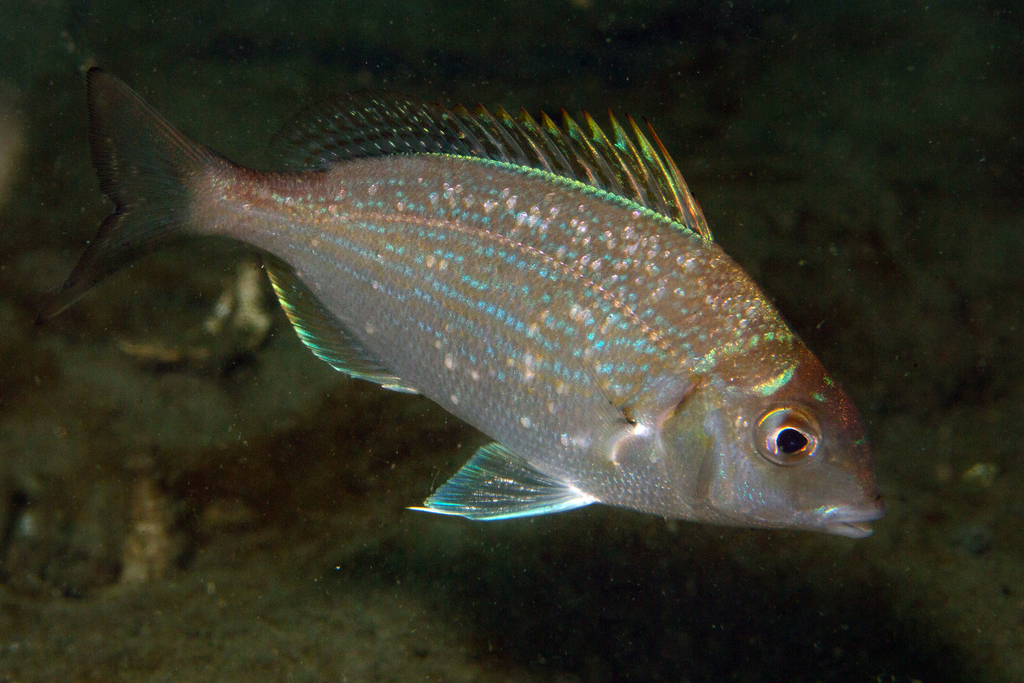
Scup
Stenotomus chrysops · Sparidae
Scup is a sparid of the western Atlantic, from Nova Scotia to Florida. It lives deeper than 15 m in subtropical water, reaches 46 cm TL and 2.1 kg, and feeds on worms. Boat bottom fishing is the usual approach, with the season running May to August.
- Family
- Sparidae
- Max length
- 46 cm TL
- Max weight
- 2.1 kg
- Depth
- ≥ 15 m
- IUCN
- NT
- Climate
- Subtropical
- Diet
- worms
Scup (Stenotomus chrysops) is a fish of the family Sparidae. FishBase gives its range as: Western Atlantic: Nova Scotia in Canada to Florida in USA; rare south of North Carolina, USA. It is recorded deeper than 15 m, in subtropical water. The recorded maxima are 46 cm TL, 2.1 kg. Common length is recorded at 25 cm. Diet includes worms. IUCN status: Near Threatened (NT). Chinese name: .
Techniques
- Boat bottom fishing —
Seasonality
Other US-RI regulations
Same jurisdictionBefore you keep a fish
- Read the recorded value. It is copied from the notice; if the number and the notice disagree, the notice wins.
- Check the area. Federal, state and local waters can set different limits for the same fish.
- Check the date. Seasons, quotas and closures change; confirm the current notice before you go.
Common questions
- What is the bag limit for Scup in United States — Rhode Island?
- 11 in (9.5 in shore) · 30 fish per person per day · May 1 – Dec 31
- Where does this regulation apply?
- Rhode Island state waters
- When was it checked?
- 2026-11-18, against 250-RICR-90-00-3 Finfish.
- Do other jurisdictions set different limits?
- Yes. This register lists 6 jurisdictions for Scup; compare them in the table above.