
African pompano
Two sources put this fish at different depths, and neither is obviously wrong. FishBase gives a range of 60–100 m. DORIS describes adults near the bottom from the surface down to 60 m. The overlap is a single point at 60 m; above and below it, the two accounts place the adult body differently. That is the useful part of the record for a bottom-fishing problem.

Two sources put this fish at different depths, and neither is obviously wrong. FishBase gives a range of 60–100 m. DORIS describes adults near the bottom from the surface down to 60 m. The overlap is a single point at 60 m; above and below it, the two accounts place the adult body differently. That is the useful part of the record for a bottom-fishing problem.
Two depth statements
FishBase's environment line reads 60–100 m, tropical and subtropical. Its biology text says the species is pelagic in neritic and oceanic waters, sometimes near the bottom, with adults near bottom to depths of 60 m. The depth field and the biology text do not describe the same band: one begins where the other ends.
DORIS states that adults live near the bottom between the surface and 60 m. That makes the 0–60 m band part of the adult habitat, while the FishBase field begins at 60 m.
The reef tag and the pelagic juvenile
FishBase files this species under reef-associated habitat. The biology text calls it pelagic. The two tags can apply to different ages; which life stage the tag covers is not stated.
DORIS separates the stages explicitly: juveniles are pelagic and live near the surface, carrying long trailing filaments from the dorsal and anal fins; adults become solitary and live near the bottom. The filaments are the reason young fish are often found far offshore, tangled in weed lines and drifting debris, while the adults are caught on structure.
Where the adult body sits
The adult is described as solitary and bottom-associated, not as a reef resident in the sense of a fish that hugs coral. DORIS says it lives near the bottom; FishBase says near the bottom to 60 m, and then gives a deeper column of 60–100 m. Neither source names a substrate.
That absence is the honest part of the record. The fish is caught on bottom structure, but the pages do not say whether that structure is rock, wreck, rubble or sand. An angler can treat the 60 m line as the hinge: fish the upper edge where the two accounts overlap, and change the presentation before going deeper.
One hundred fifty centimetres and one hundred
FishBase's size fields show 150 cm TL as the maximum, 100 cm fork length as the common figure, and 22.9 kg as the published weight maximum. DORIS gives an average length of about 1 m and a maximum of 1.5 m. The two maximums agree; the common figures use different measurements.
The distinction matters when a fish is released. Fork length stops at the tail notch, so 100 cm FL is less than 100 cm TL. If the regulation is expressed in total length, a fish whose 100 cm is a fork length may still be under the limit; if the rule is in fork length, the same fish is at the common size.
A record set that runs past the map
FishBase calls the species circumglobal in tropical seas, including the Red Sea and the Hawaiian Islands, and gives a southeastern Pacific presence. GBIF's 155 distribution records fill in the edges: the Gulf of Maine and Gulf of Mexico, the North West Atlantic, the Red Sea, Madagascar, Réunion, the Somali and Kenyan exclusive economic zones, South Africa, and a note that Chile reaches Antofagasta during warm El Niño events.
The Gulf of Maine record and the Antofagasta note both sit at the edge of the described range. They are records of occurrence, not evidence that the species breeds there.
Two state ranks and one global status
NatureServe gives a global status of GNR, meaning unranked, and a United States national status of NNR. At state level it ranks Louisiana as S4, apparently secure, and South Carolina as SU, unrankable. The record carries two state ranks: Louisiana S4 and South Carolina SU.
Against that thin conservation footprint, GBIF holds records from the Gulf of Maine to the Gulf of Mexico. The two data sets are answering different questions: NatureServe ranks jurisdictions, GBIF records specimens and sightings. Neither is a population estimate, and the two files are counting different things — legal jurisdictions in one, individual records in the other.
Ciguatera on both pages
FishBase records reports of ciguatera poisoning. DORIS also states that the species is known to transmit ciguatera-type food poisoning. Two independent pages carrying the same warning is a stronger signal than either alone, and it applies to the fish that is kept for the table, not to the one released.
The warning does not change where the fish lives. It changes what happens after a capture in a reef area where ciguatera is established, and it belongs with the decision to eat, not with the decision to fish.
Fishing the junction
Use the 60 m line as the working hinge. Start at the upper edge, where the DORIS account and the FishBase prose both place adults near the bottom, and fish a slow, heavy presentation close to structure. If the sounder shows fish deeper, step down through the 60–100 m band that FishBase records, but expect the catch to thin.
Match the bait to the diet: sedentary or slow-moving crustaceans, with occasional small crabs and fish. A whole or cut crustacean on a bottom rig is a better fit than a fast-moving artificial. Keep the rig light enough to feel the take, because the fish is solitary and the bites are not going to be frequent.
Then record the depth of every adult. Record whether each adult came from above or below 60 m; that is exactly where the two sources stop agreeing.
Where these facts come from
Check these pages before you rely on a size, range or protection status.
- FishBase — Alectis ciliaris — FishBase · T2
- GBIF — Alectis ciliaris occurrence records — GBIF · T2
- IUCN Red List — Alectis ciliaris — IUCN · T1
- Photo record — iNaturalist — iNaturalist · T3
Fish in the same water
These fish live in the same place.

Almaco jack
- Family
- Carangidae
- Depth
- 5–245 m

Atlantic horse mackerel
- Family
- Carangidae
- Depth
- 0–1050 m
- Season
- Jan, Feb, Mar, Apr, May, Jun, Jul, Aug, Sep, Oct, Nov, Dec
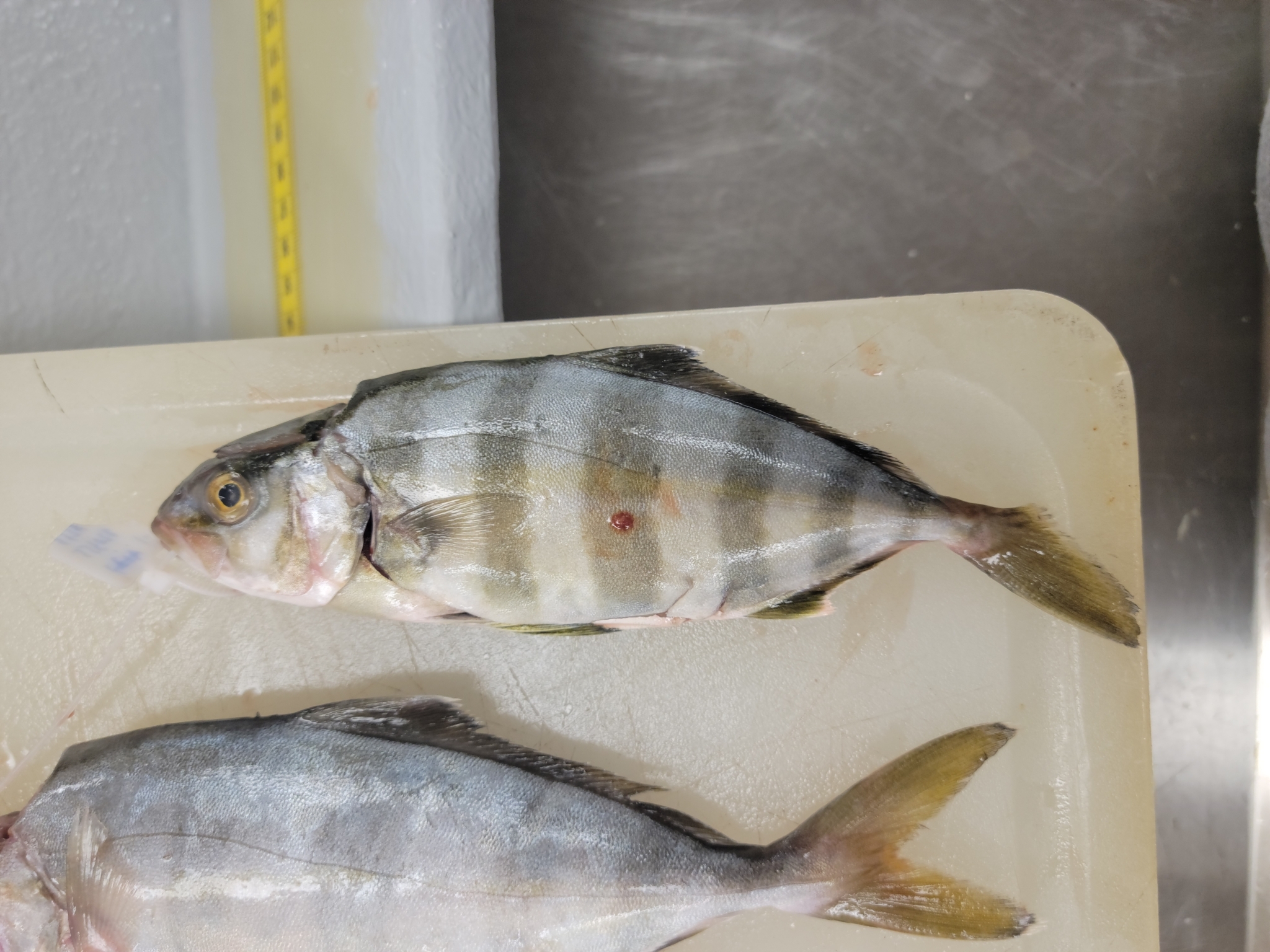
Banded rudderfish
- Family
- Carangidae
- Depth
- 3–360 m
Guides for this water
Technique, gear and safety guides that fit African pompano.