
Banded rudderfish
Banded rudderfish is a western Atlantic carangid from Nova Scotia to Brazil, common at 50 cm and reaching 75 cm and 5.2 kg. Juveniles drift with sargassum and debris and carry dark vertical bands; adults live over the continental shelf and feed on fish and shrimp.
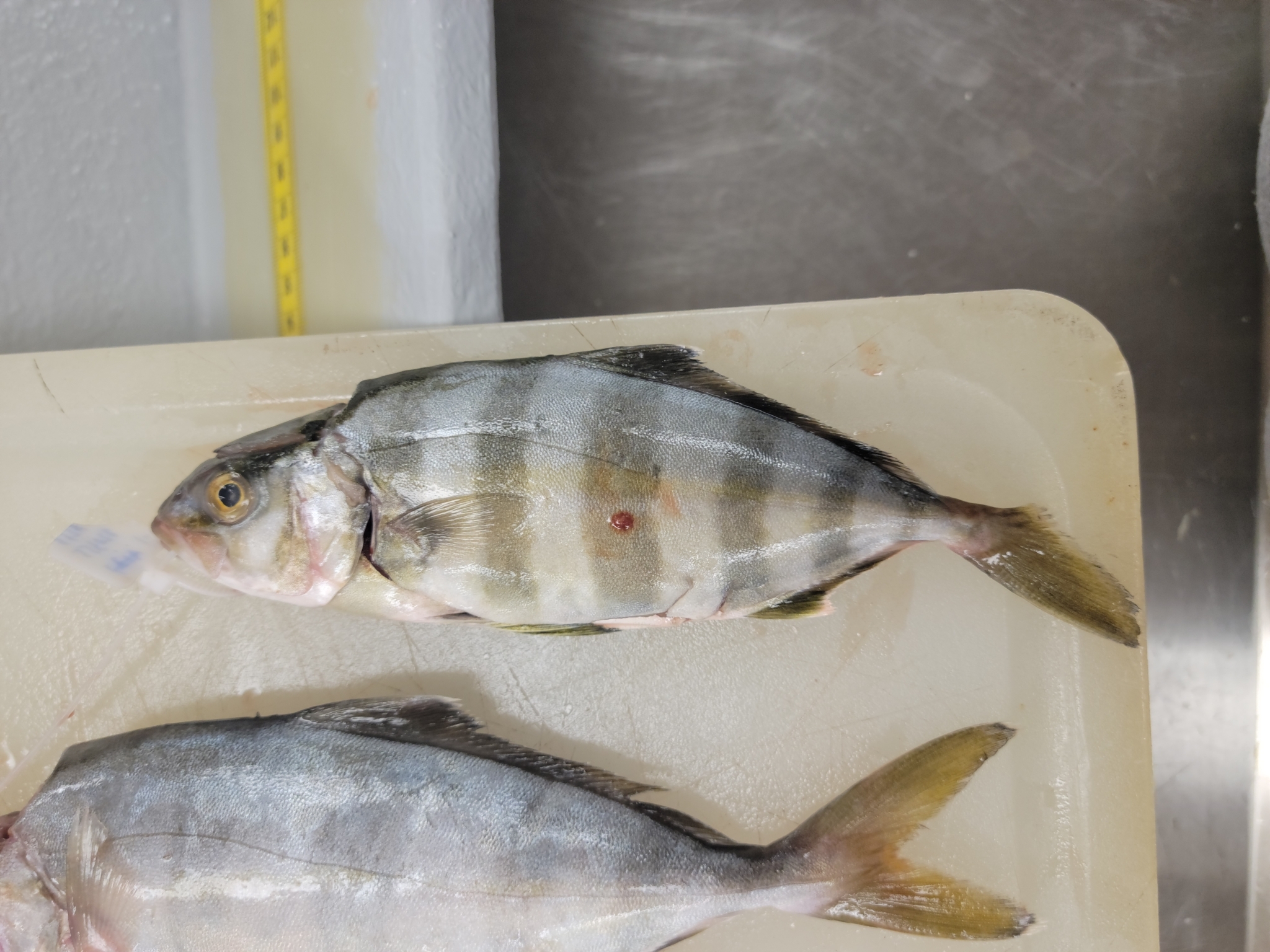
Banded rudderfish is a western Atlantic carangid from Nova Scotia to Brazil, common at 50 cm and reaching 75 cm and 5.2 kg. Juveniles drift with sargassum and debris and carry dark vertical bands; adults live over the continental shelf and feed on fish and shrimp.
Identification
Banded rudderfish is a slender jack, more elongate than lesser amberjack and with a smaller eye. Young fish and subadults carry several dark vertical bands over an olive-brown back, and the bands fade as the fish grows.
FishBase gives a maximum of 75 cm total length, a common length of 50 cm and 5.2 kg. The bands, the slender body and the small eye separate it from a young greater amberjack, which is deeper through the shoulder and has a different head profile.
Distribution and Habitat
The range runs from Nova Scotia through the Gulf of Mexico and the Caribbean to Santos in Brazil, but FishBase notes it is absent from the Bahamas and most islands. It is a mainland-shelf fish rather than an island fish.
Depth is listed as 3 to 360 m. Adults are pelagic or epibenthic and stay over the continental shelf, while juveniles are surface-oriented and drift with sargassum, weed lines, logs and other flotsam.
Habits and Diet
Adults feed on fishes and shrimps, generally over the shelf rather than on deep reefs. Juveniles under weed lines pick at small crustaceans and take small fish and shrimp attracted to the same structure.
The association with floating weed is the practical signature of the species. A weed line that holds small bait usually holds rudderfish, often mixed with filefish, jacks and juvenile dolphin.
Fishing Methods
Cast small metal jigs or soft plastics at the edge of a sargassum line and retrieve fast. The fish are usually just under the weed, so a lure that runs a foot or two below the surface gets more strikes than a deep diver.
Light trolling at 4 to 6 knots along the line works when the weed is too thick to cast into. For adults over the shelf, a squid strip or fish chunk on a light sinker near hard bottom is the simple approach.
Gear and Approach
A 7 ft medium rod, a 4000 size reel, 20 to 30 lb braid and a 30 to 40 lb leader is plenty. Small 1/0 hooks and light jigs suit the small mouth and the weed-holding fish.
When a fish is outside the 14 to 22 inch slot, release it without lifting it from the water if possible. If it comes up from deeper water and shows barotrauma, use a release device rather than dropping it back on the surface.
Seasonal Window
Late spring through autumn is the weed-line season, when sargassum pushes into the Gulf and along the Florida Current edge. Adults are present over the shelf year-round but are most active in warm water.
Calm mornings with distinct weed lines are the best condition. Wind mixes the surface and breaks the lines apart, and the fish scatter with the weed.
Edibility and Handling
The flesh is pale, firm and mild, good fried, grilled or raw after proper chilling. FishBase records no threat to humans for this species, and there are no ciguatera reports attached to it.
Bleed and ice immediately, and keep the fish out of the sun. The small size means thin fillets, so they cook fast and dry out if overcooked.
Regulations and Conservation
Federal Gulf rules manage banded rudderfish and lesser amberjack together: 5 fish per person per day, with a 14 to 22 inch fork-length slot, and fish outside that range must be released.
Florida applies the same 5 fish combined limit and slot. Mississippi also uses 14 to 22 inches and 5 fish combined. Alabama applies the slot and the 20-fish reef-fish aggregate where no bag is listed. Louisiana does not list it, so federal rules apply in federal water. Texas does not list it and points anglers to the greater amberjack rule of 1 fish at 38 inches for the larger species.
Coastal bycatch and recreational landings are the main pressures, and the species is not considered overfished. The IUCN Red List lists banded rudderfish as Least Concern, assessed 21 August 2012. Rules change yearly; measure fork length and confirm the current notice before keeping fish.
How to catch it
Lure fishing
Trolling
4 6
Boat bottom fishing
Where these facts come from
Check these pages before you rely on a size, range or protection status.
- FishBase — Seriola zonata — FishBase · T2
- GBIF — Seriola zonata occurrence records — GBIF · T2
- IUCN Red List — Seriola zonata — IUCN · T1
- Photo record — iNaturalist — iNaturalist · T3
Fish in the same water
These fish live in the same place.

African pompano
- Family
- Carangidae
- Depth
- 60–100 m

Almaco jack
- Family
- Carangidae
- Depth
- 5–245 m

Atlantic horse mackerel
- Family
- Carangidae
- Depth
- 0–1050 m
- Season
- Jan, Feb, Mar, Apr, May, Jun, Jul, Aug, Sep, Oct, Nov, Dec
Guides for this water
Technique, gear and safety guides that fit Banded rudderfish.