
Indian threadfish
Indian threadfish is a large carangid of the Indo-Pacific, from the Red Sea and East Africa to French Polynesia, north to southern Japan and south to the Arafura Sea and Australia. It works 20 to 100 m in tropical water, reaches 165 cm TL and 25 kg, and is taken on lures and by trolling. Its genus has been recombined: FishBase now lists it as Scyris indica while the older name Alectis indica still circulates.
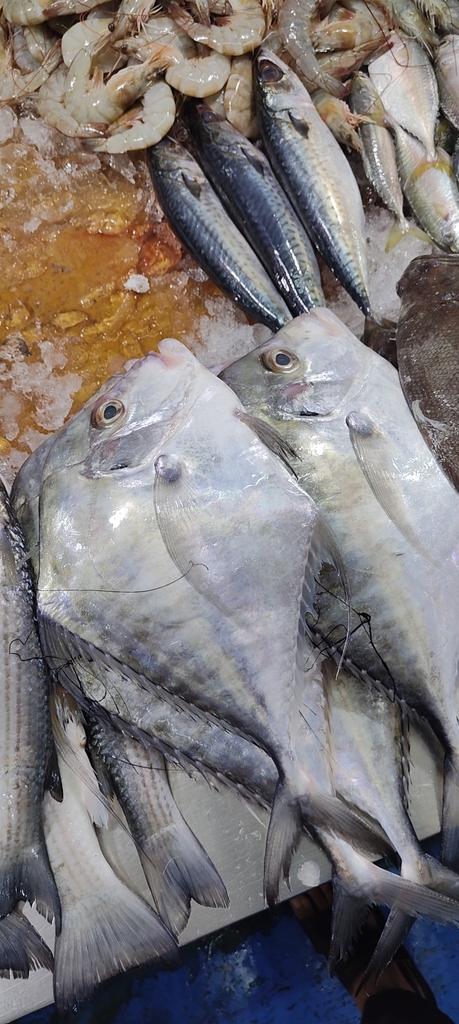
Load the FishBase summary for this fish and the heading reads Scyris indica; WoRMS and the Catalog of Fishes agree, and Alectis indica is the older combination. The Chinese literature has stayed with through both combinations. Neither label is wrong; the genus was recombined and the older name never stopped circulating. The cost is small but real: a size rule or a bag limit quoted for one genus can sit on a page filed under the other, so check which name the list in front of you is using before you copy a number down.
A genus that moved, a name that stayed
East-coast Malaysian anglers know it as ebek, and that word is not exclusive. Cermin and cupak appear in the same conversations, sometimes for this fish, sometimes for relatives with a similar silhouette. A description of body shape travels further than a name does.
Short and deep, with a small head
Seven dorsal spines and eighteen to twenty soft rays, three anal spines and fifteen to twenty soft rays, twenty-four vertebrae, and a body that is short for its depth. The small head against a tall, compressed trunk is the field mark that survives a bad look in choppy water. Juveniles and adults diverge so sharply that a casual catch log can split them into two species: the young drift alone at the surface, the adults work the lower reef.
Twenty metres at the top, a hundred at the bottom
The recorded depth band runs from 20 to 100 m. Adults are described over coral reefs below 60 m and are said to school there. That splits the water into two fisheries. The 20 to 60 m slice is boat territory, reef slope and outer edge, where the fish worth weighing live. The top metre belongs to juveniles, alone in surface water and in estuaries, reportedly mimicking jellyfish.
The horizontal range starts at the Red Sea and the East African coast and runs to French Polynesia, with southern Japan at the northern corner and the Arafura Sea and Australia at the southern one. Four of the stops that matter for a trip plan are Malaysia, Singapore, Indonesia and the Philippines.
Two fish, two retrieves
Surface work is small-lure work: a short minnow or a soft plastic kept a hand's width under the surface and wound in slowly, because a fish chasing a shape does not need speed. Deep work is the opposite: a live bait or a heavy jig walked down the slope and lifted off the bottom, with the drop placed a little outside the reef edge so the retrieve never finishes inside coral.
The diet is fish, squid and crustaceans, so bait choice is not delicate; a fresh small fish simply gets taken faster than a frozen one. Schooling fish compete, and the second and third fish follow a hooked one, which is why the first ten seconds after the hookset decide whether the leader comes back.
The ceiling is 165, the fish is 100
Maximum 165 cm total length, maximum published weight 25 kg, common length 100 cm, and no age on record. Build the outfit around the 100 cm fish rather than the ceiling: a medium boat rod, a 4000 to 6000 spinning reel, 1.5 to 2 PE braid, and 30 to 40 lb fluorocarbon leader, lengthened past a metre whenever the drift crosses reef.
The vulnerability score is 62 out of 100 and the population doubling time 1.4 to 4.4 years. Read together, those numbers argue against treating every legal fish as a keeper. A circle hook, or a lure with the tail treble taken off, turns release into a decision instead of an accident.
No spawning table, one February note
There is no spawning-month table and no temperature range in the record, only a latitudinal band from 44°N to 31°S that shows how much warm and subtropical water the species covers. The gap stays a gap here; nothing is estimated to fill it.
The one seasonal signal comes from the Malaysian east coast, where catches are described as heavy from February into May. That is an angler observation from one coastline, not a species-wide breeding season, and it should not be pasted onto a Philippine or Indonesian itinerary.
Four coastlines and a harmless label
Uses listed are commercial fishing, gamefishing and public aquariums. The IUCN assessment of 6 March 2015 puts it in Least Concern, and the record classes it as no danger to humans, with ciguatera unrecorded; a big reef fish still gets treated with local caution at the table.
Malaysia closes the core zones of marine parks such as Tioman, Redang and Perhentian, and individual states add size and gear rules under the 1985 fisheries framework. Singapore splits recreational fishing and reef protection between its food agency and its parks authority. Indonesia zones marine protected areas and applies separate export and size rules to reef fish. The Philippines sets closed seasons and protected areas jointly between national and local government under RA 8550 as amended by RA 10654.
How to catch it
Lure fishing
Fished with the listed approach, matched to the recorded depth and size.
Trolling
Fished with the listed approach, matched to the recorded depth and size.
Where these facts come from
Check these pages before you rely on a size, range or protection status.
- FishBase — Scyris indica — FishBase · T2
- GBIF — Scyris indica occurrence records — GBIF · T2
- IUCN Red List — Scyris indica — IUCN · T1
- Photo record — iNaturalist — iNaturalist · T3
Fish in the same water
These fish live in the same place.

African pompano
- Family
- Carangidae
- Depth
- 60–100 m

Almaco jack
- Family
- Carangidae
- Depth
- 5–245 m

Atlantic horse mackerel
- Family
- Carangidae
- Depth
- 0–1050 m
- Season
- Jan, Feb, Mar, Apr, May, Jun, Jul, Aug, Sep, Oct, Nov, Dec
Guides for this water
Technique, gear and safety guides that fit Indian threadfish.