
American eel
American eel is a snakelike fish that spends its adult life in fresh water, estuaries and coastal waters from Greenland and Canada south to Panama, before running to the Sargasso Sea to spawn. It grows to 152 cm and 7.3 kg and feeds on fish. The season runs January to July, in water of 4 to 25 °C.

American eel (Anguilla rostrata) is a fish of the family Anguillidae. FishBase gives its range as: Northwest to western Central Atlantic: Greenland south along the Atlantic coast of Canada and the USA to Panama, and throughout much of the West Indies south to Trinidad. It is recorded from 0 to 464 m, in subtropical water at 4–25 °C. The recorded maxima are 152 cm TL, 7.3 kg, 43 years. Diet includes fishes. IUCN status: Endangered (EN). Chinese name: .
Four uses on an endangered eel
The IUCN category is Endangered, assessed 8 November 2020. The human-uses field carries four entries: fisheries commercial, aquaculture commercial, gamefish yes, aquarium public aquariums. A single species therefore appears as a wild capture, a farm product, a sport target and a display animal at the same time. The four routes do not share a supply chain, and nothing on the page ranks them by landings. Wild capture and commercial aquaculture are separate entries, so the same animal is counted twice in the use table. What the record supports is that the eel is traded, farmed, angled and exhibited, and that all four sit under one Endangered assessment.
Fifty thousand records in two countries
GBIF counts 65,013 occurrences: Canada 42,536, the United States 18,276, the Bahamas 552, Singapore 434, the Dominican Republic 214 and the Turks and Caicos Islands 167. Only six countries are listed: Canada, the United States, the Bahamas, Singapore, the Dominican Republic and the Turks and Caicos Islands; the other three rows are Caribbean. Canada and the United States together carry 60,812 of the 65,013; the next row is the Bahamas with 552. Singapore is the odd row: it is not in FishBase's 40-territory list at all, and the page that publishes the occurrence count does not explain it.
Introduced beyond the Atlantic range
The distribution endpoint returns 39 declarations: four ITIS region rows for the Caribbean, Middle America, North America and the Western Atlantic; one Colombian checklist row; three FADA realm rows; one global PRESENT row from IUCN; six WoRMS rows for the Gulf of Mexico, the Gulf of Maine (twice), the Gulf of St Lawrence (twice) and the North West Atlantic; one Canadian INTRODUCED row; eight Chinese INTRODUCED rows; one Colombian country row; two German INTRODUCED rows; three Italian rows (PRESENT, INTRODUCED, and an UNCERTAIN entry marked COMMON by DAISIE); one Japanese INTRODUCED row; one Mexican NATIVE entry; three Norwegian rows (two INTRODUCED and one with no status); two Swedish ABSENT rows, one carrying INVASIVE; and two United States rows, one INTRODUCED and one UNCERTAIN entry from Vermont. China, Germany, Japan, Norway and Sweden are not in the 40-territory list, so the record carries introductions on three continents and an absence claim in one European country.
The Sargasso rows
Six months appear in the spawning table — January, February, March, May, June and July. Ontario supplies February and March; the Sargasso Sea supplies January and May to July. The Ontario rows come from a freshwater system, the Sargasso rows from the spawning sea. April is the month neither record fills. The Sargasso rows are the ones that matter for the life cycle, because the page calls the species catadromous, and the two Canadian freshwater rows are a northern sample of the same event. A six-month envelope with a one-month gap is the whole seasonal record the sources provide.
A hundred and fifty-two centimetres, forty-three years
The record tops out at 152 cm TL for male and unsexed individuals, with 122.0 cm TL given for females; common length is 50.0 cm TL, maximum published weight 7.3 kg, and the oldest reported fish 43 years. Three lengths and one weight sit in the same block without being tied to a specimen, and the 7.3 kg figure is not attached to any of the three lengths. A 152 cm eel at 7.3 kg is a long, thin animal, and the two figures are not a matched pair. The age is the only value that connects to a lifespan, and it is a maximum rather than an average.
Maturity from thirty-seven to a hundred
Maturity is 68.5 cm, inside a published range of 37 to 100 cm. The common length is 50.0 cm, 18.5 cm below the maturity mean and inside the maturity range. That combination is unusual and worth stating plainly: the working size on the page can be an immature fish, and a release rule set at the common length would return animals that have not yet spawned. The maturity range spans 63 cm, from 37 to 100, so the single figure of 68.5 is a mean laid over a very wide published interval.
Catadromous, and counted in freshwater
The species is demersal and catadromous, flagged for marine, freshwater and brackish water, with a depth range of 0 to 464 m and a preferred temperature band of 4 to 25°C. The habitat keywords are muddy, estuary, coastal, freshwater and deep; the diet field contains one keyword, fishes. Five habitat words and one prey word is the whole environmental description, and the 464 m figure applies to the marine end of a catadromous life cycle that also runs up rivers. The temperature band runs from 4°C to 25°C, which is colder than the subtropical label suggests, and the 0 m floor puts river mouths and estuaries inside the depth range.
Forty territories and one accepted name
FishBase lists 40 territories, all in the western Atlantic from Greenland to Trinidad. The name is just as unstable in the other direction: American eel is the form used by the AFS and by the FAO, Common eel is what the Caribbean records say, and the Chinese splits into and , so a records search has to try several keys before it reaches the stock. In WoRMS the accepted entry is AphiaID 158562 (Lesueur, 1817), with all three environment flags set. The CITES and CMS fields carry no assessment, the danger column reads Harmless, and iNaturalist holds 4,644 observations filed as American Eel.
Where these facts come from
Check these pages before you rely on a size, range or protection status.
- FishBase — Anguilla rostrata — FishBase · T2
- GBIF — Anguilla rostrata occurrence records — GBIF · T2
- IUCN Red List — Anguilla rostrata — IUCN · T1
- Photo record — iNaturalist — iNaturalist · T3
Fish in the same water
These fish live in the same place.
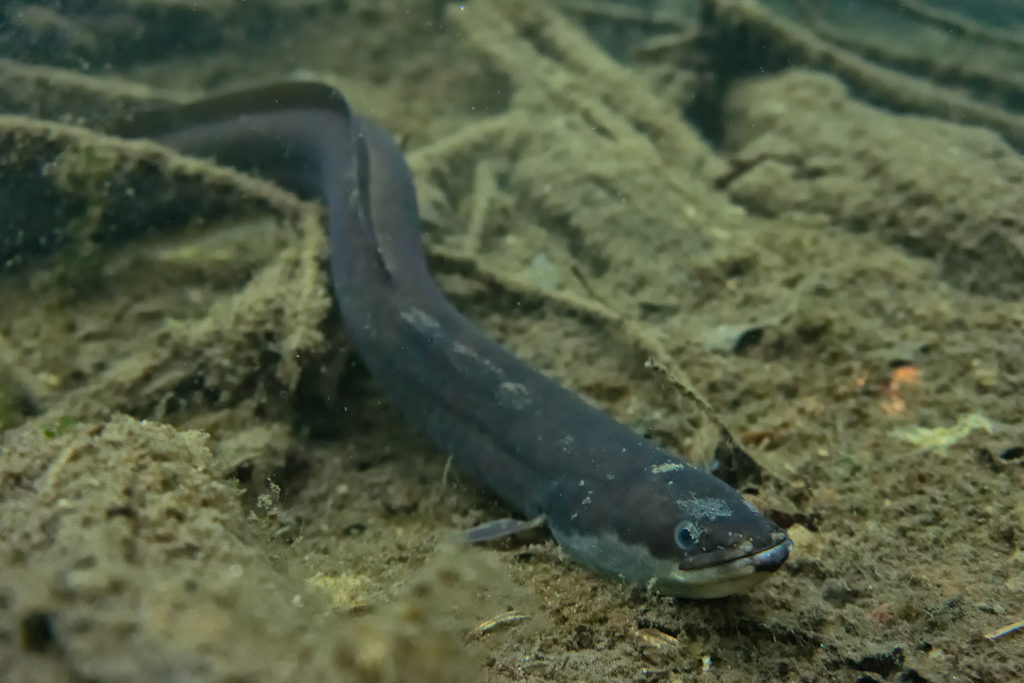
European eel
- Family
- Anguillidae
- Depth
- 0–700 m
- Season
- Jan, Feb, Mar, Apr, May, Jun, Jul
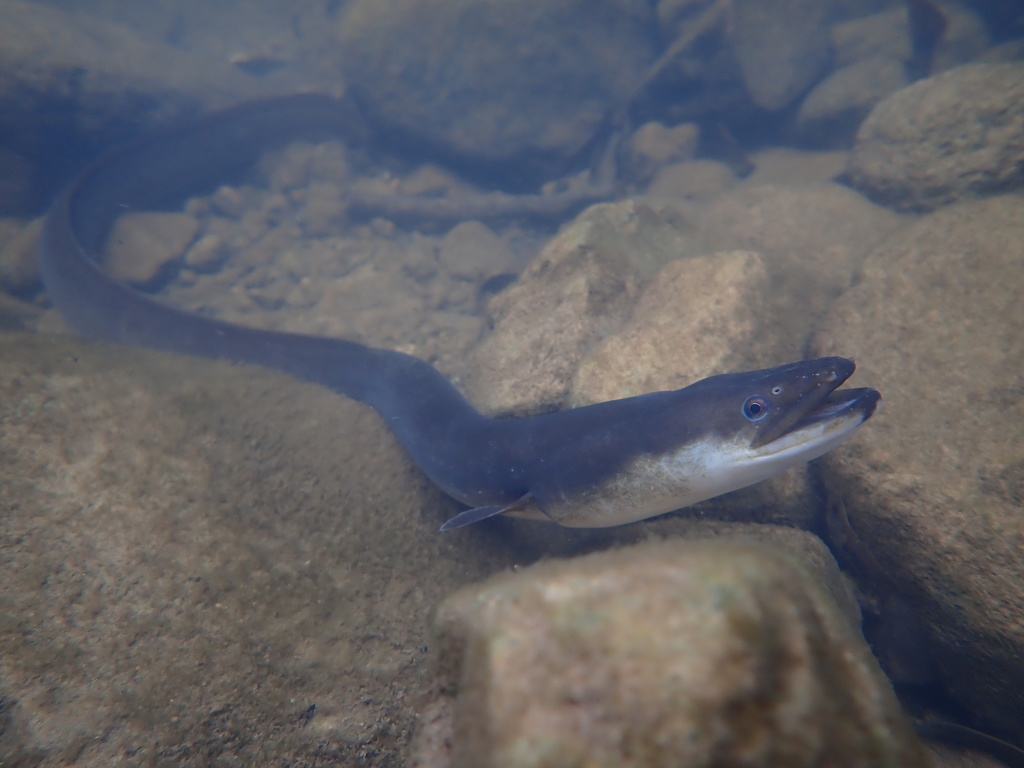
Japanese eel
- Family
- Anguillidae
- Depth
- 1–400 m

Acoupa weakfish
- Family
- Sciaenidae
- Depth
- 1–20 m
- Season
- Jan, Feb, Mar, Apr, May, Jun, Jul, Aug, Sep, Oct, Nov, Dec
Guides for this water
Technique, gear and safety guides that fit American eel.