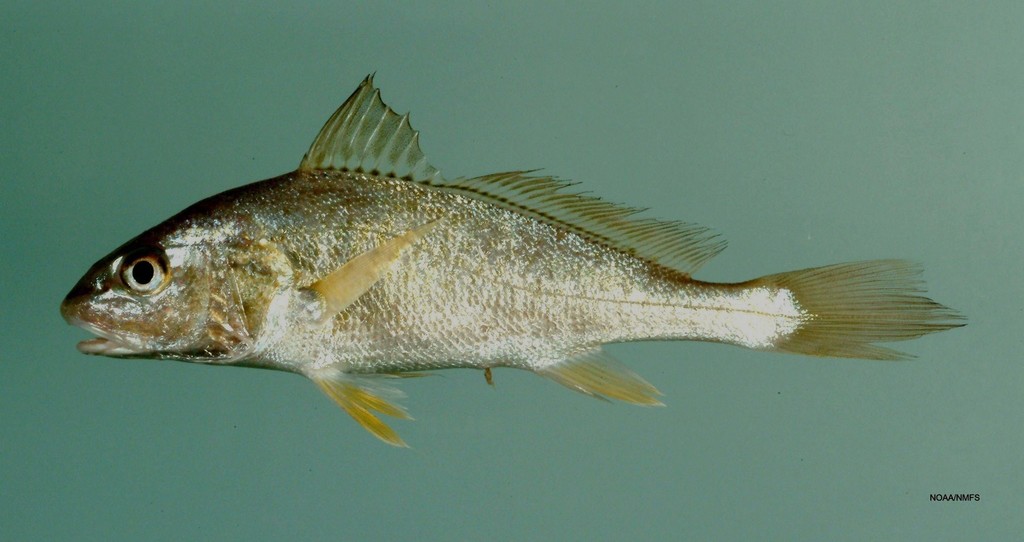
FishBase records *Argyrosomus inodorus* at 145 cm TL maximum, 115 cm TL common, 36.3 kg published weight and first maturity at 34.4 cm. It is a Southeast Atlantic fish, running from Namibia around the Cape of Good Hope and north again to at least the Kei River, and the IUCN assessed it as Vulnerable on 9 November 2018. This page covers two things a kob page usually blurs: which species the word kob is standing for, and the four-part South African rule that decides whether a fish goes in the bag.
Identification
The counts are 11 dorsal spines, 25–29 dorsal soft rays, 2 anal spines, 7–8 anal soft rays and 25 vertebrae. The internal characters are recorded in detail: a carrot-shaped swim bladder with 31–42 arborescent appendages, drumming muscles only in males, an elongate sagitta bulging in the posterior third of its ventral margin and a slightly curved anterior lateral line. Most of that needs a specimen and a knife; on deck the usable parts are the ray count and the smell.
The smell is why the species exists in the literature. The name is Latin for without smell, and the etymology note says the fish was first suspected of being separate because it lacked the strong brassy or metallic odour typical of A. japonicus in South African waters. The split of the southern African kob complex begins there, not at a fin count.
Kob is a genus word here. The DFFE brochure writes its kob rule against Argyrosomus spp., not one species, and FishBase lists silver kob for both Namibia and South Africa, with mild meagre as the old FAO name and kabeljou as the Afrikaans one. The squaretail kob is the other named kob in the same water and has its own page; the regulation does not separate them.
Range and habitat
FishBase gives a Southeast Atlantic range: Namibia south around the Cape of Good Hope and north again at least to the Kei River. The GBIF set is small — 182 present records, 164 South African, 15 Namibian, 2 without country — and iNaturalist holds 17 observations. The map is thin for a target of two national fisheries, and thinnest on the Namibian side.
The environment line adds brackish water, a benthopelagic habit, oceanodromous movement, 1–100 m and subtropical water from 17°S to 38°S and 11°E to 29°E. The biology paragraph cuts the depth down: between the Kei and Cape Agulhas the species rarely enters estuaries or the surf zone but is more abundant in the surf zone on the west coast, and in Namibia it is restricted to 1–20 m, apparently because deeper water is anoxic. Habitat therefore splits in two, and a plan built on the 100 m maximum will overestimate the water worth fishing.
Habits and diet
The page records no diet: no prey list, no feeding time, no juvenile habitat note beyond the estuary sentence. What it records is sound — drumming muscles in males only, and a swim bladder of 31–42 arborescent appendages.
Movement is oceanodromous, a migration category rather than a route; no direction, distance or season is given. For fishing this leaves inference: a benthopelagic fish over 1–100 m, concentrated in the west-coast surf and held in 1–20 m in Namibia, is one to present near the bottom rather than at the surface, and the surf-zone abundance is the only fact here pointing at a shore mark. Bait, trace and tide are not on the page.
Season and time of day
The spawning table has three entries: Meob Bay and Sandwich in January–March, Swakopmund in January, February, November and December, and South Africa in August–December with the locality listed as not specified. Two Namibian grounds are named and the South African record is not, the reverse of what the GBIF map suggests, since 164 of the 182 records are South African.
No time of day is recorded and no temperature is attached to the entries. The table describes spawning, not catchability: it does not say the fish is easier to catch in August.
Tackle and techniques
Size sets the gear. A 115 cm common length and a 36.3 kg published maximum are large-fish numbers, while a 34.4 cm Lm says a legal fish can be far below the common class. The biology gives two water situations: shore work on the west coast, where surf-zone abundance is recorded, and boat work in 20–100 m elsewhere, with Namibia limited to the top 20 m by anoxia. East of Cape Agulhas the same paragraph says the fish rarely enters estuaries or surf, an instruction about where not to spend a session.
Line class, leader and bait are not given. A 115 cm common length argues for gear that will hold that class in surf; the page gives no size distribution between 34.4 and 115 cm, so the mix on the ground is unknown.
Kitchen and handling
The species is recorded as highly regarded as a table fish, marketed mostly fresh and sometimes frozen. That is the whole culinary record: no flesh description, fat content, price or preparation note.
Handling has one species fact behind it: the name refers to the absence of the brassy smell that marks A. japonicus. An odourless fish is not a flavourless one, and the source makes no eating-quality claim beyond the table-fish line.
Regulations and conservation
South Africa splits the kob rule four ways. From a boat at sea between Cape Agulhas and the Umtamvuna River: 50 cm TL, 5 per person per day, of which only one may exceed 110 cm. From a boat at sea in KwaZulu-Natal: 40 cm TL, 5 per day, with the same single-fish allowance above 110 cm. From the shore or an estuary east of Cape Agulhas: 60 cm TL, 1 per day. From the shore west of Cape Agulhas: 50 cm TL, 5 per day. A permit is required, the catch is for own use and may not be sold, and the general bag is 10 fish where no species rule applies.
Namibia sets one combined bag of 10 fish per day across blacktail, galjoen, kob and West Coast steenbras, with kob at 40 cm and no more than 2 kob over 70 cm per day; a permit is required.
The sets do not meet in the middle: a 55 cm kob is legal in Namibia and from a boat in the Western Cape, and illegal from the shore east of Agulhas. The 34.4 cm Lm sits below all four South African minimums and below the Namibian 40 cm, so every legal size is above first maturity — arithmetic across two sources, not a claim either makes.
The IUCN entry is Vulnerable, assessed 9 November 2018, with no trend, stock estimate or regional breakdown given. MPAs, estuaries and provincial rules add closures; check current permit conditions and MPA zoning.
How to catch it
Boat bottom fishing
Fished with the listed approach, matched to the recorded depth and size.
Shore casting
Fished with the listed approach, matched to the recorded depth and size.
Regulations before you keep it
These are the published regulations for this fish. Read the number first. The notice below it is the actual regulation.
Bag limit1
50 cm minimum · 5 fish per person per day, of which only 1 may exceed 110 cm
South Africa · ZA
For kob taken from a boat at sea between Cape Agulhas and the Umtamvuna River, South Africa sets a 50 cm minimum size and a bag of five per person per day, with only one fish over 110 cm.
Size is total length. The boat-based rule applies between Cape Agulhas and the Umtamvuna River; a stricter 60 cm / 1 fish limit applies in estuaries and from the shore east of Cape Agulhas.
Kob caught from a boat at sea (Cape Agulhas to Umtamvuna River) Argyrosomus spp. 50 cm 5 but may only land or be in possession of one kob > 110 cm per day
Every record above names its source and the date it was retrieved. See the regulation register for the full list, or how to read these regulations.
Where these facts come from
Check these pages before you rely on a size, range or protection status.
-
FishBase — Argyrosomus inodorus
— FishBase · T2
-
GBIF — Argyrosomus inodorus occurrence records
— GBIF · T2
-
IUCN Red List — Argyrosomus inodorus
— IUCN · T1
-
Photo record — iNaturalist
— iNaturalist · T3