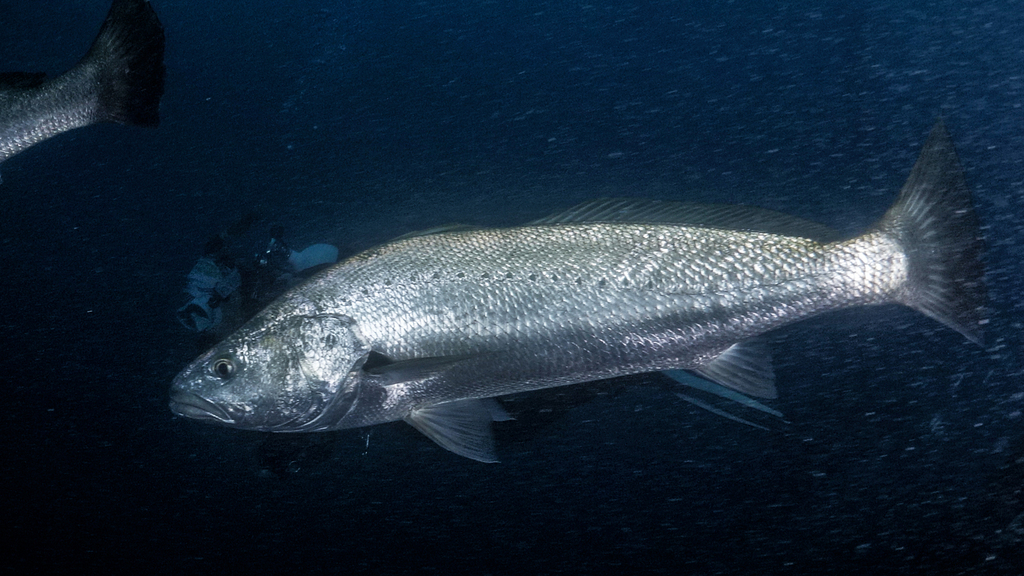
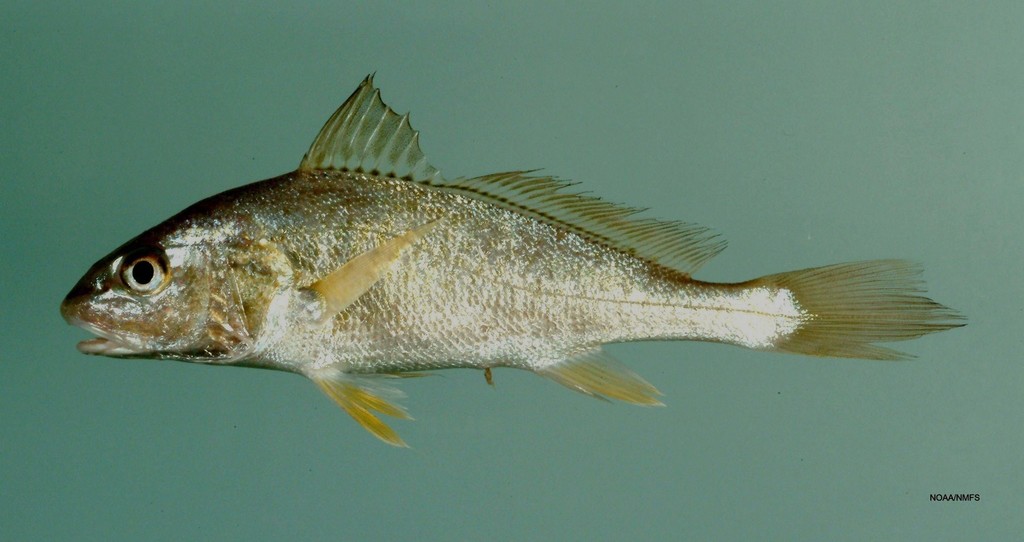
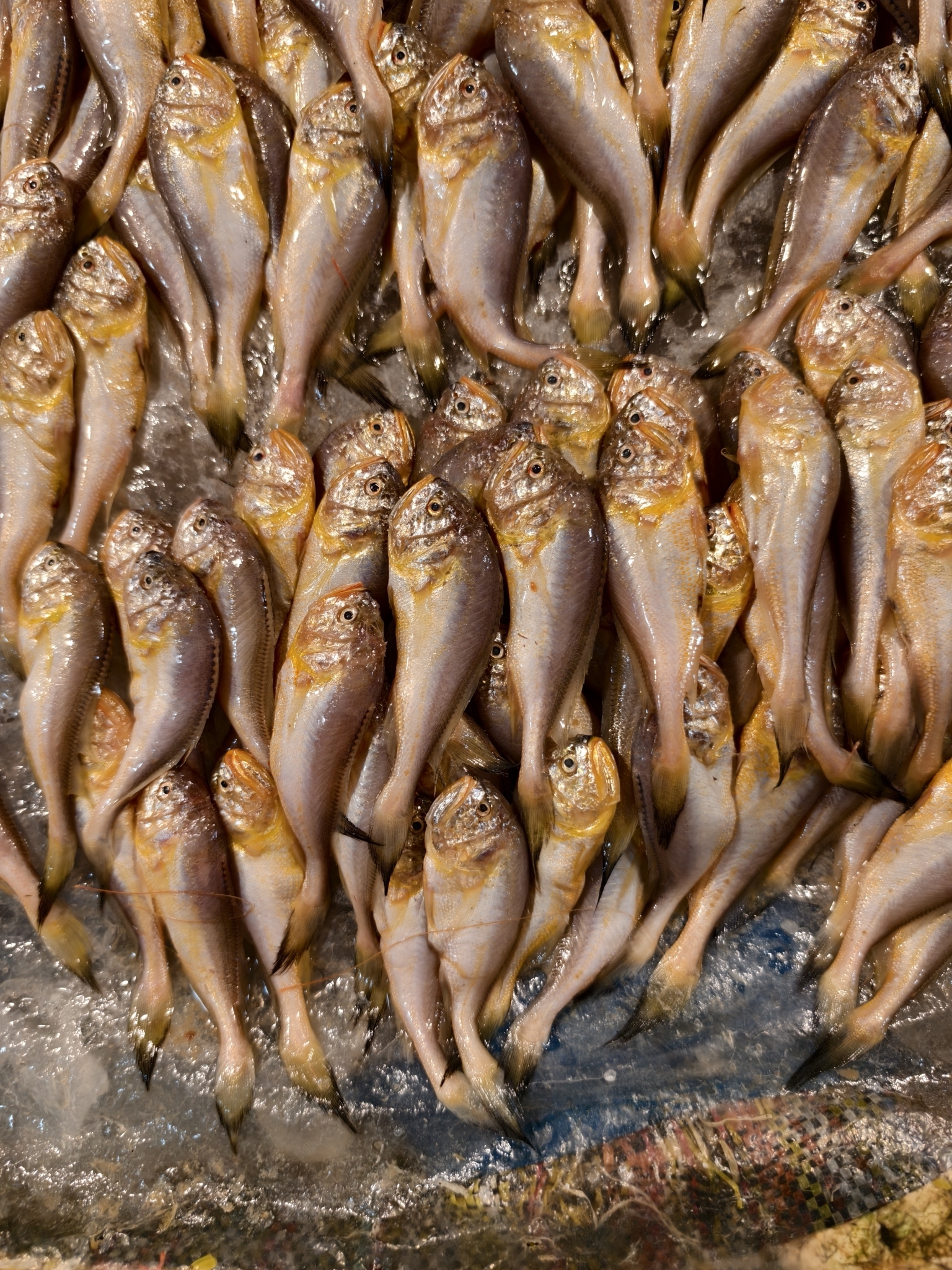
One line of the record carries three economic identities: commercial fishery, commercial aquaculture, and gamefish: yes. A few lines below, the same page places the species in Endangered, assessed in September 2018. Those statements do not cancel each other; they are different economies looking at one fish. The angler meets a fourth.
Three uses in one row
The human-use line is unusually full. Capture fisheries are commercial, aquaculture is commercial, and the gamefish box is ticked. Nothing is said about volume, price or the share of each sector, so the row describes paths to market rather than the size of any of them.
That matters for how the page is read. A farmed fish and a wild fish can carry the same name on a menu while coming from completely different supply chains. A menu cannot show which supply chain produced the fillet, and no guess is offered here.
What the auction measures
The maximum is 181 cm total length and 75 kg, from one reference. Wikipedia gives a different pair: up to 2 m and 82 kg. Both are on the record; neither is marked as the correction of the other.
The common length is missing altogether. That is the figure a market would use, and it is the one column the record does not fill. A buyer's "typical" mulloway therefore has no number attached here, only a maximum that belongs to a very old fish.
The missing depth column
Depth is null. The environment line still says marine, brackish, benthopelagic and oceanodromous, and the habitat keywords say estuary and coastal. Those words describe where the fish can be, not how deep the water is.
This is a documented gap, and the page will leave it as one. There is no basis here for a 5–50 m band or any other invented range. The defensible claim is smaller: this is a water-column fish associated with estuary and coastal ground, and only a sounder can answer the question of height in the water column on a given day.
The 100 cm line
The source puts first maturity at 100 cm. Against a 181 cm maximum, that is more than half the record length before a fish can spawn. The common length is absent, so there is no second, lower figure to soften the picture.
For a release decision, 100 cm is the only threshold the source supplies. It is a strict one: a 90 cm fish is below the source's maturity point, and a 120 cm fish is only just above it. The record gives no age, so the cost of reaching that size cannot be read from this page either.
A range in three pieces
The distribution sentence describes three separate blocks: the African southeast coast from the Cape of Good Hope to southern Mozambique; the northern Indian Ocean off Pakistan and northwest India; and the northern Pacific from southern Korea and Japan along the Chinese coast to Hong Kong SAR, China. Australia is added along its entire southern seaboard, from North West Cape to the Burnett River.
The country table lists 16 entries that follow those blocks. The gaps between them are not explained. A fish that appears off Pakistan and again off Japan may be continuous through unsampled water, or may be separate populations; the record does not decide, and a trip plan should treat each block as its own fishery.
October to February, one hemisphere
There is exactly one spawning record: South Australia, in January, February, October, November and December. This window belongs to the southern summer, and the table holds no other row.
No northern-hemisphere months are listed. The climate envelope runs from 40°N to 39°S, so the species spans both hemispheres, but the spawning evidence does not. A trip to Japan or China cannot borrow the South Australian calendar, and the page will not extend it.
Kob, mulloway
Wikipedia collects the market names: dusky kob, dusky salmon, salmon and kabeljou in South Africa; Japanese meagre on the FAO list; mulloway or jewfish in Australia; Ô-nibe in Japan; and Sawwa Krokar Fish or Sawwa Machli in Pakistan. It also explains that "jewfish" comes from the large otoliths, prized as jewels by some fishermen.
FishBase's Chinese entry is ; is the expansion list's choice, and the common-name table adds , and more variants. iNaturalist stays with Mulloway. None of these names is a synonym in the taxonomic sense; they are local market handles, and they move with the flag on the boat.
What the angler keeps
Keep the 100 cm maturity line, and keep the empty depth column visible. The first is a release threshold the source actually states; the second is the reason this page cannot tell you where in the water column to set a bait.
The Endangered assessment from 2018 is a stock-level judgement, not a prohibition at the rail. It sits beside 705 iNaturalist observations, which show that the fish is still being seen and photographed.
GBIF's distribution set is thin: 8 assertions, country codes only for Mozambique and Taiwan region, with South Africa, the Mozambican EEZ and the Oriental and Australasian realms as the remaining localities. That thinness matches the three-block range rather than resolving it. What remains is a large, late-maturing fish with a commercial farm, a commercial wild fishery and a gamefish tick — and a release line that should be carried before the camera.
Regulations before you keep it
These are the published regulations for this fish. Read the number first. The notice below it is the actual regulation.
Minimum size5
≥70 cm
Australia — New South Wales · AU-NSW
New South Wales sets a 70 cm minimum legal length for mulloway.
The mulloway row of the official finfish table lists 70 cm against a bag limit of 1. The official Australian tables publish this species as mulloway (Argyrosomus japonicus).
70 cm
≥75 cm
Australia — Queensland · AU-QLD
Queensland sets a 75 cm minimum size for mulloway.
Queensland uses the common name mulloway; species.json lists Argyrosomus japonicus as Japanese meagre with Jew as an alias.
Mulloway | Min: 75cm | Limit: 2 | Must be kept whole while on a boat.
≥82 cm
Australia — South Australia · AU-SA
South Australia sets an 82 cm minimum legal length for mulloway.
Mulloway | 82 | 2 | 6
≥60 cm
Australia — Victoria · AU-VIC
Victoria sets a 60 cm minimum legal size for mulloway.
Listed as mulloway (Argyrosomus japonicus) on the official page; species.json uses the same species under the name Japanese meagre. The official Australian tables publish this species as mulloway (Argyrosomus japonicus).
Minimum legal size: 60cm
≥500 mm
Australia — Western Australia · AU-WA
Western Australia sets a 500 mm minimum legal size for mulloway.
"Mulloway (caught primarily south of Exmouth Gulf) Argyrosomus japonicas 500 mm 2"
Bag limit5
1 fish per person per day · boat limit 2 (charter boat limit 3)
Australia — New South Wales · AU-NSW
NSW allows one mulloway per person per day, with a boat limit of 2 and a charter boat limit of 3.
The official Australian tables publish this species as mulloway (Argyrosomus japonicus).
1
Boat limit of 2 per boat per day (if 2 or more fishers are onboard).
Charter Boat limit of 3 per boat per day.
2 fish possession limit
Australia — Queensland · AU-QLD
Queensland sets a possession limit of 2 Japanese meagre.
A possession limit is the total number of fish you may keep at any time, including fish at home or in the freezer; it is not a daily take limit.
Mulloway | Min: 75cm | Limit: 2 | Must be kept whole while on a boat.
2 fish per person per day · 6 per boat
Australia — South Australia · AU-SA
South Australia allows 2 mulloway per person per day and a boat limit of 6, except in the Coorong where different limits apply.
The quick-lookup table gives 82 cm / 2 / 6 as the general rule; the Coorong has separate 46–82 cm and over-82 cm limits.
Mulloway | 82 | 2 | 6
5 fish per person per day
Australia — Victoria · AU-VIC
Victoria's daily bag limit for mulloway is 5 fish.
The official Australian tables publish this species as mulloway (Argyrosomus japonicus).
| Scientific name | *Argyrosomus japonicus* |
| Minimum legal size | 60cm |
| Bag limit | 5 |
2 fish per person per day
Australia — Western Australia · AU-WA
Western Australia allows 2 mulloway per fisher per day.
"Mulloway (caught primarily south of Exmouth Gulf) Argyrosomus japonicas 500 mm 2"
Every record above names its source and the date it was retrieved. See the regulation register for the full list, or how to read these regulations.
Where these facts come from
Check these pages before you rely on a size, range or protection status.
-
FishBase — Argyrosomus japonicus
— FishBase · T2
-
GBIF — Argyrosomus japonicus occurrence records
— GBIF · T2
-
IUCN Red List — Argyrosomus japonicus
— IUCN · T1
-
Photo record — iNaturalist
— iNaturalist · T3