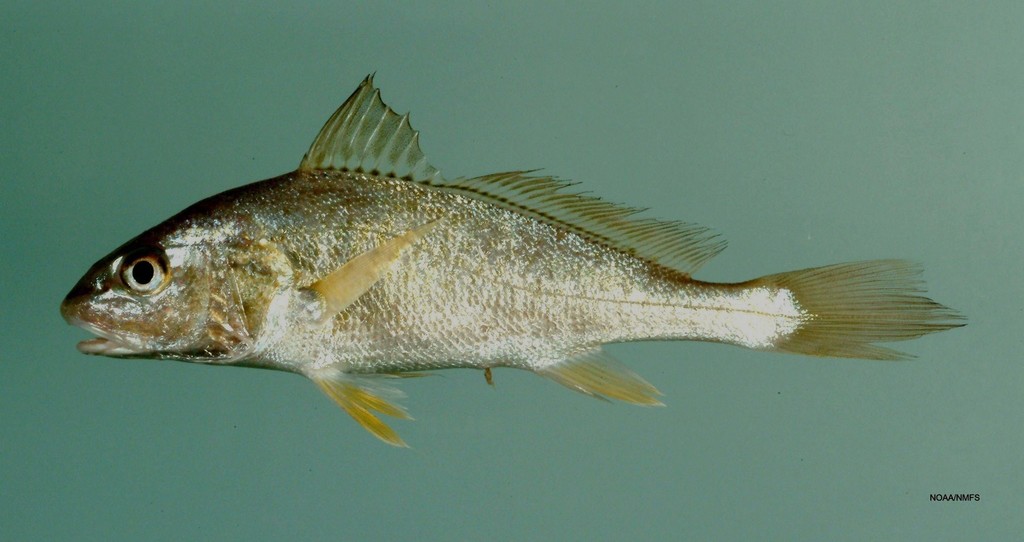
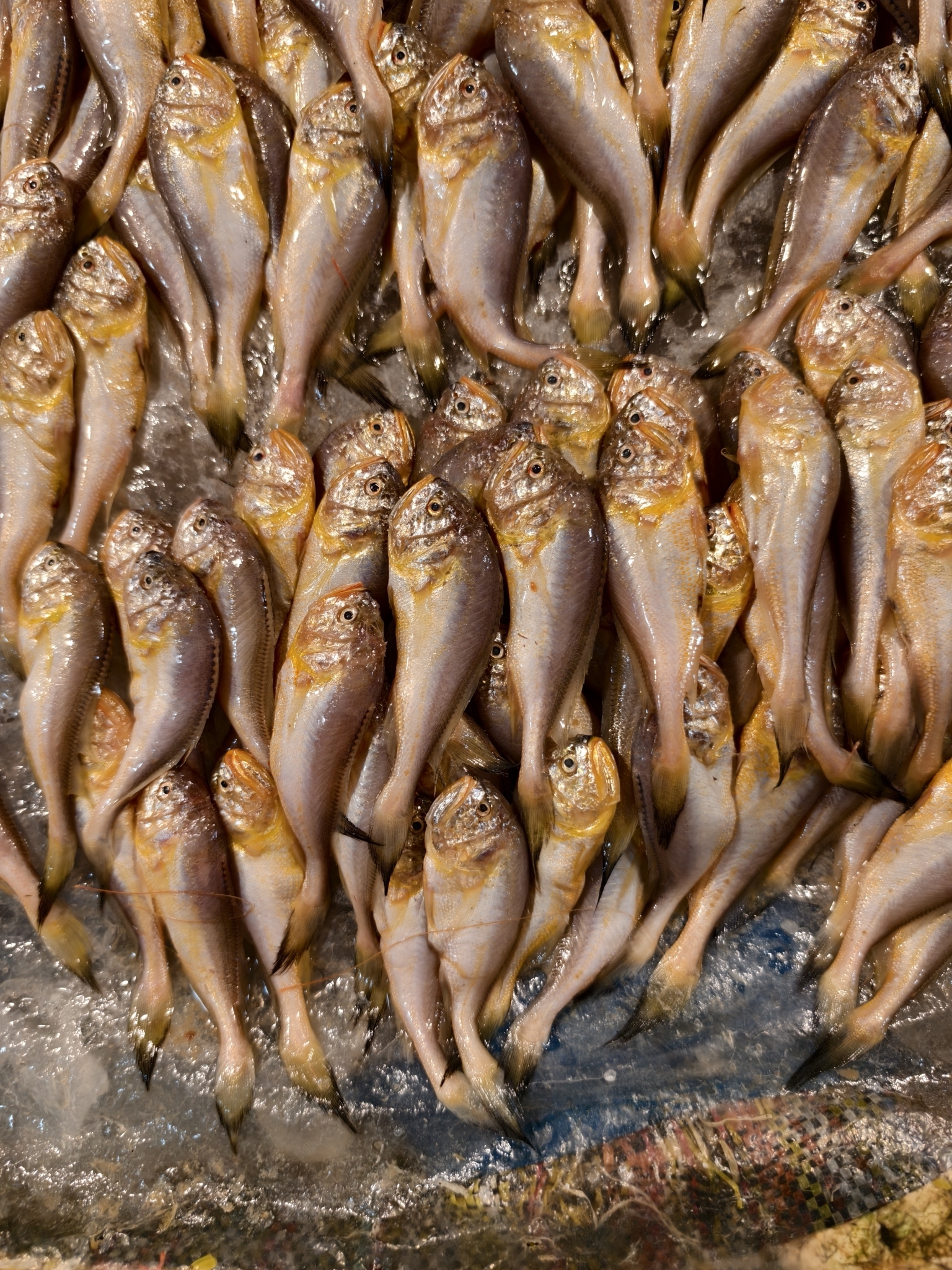
FishBase gives *Atractoscion aequidens* 130 cm TL maximum, 90 cm SL common, 25 kg published weight, and a maturity entry of Lm unknown with a range starting at 65 cm. The environment line is 15–200 m, usually 100–200 m, in tropical water from 14°N to 28°S, and the IUCN assessed it as Near Threatened on 25 September 2018. It is a croaker, not a kob: the word geelbek belongs to *Atractoscion*, and none of the kob rules are written for it.
Identification
Ten to eleven dorsal spines, 25–32 dorsal soft rays, 2 anal spines and 9–10 anal soft rays, on a silvery, fusiform body. That is the whole external description the page carries — no colour detail beyond silvery, no meristic table for the head, and no photograph key.
The genus name is Greek: atraktos, an arrow, plus skion, from skiaina, a barbel or red mullet. The names in use are where the confusion starts. FishBase lists geelbek for both Namibia and South Africa, Cape salmon for Namibia, African weakfish as the old FAO English name and geelbeck croaker as the current FAO one. The same list also carries jew, teraglin, teraglin-jew and trag for Australia, geelbeck croaker for Iraq, and Arabic names for Oman. A name list that wide is a warning, not a range.
Two disciplines follow. Geelbek is not a kob; kob is Argyrosomus, and the South African kob limits do not apply here. African weakfish is an old FAO label, and the American weakfish of the same family belongs to a different genus, Micropogonias; the shared English word is a market name, not a relationship, and nothing in the kob rules reaches either fish.
Range and habitat
FishBase gives the western Indian Ocean, off Mozambique and South Africa. GBIF holds 1,325 present records: 634 South African, 304 Australian, 78 Namibian, 63 Angolan, 40 Nigerian, and a long tail through Ghana, Côte d'Ivoire, Gabon, Sierra Leone, Cameroon and others. The Australian and West African blocks sit far outside the distribution text. Either the name is being applied to a species complex across two oceans, or a large share of those records are misidentified; the page follows the FishBase text and flags the gap rather than redrawing the map from GBIF. iNaturalist holds 16 observations.
The habitat is coastal water over sand and muddy bottom, with juveniles entering estuaries. The depth line is the one that shapes the fishing: 15–200 m with the usual band at 100–200 m. A fish normally at 100 m or deeper is not a shore target, and the estuarine juvenile line describes another life stage in another place.
Habits and diet
Adults feed on pelagic fishes at night, and the recorded prey are mackerel and horse mackerel. The page also notes the species is often caught with Umbrina canariensis, which is a co-occurrence note rather than a diet one.
It gives a prey type, two prey species and a time of day, but no prey size, no feeding depth and no seasonal shift. The benthopelagic label and a pelagic-fish diet sit together without contradiction — a fish can live near the bottom and feed upward.
There is no schooling or migration note on the page, and nothing locates the fish in the 15–200 m band at any given hour beyond the recorded night feeding.
Season and time of day
The spawning section is empty. FishBase's spawning table has no rows for this species, and the page does not give a season, a ground or a temperature anywhere else. That is a blank, not a closed season, and the difference matters for how the page is read.
The only timing fact is nocturnal feeding. Night is when the source records adults feeding on pelagic fish; it is not a record that night is when anglers catch them, and the page makes no catchability claim.
A season section here can state one thing and must stop. Spawning is unrecorded. Feeding is at night. Whether the fish is more available in a given month is not in the source, and no month is listed.
Tackle and techniques
The usual depth band, 100–200 m, decides the method before any preference does. That is deep boat water, which rules out shore fishing for adults as a default rather than an opinion. The minimum of 15 m leaves a shallow edge, and juveniles in estuaries are a separate, smaller-fish proposition.
Size sets the class of gear: 90 cm SL common, 130 cm TL maximum, 25 kg published maximum. A 25 kg fish at 130 cm is a substantial animal, and a 90 cm common length means the average adult is not small either.
Bait and rig are not recorded, but the diet narrows it: pelagic fish, mackerel and horse mackerel, taken at night. A baitfish or a lure that reads as a pelagic fish is the inference the source supports; the depth band says to present it deep. Everything past that — hook size, leader, drift or anchor — is inference, and should be labelled as such.
Kitchen and handling
The species is marketed fresh and its flesh is highly esteemed. That is the whole entry: no fat content, no price, no size grade and no handling note. It carries commercial and gamefish listings, so one stock serves two sectors.
The maturity entry is the handling point: Lm is unknown, the range starts at 65 cm, and the 90 cm common length sits well above it.
Regulations and conservation
South Africa sets geelbek at 2 fish per person per day with a 60 cm minimum. The general conditions apply: a recreational permit is required, the catch is for own use and may not be sold, and where no species rule exists the general bag is 10 fish.
Namibia's recreational text in the sources checked sets one combined bag of 10 fish per day across blacktail, galjoen, kob and West Coast steenbras. Geelbek is not named in that list, and no separate Namibian geelbek size or bag appears in the text located. That absence is a gap in the sources, not a licence, and the Namibian permit conditions should be read in full before a fish is kept.
The South African 60 cm minimum sits below the 65 cm start of the recorded maturity range. A 60 cm geelbek is therefore legal and, on the only maturity figure available, not yet mature. The two numbers come from different sources, and the comparison is arithmetic rather than a statement either source makes.
The IUCN entry is Near Threatened, assessed 25 September 2018, with no trend or stock estimate on the page. The 1,325 GBIF records spread across two oceans are not a population estimate, and should not be read as one.
How to catch it
Boat bottom fishing
Fished with the listed approach, matched to the recorded depth and size.
Jigging
Fished with the listed approach, matched to the recorded depth and size.
Regulations before you keep it
These are the published regulations for this fish. Read the number first. The notice below it is the actual regulation.
Bag limit1
60 cm minimum · 2 fish per person per day
South Africa · ZA
South Africa sets a 60 cm minimum size and a daily bag limit of two geelbek (Cape salmon) per person.
Size is measured in a straight line from the tip of the snout to the extreme end of the tail (regulation 22(8)).
Geelbek (Cape salmon) Atractoscion aequidens 60 cm 2
Every record above names its source and the date it was retrieved. See the regulation register for the full list, or how to read these regulations.
Where these facts come from
Check these pages before you rely on a size, range or protection status.
-
FishBase — Atractoscion aequidens
— FishBase · T2
-
GBIF — Atractoscion aequidens occurrence records
— GBIF · T2
-
IUCN Red List — Atractoscion aequidens
— IUCN · T1
-
Photo record — iNaturalist
— iNaturalist · T3