
Longfin trevally
A longfin trevally does not hold on a mark; it patrols the border of one. The record puts it from 1 to 59 m, in coastal water near corals and rocks and in shallow lagoons, with small groups working the perimeter of reefs. Adults are often solitary on inshore reefs, while juveniles may enter estuaries.
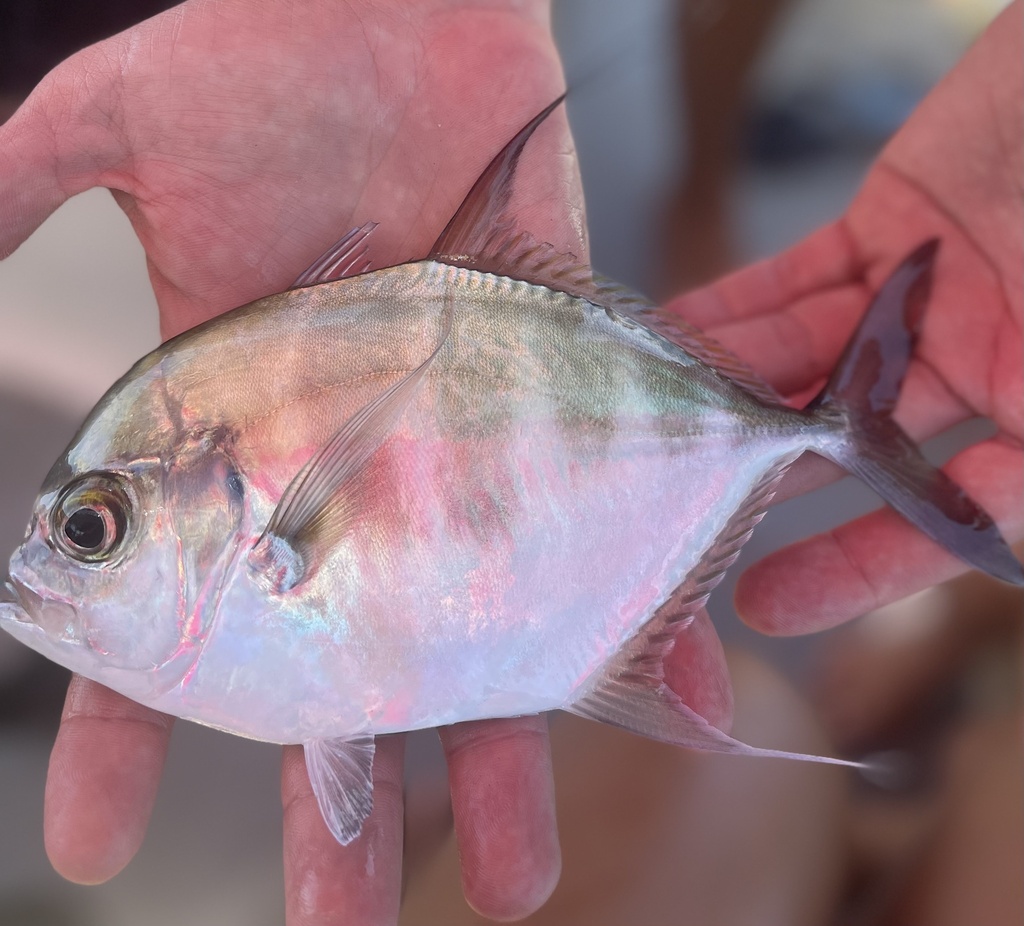
A longfin trevally does not hold on a mark; it patrols the border of one. The record puts it from 1 to 59 m, in coastal water near corals and rocks and in shallow lagoons, with small groups working the perimeter of reefs. Adults are often solitary on inshore reefs, while juveniles may enter estuaries. That is a fish defined by an edge — reef against sand, lagoon against slope, fresh water against salt — rather than by a number on a sounder. The 59 m figure is the deepest record, not a place to anchor. A sounder shows depth; it does not show a border, which is a change in substrate and has to be read rather than measured.
A fin that gives the name away
The second dorsal fin carries 19–22 soft rays, and the front of that fin is noticeably long; the anal fin has three spines and 16–18 soft rays. Body is fusiform and compressed. Maximum length is 58 cm total length, the common length 30 cm, and the maximum published weight 3.5 kg. The fish in front of you is usually the 30 cm one. FishBase 2026, WoRMS and the Catalog of Fishes all place the species in Atropus; Carangoides armatus is the older combination, and the fin shape is the same under either label. Names move between revisions, and the count does not.
Where the patrol runs
The range runs from the Red Sea and the Gulf of Oman south to East London in South Africa, east to Indonesia and north to Yamaguchi in Japan. Within that map, the productive structure is the reef perimeter: the outer rim where the coral drops into sand, the mouth of a lagoon, the corner where current hits rock. Groups patrol those lines rather than spreading over the flat. A lure or bait placed on the line and retrieved along it has a better chance than one cast into the middle of the reef. If the reef has no visible edge, the edge is where the bottom changes colour.
Small jigs and live bait
Malaysian east-coast reports name this fish as a target and describe two approaches: small metal jigs, or live bait. A small jig suits the 30 cm average and the patrol behaviour; cast past the edge, let it sink to the working depth, and retrieve across the line rather than straight back. Live bait is fished slowly beside the reef, not anchored in the middle of it. The record also notes a behaviour of shadowing a larger fish, observed and thought to be more common in juveniles. That is a useful search rule: when a big grouper or a school of larger trevallies moves past, look at the outside of the group, not its centre.
Light tackle, heavy leader
PE 1–2, a 20–30 lb fluorocarbon leader and a 2500–3000 size reel match the usual 30 cm fish. The 58 cm maximum and 3.5 kg weight are bonus fish, not the basis for the outfit. The leader matters more than the rod: the reef edge is abrasive, and the last two metres of the retrieve are where fish are lost. Replace the tail hook with a single, both to reduce snags and to make release quicker. A long, steady retrieve beats a fast one; this fish follows before it commits, and a lure that leaves the strike zone early gets no second chance.
A minor commercial fish with a clean record
The uses field lists commercial fishing and gamefishing, and the threat-to-humans field says Harmless. No ciguatera report appears for this species. Red List status is Least Concern, assessed 17 July 2017. That clean record is not a licence to ignore the reef rules. Malaysia protects the core zones of the Tioman, Redang and Perhentian marine parks, and states add size and gear rules under the 1985 Fisheries Act framework. Singapore manages recreational fishing and catches under its own current rules, and the permitted areas and gear limits are set by the responsible agency; this page has not checked them line by line. For a fish that is usually released, the park boundary matters more than the size limit.
Names that travel badly
In Malaysia the fish is called Sagai, and also Cermin, Rambai, Cupak and Demudok Putih in east-coast reports. Those are not species names. Sagai in particular is applied to several carangids, so a report that says “sagai” may be describing a different trevally. The English “longfin trevally” is more specific, and the scientific name is the only label that survives translation. iNaturalist holds 74 observations, a small number that reflects how little this fish is photographed rather than how rare it is. The count is the part that does not move: nine dorsal spines, 19–22 soft rays, three anal spines, 16–18 soft rays. Nothing in the source gives a weight for a 30 cm fish, so line class is chosen from the common length, not from a table.
How to catch it
Lure fishing
Fished with the listed approach, matched to the recorded depth and size.
Boat bottom fishing
Fished with the listed approach, matched to the recorded depth and size.
Where these facts come from
Check these pages before you rely on a size, range or protection status.
- FishBase — Atropus armatus — FishBase · T2
- GBIF — Atropus armatus occurrence records — GBIF · T2
- IUCN Red List — Atropus armatus — IUCN · T1
- Photo record — iNaturalist — iNaturalist · T3
Fish in the same water
These fish live in the same place.

African pompano
- Family
- Carangidae
- Depth
- 60–100 m

Almaco jack
- Family
- Carangidae
- Depth
- 5–245 m

Atlantic horse mackerel
- Family
- Carangidae
- Depth
- 0–1050 m
- Season
- Jan, Feb, Mar, Apr, May, Jun, Jul, Aug, Sep, Oct, Nov, Dec
Guides for this water
Technique, gear and safety guides that fit Longfin trevally.