
Jesh
Jesh is a carangid trevally of the Indo-West Pacific, from the Red Sea and Persian Gulf to Indonesia and Japan, listed now under the accepted name Flavocaranx bajad. It works 2 to 70 m around coastal reef slopes and large coral heads. It reaches 55 cm TL with a common length of 42 cm, matures at 24.7 cm and can live eight years. Lures, drifting and jigging are the methods listed.
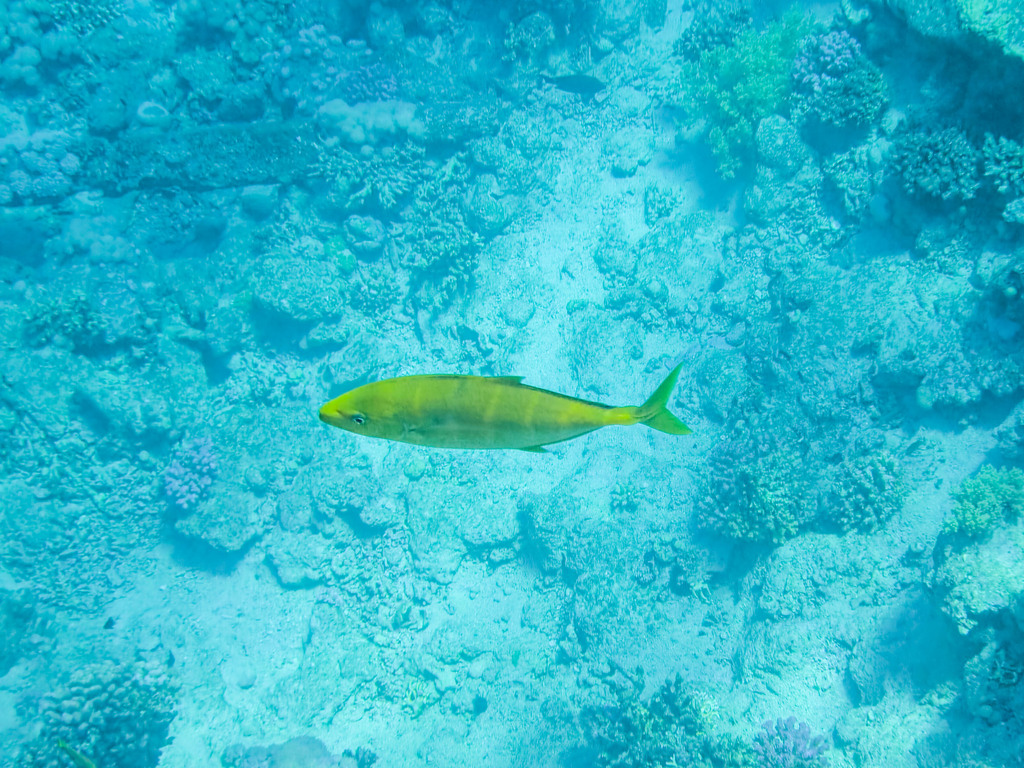
Carangoides bajad, listed by FishBase and GBIF under the accepted name Flavocaranx bajad, is a Carangidae trevally of the Indo-West Pacific from the Red Sea and Persian Gulf to Indonesia and Japan. It is recorded from 2 to 70 m around coastal reef slopes and large coral heads. FishBase gives a maximum of 55 cm total length, a common length of 42 cm, a maximum age of 8 years and maturity at 24.7 cm. Adults are reef-associated; juveniles are solitary in sheltered bays. The UAE lists jesh na'imi at a 25 cm minimum.
Identification
A carangid with a fusiform, laterally compressed body. The dorsal fin has IX spines and 24 to 26 soft rays, and the anal fin has III spines and 22 to 24 soft rays. FishBase's summary page gives no further diagnostic text, so the fin counts and the overall trevally shape carry the identification.
The English name Orangespotted trevally refers to orange spots on the flank, but the FishBase summary does not describe the colour pattern in words. Use the name as a lead, not as a confirmed field mark.
FishBase and GBIF now place the species in Flavocaranx; this entry keeps Carangoides bajad, the name used in the project plan, and notes the accepted name so the two can be reconciled at import.
Distribution and Habitat
Indo-West Pacific: the Red Sea, Gulf of Aden, Persian Gulf and Gulf of Oman east to Indonesia, the Gulf of Thailand, the Philippines and Okinawa. FishBase lists 30 territories.
Recorded from 2 to 70 m, reef-associated, in tropical water from 35°N to 8°S. Adults are common along coastal reef slopes and around large coral heads in lagoons; juveniles are solitary in sheltered coastal bays.
That means the shallow bay is a nursery and the reef slope is the fishing ground. Casting along the slope edge, not into the lagoon, is the higher-percentage approach.
Habits and Diet
FishBase does not list prey items for the species. It describes adults as common along coastal reef slopes and around large coral heads, with a xanthic form often seen in muddy bays, and juveniles as solitary in sheltered coastal bays.
A trevally of that shape is a pursuit predator, so live bait and fast lures match the body plan. The absence of a diet list means the choice should be driven by what is present locally rather than by a prescribed bait.
Fishing Methods
Casting 20 to 40 g minnows and pencils along the reef edge at first light and last light is the classic approach. Work the lure fast and parallel to the structure rather than straight out.
Live shrimp or a small fish drifted past a coral head on a slow current is the bait alternative. Light jigs in the 40 to 60 g class cover the 10 to 30 m slope quickly and find fish that are not showing.
Gear and Approach
A 7 to 7 ft 6 in medium spinning rod, a 3000 to 4000 reel, 1.0 to 1.5 PE and a 25 to 30 lb leader handle fish to 55 cm. The drag should be smooth enough for a burst at the reef.
Keep the lure moving and the rod tip low to the water; a trevally that reaches the coral head usually cuts the line. On bait, use a circle hook and let the fish run before engaging the reel.
Seasonal Window
FishBase records spawning off Abu Dhabi in June and September. That is a two-point record, not a full season, and should be read as evidence of a warm-season spawn rather than a closed period.
The best fishing follows water clarity and bait presence more than the calendar. Dawn and dusk on a moving tide are the reliable windows; midday on slack water is not.
In the Gulf the summer heat pushes activity to the edges of the day, while the cooler months widen the window through the morning.
Edibility and Handling
Marketed commercially and listed as a gamefish. The flesh is darker and oilier than a sparid's and is best bled and iced immediately, then eaten fresh.
Trevally are active fish that produce lactic acid quickly. Bleed, gill and slurry them rather than leaving them flapping in a box; the difference in taste is large.
Regulations and Conservation
United Arab Emirates: MD 580/2015 lists jesh na'imi (Carangoides bajad) at a minimum total length of 25 cm. A recreational licence is required, and Abu Dhabi charges AED 120 per year or AED 30 per week.
Oman: the 40 cm minimum in MD 67/2020 is listed for sal (Carangoides chrysophrys or C. coeruleopinnatus), not for this species, so it should not be applied to jesh. The recreational licence is OMR 2 per day or OMR 30 per year.
Saudi Arabia: this species is not in the master-plan region set for the batch and no Saudi species rule was reviewed. IUCN global status is Least Concern, assessed in 2015.
How to catch it
Lure fishing
20–40
Drift fishing
Jigging
40–60 10–30
Where these facts come from
Check these pages before you rely on a size, range or protection status.
- GBIF — Carangoides bajad occurrence records — GBIF · T2
- IUCN Red List — Carangoides bajad — IUCN · T1
- Photo record — iNaturalist — iNaturalist · T3
Fish in the same water
These fish live in the same place.

African pompano
- Family
- Carangidae
- Depth
- 60–100 m

Almaco jack
- Family
- Carangidae
- Depth
- 5–245 m

Atlantic horse mackerel
- Family
- Carangidae
- Depth
- 0–1050 m
- Season
- Jan, Feb, Mar, Apr, May, Jun, Jul, Aug, Sep, Oct, Nov, Dec
Guides for this water
Technique, gear and safety guides that fit Jesh.