
Yellowspotted trevally
Most species pages have to warn that the record fish is a fantasy. This one needs the opposite warning. The maximum is 120 cm fork length and 18 kg, and the common length is 90 cm total length. The gap between the ceiling and the everyday fish is about 30 cm, and the two figures are measured differently — fork length against total length — so even that gap is not exact.
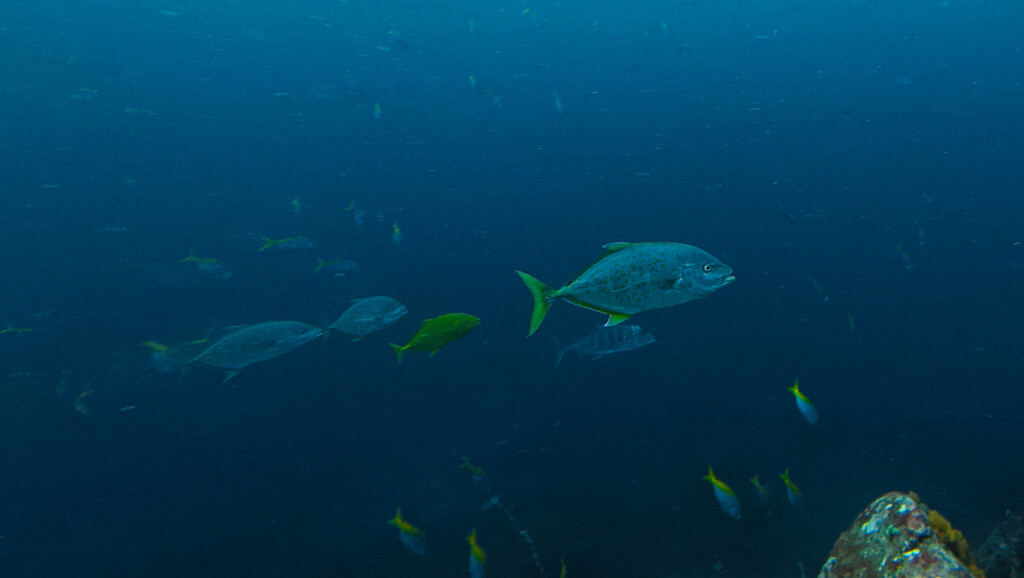
Most species pages have to warn that the record fish is a fantasy. This one needs the opposite warning. The maximum is 120 cm fork length and 18 kg, and the common length is 90 cm total length. The gap between the ceiling and the everyday fish is about 30 cm, and the two figures are measured differently — fork length against total length — so even that gap is not exact. The practical reading is that a 90 cm trevally is not an exceptional catch here; it is the normal size class. An outfit chosen for a 60 cm fish is undersized before the trip starts. “Common” here means the length most often recorded in the fishery, not a target that every trip will meet.
The fish changes shape as it grows
Juveniles are subovate and compressed; adults become elongate-ovate and slightly subcylindrical, and the head profile steepens with age. The mouth cleft of adults sits distinctly below the level of the eye. Colour follows the same curve: adults are iridescent blue-green above and silvery below, with numerous small gold or brassy spots on the dorsal half, and large adults develop three to five irregular black blotches on the flanks — sometimes very faint, sometimes absent. Counts are nine dorsal spines, 25–30 soft rays, three anal spines and 21–26 soft rays, with 24 vertebrae. A photograph of a big fish and a photograph of a small one can look like two species. They are not.
Reef, rock, and a missing shallow limit
The range extends from the Red Sea and East Africa to Palau and New Caledonia, north to the Ryukyu and Ogasawara islands, and east to Tonga. Adults prefer rocky and coral reef areas, and also occur offshore. The depth field reads “?–100 m”: the maximum is recorded and the minimum is not. That blank is more useful than a made-up number. It means the source cannot say where the shallow edge of the range is, so the 100 m figure should not be read as a target depth. Work the reef structures that reach toward 100 m, and let the fish show you the band.
Trolling and heavy jigs
The species is recorded as a gamefish, but the source does not break the methods down. The size class does: 90 cm and 18 kg needs tackle that can turn a fish away from a reef, not tackle that casts well. Trolling large minnows or soft plastics along the reef edge covers water and finds the fish; heavy vertical jigs over the slope cover the depth. The mouth sits low, and a trolled bait is often taken deep, so both the front and rear hooks need to be in the load path. Once hooked, the first move should be to pull the fish away from the structure, before the drag is adjusted.
Rigging for the 90 cm class
PE 4–5, an 80–100 lb leader, an 8000–10000 size reel and a drag set from about 70 per cent of the line rating is the working range. The 120 cm, 18 kg fish is a record, not the daily target. Because the common length is already close to the top of what most carangid outfits handle, this is not a species where “light is more fun” applies. Fluorocarbon leader, checked after every snag; reef abrasion is a bigger risk than the teeth. Carry more leader than you think you need, and cut back rather than retie a damaged section.
Slow growth, clean record, six jurisdictions
The uses field lists commercial fishing and gamefishing. Red List status is Least Concern, assessed 9 March 2015. The threat-to-humans field says Harmless and no ciguatera report is listed. The resilience field is Low, with a minimum population doubling time of 4.5 to 14 years, and the fishing vulnerability score is high to very high. A 90 cm fish that grows slowly is exactly the fish that a size-based keep rule fails to protect. Rules by country: Malaysia protects the core zones of the Tioman, Redang and Perhentian marine parks, with state-level size and gear rules under the 1985 Fisheries Act framework. Indonesia zones marine protected areas and manages reef-fish exports and sizes by ministerial regulation. The Philippines works through RA 8550 as amended by RA 10654. Mozambique, Kenya and Tanzania each apply their own fisheries law, with different export and reef protection rules. Check the current notice before keeping a large one.
A name with no local equivalent
Malaysian reports use the English “yellow-spotted trevally” because there is no settled Malay species name; the fish appears in the Rompin catch lists under that label. The scientific name has moved: FishBase 2026, WoRMS and the Catalog of Fishes list it as Turrum fulvoguttatum, with Carangoides fulvoguttatus as the older combination. The gold spots and the black blotches are the field marks; the genus is a matter of which revision you open. iNaturalist holds 604 observations.
How to catch it
Trolling
Fished with the listed approach, matched to the recorded depth and size.
Jigging
Fished with the listed approach, matched to the recorded depth and size.
Where these facts come from
Check these pages before you rely on a size, range or protection status.
- FishBase — Turrum fulvoguttatum — FishBase · T2
- GBIF — Turrum fulvoguttatum occurrence records — GBIF · T2
- IUCN Red List — Turrum fulvoguttatum — IUCN · T1
- Photo record — iNaturalist — iNaturalist · T3
Fish in the same water
These fish live in the same place.

African pompano
- Family
- Carangidae
- Depth
- 60–100 m

Almaco jack
- Family
- Carangidae
- Depth
- 5–245 m

Atlantic horse mackerel
- Family
- Carangidae
- Depth
- 0–1050 m
- Season
- Jan, Feb, Mar, Apr, May, Jun, Jul, Aug, Sep, Oct, Nov, Dec
Guides for this water
Technique, gear and safety guides that fit Yellowspotted trevally.