
Island trevally
Island trevally is a carangid of the Indo-Pacific, from the western Indian Ocean to the Austral Islands, north to southern Japan and Hawaii and south to Sydney. It lives from the surface to 168 m in tropical water, reaches 75 cm TL and 6.6 kg, and feeds on crustaceans.
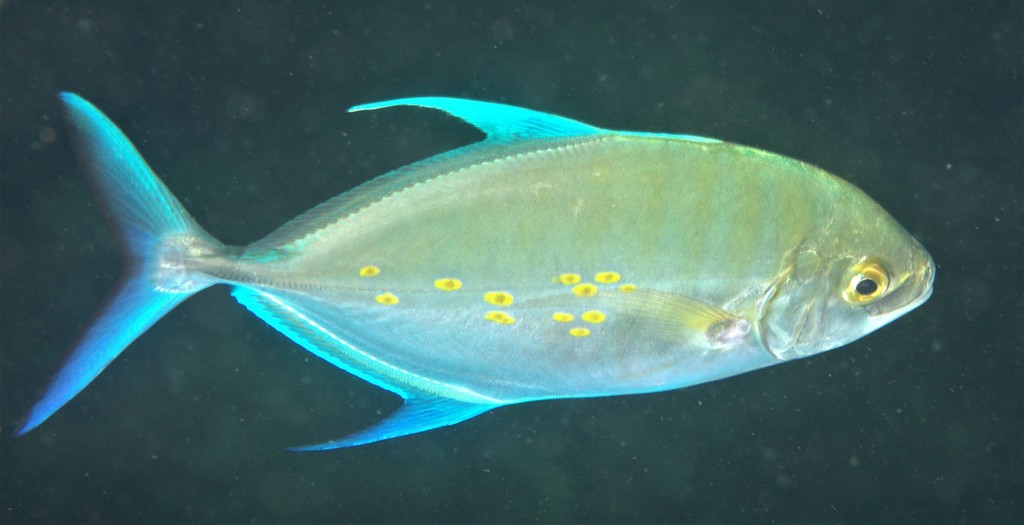
Island trevally (Carangoides orthogrammus) is a fish of the family Carangidae. FishBase gives its range as: Indo-Pacific: western Indian Ocean to the Austral Islands, north to southern Japan and Hawaii, south to Sydney, Australia. Eastern Central Pacific: Mexico and the Revillagigedo Islands. Fusiform and compressed, the island trevally carries 28–31 dorsal soft rays, while the anal fin has three spines and 24–26 soft rays. It is recorded from 0 to 168 m, in tropical water. The recorded maxima are 75 cm TL, 6.6 kg. Diet includes crustaceans. IUCN status: Least Concern (LC). Chinese name: .
Identification
Fusiform and compressed, the island trevally carries 28–31 dorsal soft rays, while the anal fin has three spines and 24–26 soft rays. Its total-length maximum is 75 cm; the common figure is 40 cm fork length; the heaviest published specimen weighed 6.6 kg. Maturity and age are unrecorded. Total and fork length are different rulers, so treating 75 cm and 40 cm as the same measurement inflates the ordinary fish. Taxon 1360075 has 330 iNaturalist observations. Wikipedia calls it a wide-ranging offshore jack of the tropical Indian and Pacific Oceans.
Habitat and distribution
Marine, reef-associated and oceanodromous is the classification, with a 0–168 m depth span and tropical water between 35°N and 34°S. The distribution text reaches from the western Indian Ocean to the Austral Islands, north to southern Japan and Hawaii, south to Sydney, with a presence in the eastern central Pacific. The country list runs past 50 territories, Hawaii, Japan, Australia, the Maldives and the Galápagos among them. Wikipedia draws the range from Mozambique and the Seychelles to Hawaii and the Revillagigedo Islands. This is an offshore wanderer, not a reef resident; the depth span covers surface schools as well as deeper structure.
Season and fishing approach
No spawning month is listed, so water colour and current must stand in for a calendar. Size is the sharpest lesson in the entry: 75 cm and 6.6 kg are extremes, while most fish encountered will be near the 40 cm fork-length common figure. Tackle belongs in the 40 cm class; the maximum is an exception, not the objective. Oceanodromous behaviour argues for current lines, drop-offs and open-water edges. Sand and open water are the habitat keywords, and crustaceans are the prey, which places lures and baits around sand channels and flotsam. Gamefish status is recorded and fits the ordinary size class better than a trophy mindset.
Edibility and regulations
Commercial fishing and gamefish use appear on the record; aquaculture and the aquarium trade do not. IUCN's category is Least Concern; the assessment date is 9 March 2015. It is unlisted by both CITES and CMS. Neither a legal minimum length nor a daily take limit appears anywhere in the three sources. With more than 50 jurisdictions in the country list, one 40 cm fish may fall under widely different coastal rules, and nothing in the entry justifies carrying a limit across borders. The 6.6 kg peak is a published specimen weight, not a daily target.
Where these facts come from
Check these pages before you rely on a size, range or protection status.
- FishBase — Carangoides orthogrammus — FishBase · T2
- GBIF — Carangoides orthogrammus occurrence records — GBIF · T2
- IUCN Red List — Carangoides orthogrammus — IUCN · T1
- Photo record — iNaturalist — iNaturalist · T3
Fish in the same water
These fish live in the same place.

African pompano
- Family
- Carangidae
- Depth
- 60–100 m

Almaco jack
- Family
- Carangidae
- Depth
- 5–245 m

Atlantic horse mackerel
- Family
- Carangidae
- Depth
- 0–1050 m
- Season
- Jan, Feb, Mar, Apr, May, Jun, Jul, Aug, Sep, Oct, Nov, Dec
Guides for this water
Technique, gear and safety guides that fit Island trevally.