
Pacific crevalle jack
The “estuary” in a species account is not a single place. For this fish it is a line that runs from river water through brackish channels to coastal schools and then to the edge of the shelf, and the same species occupies different points on that line at different ages. This article follows the salinity and depth gradient rather than treating “brackish” as a habitat label.
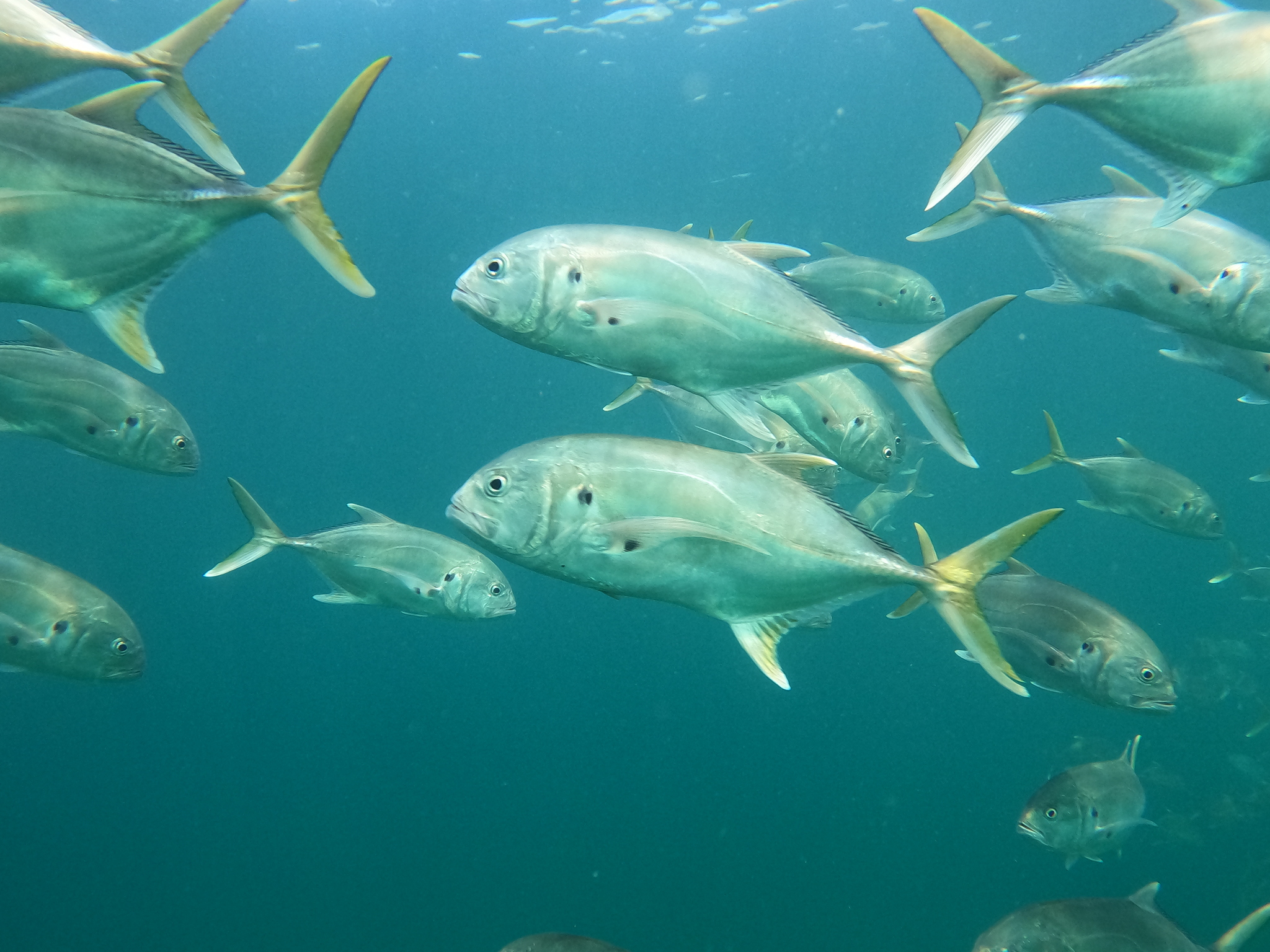
The “estuary” in a species account is not a single place. For this fish it is a line that runs from river water through brackish channels to coastal schools and then to the edge of the shelf, and the same species occupies different points on that line at different ages. This article follows the salinity and depth gradient rather than treating “brackish” as a habitat label.
A fish that crosses the line
FishBase describes adults as oceanic and coastal, commonly in shallow water, with larger individuals down to 350 m. The same account also places it in brackish water and occasionally ascends rivers. Juveniles are often found in river estuaries.
Those statements place the species on both sides of the freshwater-saltwater boundary. The adult is not confined to the sea and the juvenile is not confined to the river; each life stage uses the part of the gradient that suits it.
Where the estuary ends
The estuary in the account is a juvenile habitat, not an adult one. Juveniles are in river estuaries; adults are coastal and oceanic, and larger fish move deeper. A trip that targets the river mouth is therefore a juvenile trip, whether or not that is the intention.
The brackish record for adults is separate from the nursery record for juveniles. FishBase says adults occasionally ascend rivers but does not say how far upstream. The upper limit of that movement is one of the blanks in the account.
The one-to-three-hundred-fifty column
The depth band begins at 1 m and reaches 350 m, subtropical. The biology text explains the shape of that range: adults are commonly shallow, and the deepest figure belongs to larger individuals. It is a size-linked depth range, not a uniform distribution through the column.
That changes the reading of the range. A 60 cm fish belongs to the shallow part of the range; the 350 m records belong to larger individuals. Fishing the whole 1–350 m band at random is not fishing the species, it is sampling a gradient that belongs to the upper size classes.
One hundred one centimetres and sixty
FishBase gives a maximum fork length of 101 cm and a common total length of 60 cm, weighing up to 17.7 kg and living to a reported 15 years. The IGFA all-tackle record for the species, reported in Smith-Vaniz and Carpenter's 2007 revision of the crevalle jacks, is 19.7 kg at 101.6 cm total length, taken in Costa Rica.
The record length and the database maximum are close once the measurement is accounted for: 101 cm to the fork is less than 101.6 cm to the tail tip. The weights differ by 2 kg, and the revision places all three species at or above 22.7 kg.
Fifteen years, measured
The growth study from Colima sampled otoliths monthly through 2002 and identified seven age groups. Growth in the first year was 14.4 cm; the second year added 11.76 cm, the third 9.61 cm, the fourth 7.85 cm and the fifth 6.41 cm. The von Bertalanffy fit gave an asymptotic length of 83.26 cm and a longevity estimate of 15 years.
That longevity figure matches the FishBase maximum reported age. The first-year growth figure is the more operational number: a 14 cm fish at age one is still in the size class that uses estuaries and shallow coastal water, which is why the juvenile habitat statement and the growth curve point to the same places.
Chile during El Niño
FishBase runs the eastern Pacific range from San Diego to Peru, including the Gulf of California and the Galapagos. GBIF's distribution file adds a Chilean record described as the north coast during warm events associated with El Niño.
That is a range-edge record tied to a warm-water anomaly, not a permanent extension. The same file also lists East Pacific, Nearctic and Neotropical realms, two Colombian entries — one reading Bahia Solano, Ciudad Mutis and one only the code CO:52835573 — a Colombian country-only reference, plus a Mexican checklist record with no locality text. Bahia Solano is a mangrove survey site rather than a stretch of coast a boat can plan around.
The hippos question
FishBase notes that the species is probably the same as Caranx hippos. The 2007 review separated the complex into three species: C. hippos in both the western and eastern Atlantic, C. caninus in the eastern Pacific, and a new species, C. fischeri, from West Africa.
The two names therefore describe one eastern Pacific fish and one Atlantic fish, with a third species between them. A report of “crevalle jack” from the Pacific and a report from the Atlantic are not the same animal, even when the common name is identical.
Setting the boat on the gradient
Start at the river mouth at first light, when juveniles and small adults use the brackish edge. Fish the channel edges and the first metre of the salt wedge rather than the fresh water above it. As the sun rises, move to the coastal school along the shore and then, if the sounder shows larger fish, step offshore toward the shelf break that leads to the 350 m records.
Match the bait to the size class being targeted. Small fish and shrimp for the estuary and coastal school; whole fish for the larger adults. The species takes both, and the size of the bait is the simplest way to select which part of the gradient is being fished.
Record the salinity and the depth with every fish. The account says the adults sometimes ascend rivers but does not say how far; noting where the brackish fish are caught is how that blank gets filled.
Where these facts come from
Check these pages before you rely on a size, range or protection status.
- FishBase — Caranx caninus — FishBase · T2
- GBIF — Caranx caninus occurrence records — GBIF · T2
- IUCN Red List — Caranx caninus — IUCN · T1
- Photo record — iNaturalist — iNaturalist · T3
Fish in the same water
These fish live in the same place.

African pompano
- Family
- Carangidae
- Depth
- 60–100 m

Almaco jack
- Family
- Carangidae
- Depth
- 5–245 m

Atlantic horse mackerel
- Family
- Carangidae
- Depth
- 0–1050 m
- Season
- Jan, Feb, Mar, Apr, May, Jun, Jul, Aug, Sep, Oct, Nov, Dec
Guides for this water
Technique, gear and safety guides that fit Pacific crevalle jack.