
Blue runner
Blue runner is a schooling jack of both sides of the Atlantic, from Senegal to Angola and through the Caribbean into the Gulf of Mexico. It gathers around reefs and inshore structure from the surface down to 100 m, reaches 70 cm and 5.1 kg, and feeds on fish. The season runs February to September.

Blue runner (Caranx crysos) is a fish of the family Carangidae. FishBase gives its range as: Eastern Atlantic: Senegal to Angola, including the western Mediterranean, St. Paul's Rocks, and Ascension Island. Reported from Mauritania. It is recorded from 0 to 100 m, in subtropical water. The recorded maxima are 70 cm TL, 5.1 kg, 11 years. Diet includes fishes. IUCN status: Least Concern (LC). Chinese name: .
Eighteen names and one binomial
The alias list runs: black jack, blue runner, bluestripe jack, Boca abou, crevalle, golden jack, green jack, hardnose, hardtail, hardtailed jack, horse mackerel, mackerel, runner, white back cavalli, Yara yag, Yaru boca abau, yellow mackerel, yellow tail cavalli. Several of those names are also used for other carangids in other places.
That is the practical problem with common names: “runner” and “mackerel” describe behaviour or appearance, not a species. A market or a skipper using either word may be talking about a different fish, and neither is obliged to say which.
One binomial and a database question
FishBase states that in the tropical eastern Pacific the species is replaced by Caranx caballus Günther 1869, which may be conspecific. VIMS gives the same relationship but dates the authority to 1868. The two pages agree on the substance and disagree on the citation.
“May be conspecific” is not a synonymy. It means the two names might describe one biological species, and the sources have not settled it. Until they do, a record from the eastern Pacific and a record from the Atlantic cannot be pooled without saying so.
Seventy centimetres or five hundred fifty millimetres
FishBase's size block lists 70.0 cm as the maximum total length. The biology text on the same page ends with “Maximum reported total length 550mm in Ref. 57392”. Both statements are about total length, and they differ by 150 mm.
The larger figure is the database maximum; the smaller is a reported maximum from a specific reference. Neither is marked as provisional. A reader who takes the first number gets a 70 cm fish; a reader who takes the second gets a 55 cm fish, and which record the other one supersedes is not stated.
The same size block also carries a common total length of 40 cm, a maximum published weight of 5.1 kg, a maximum recorded age of 11 years, and a maturity length of 27.4 cm. The four figures are independent of one another; none of them is derived from the same batch of specimens as the length-and-weight maximums.
Seven hundred twenty-one millimetres
The BOEM telemetry study adds a third figure: the largest recorded individual is 721 mm total length, and the species reaches 75 per cent of its maximum size within three to four years. That is 21 mm above the FishBase maximum and 171 mm above the reported maximum in the biology text.
Three length records, one species, no reconciliation. The useful reading is not that one source is right and the others wrong, but that “maximum” in these pages means the largest specimen each compiler happened to hold. The telemetry study's growth statement is the more operational fact: 75 per cent of maximum size is reached within three to four years, so a 55 cm fish is already near adult length.
The reef tag that VIMS rejects
FishBase calls the species reef-associated. VIMS describes it as a schooling species, primarily inshore, and explicitly not common around reefs. Both pages are describing the same animal.
The conflict is about what “reef-associated” means. A fish that passes a reef is not necessarily a reef resident, and a fish that schools inshore may still be recorded over reef habitat. The VIMS sentence is the more specific one: it says not common around reefs, which is a statement about frequency, not about possibility.
Mediterranean names and the eastern Atlantic
FishBase puts the eastern Atlantic range between Senegal and Angola, including the western Mediterranean, St. Paul's Rocks and Ascension Island. GBIF's 106 distribution records include a Greek EEZ entry in the Mediterranean, European marine waters, the Gulf of Mexico and Gulf of Maine, and the Azores archipelago with its Portuguese EEZ.
The Mediterranean presence is a range statement, not a separate stock. A fish recorded in European marine waters and a fish recorded off Angola belong to the same named species, and the record set does not partition them.
Sargassum juveniles and the zero-to-one-hundred column
FishBase's depth field runs from 0 to 100 m and describes juveniles as often found with floating Sargassum, entering lagoons and estuaries. Adults feed on fishes, shrimps and other invertebrates, and spawning occurs offshore from January through August.
VIMS adds that young are often found with sargassum and that the species probably spawns offshore off the southeastern United States. The two accounts agree on the nursery association and on the offshore spawning, which makes the floating weed line a legitimate place to look for small fish.
Fishing by name and by record
Decide which size class the trip is for before choosing the name. If the target is the inshore school, the VIMS description is the better guide: schooling, primarily inshore, not common around reefs, feeding on silvery fish and shrimp. If the target is the platform fish, the BOEM study is the better guide: schools in the upper 20 m by day, descending to about 25 m at night, with feeding peaking before dawn.
Then carry the length figures as a set. A 55 cm fish is the reported maximum in one reference, a 70 cm fish is the database maximum, and a 72.1 cm fish is the largest recorded in the telemetry study. None of them is a target size, and the 75-per-cent growth figure says the difference between them is age rather than condition.
Finally, check the name on the local list before the fish goes in the box. With eighteen aliases and a possible synonym on the other side of the Pacific, the Latin binomial is the label that survives a border crossing without reinterpretation.
Where these facts come from
Check these pages before you rely on a size, range or protection status.
- FishBase — Caranx crysos — FishBase · T2
- GBIF — Caranx crysos occurrence records — GBIF · T2
- IUCN Red List — Caranx crysos — IUCN · T1
- Photo record — iNaturalist — iNaturalist · T3
Fish in the same water
These fish live in the same place.
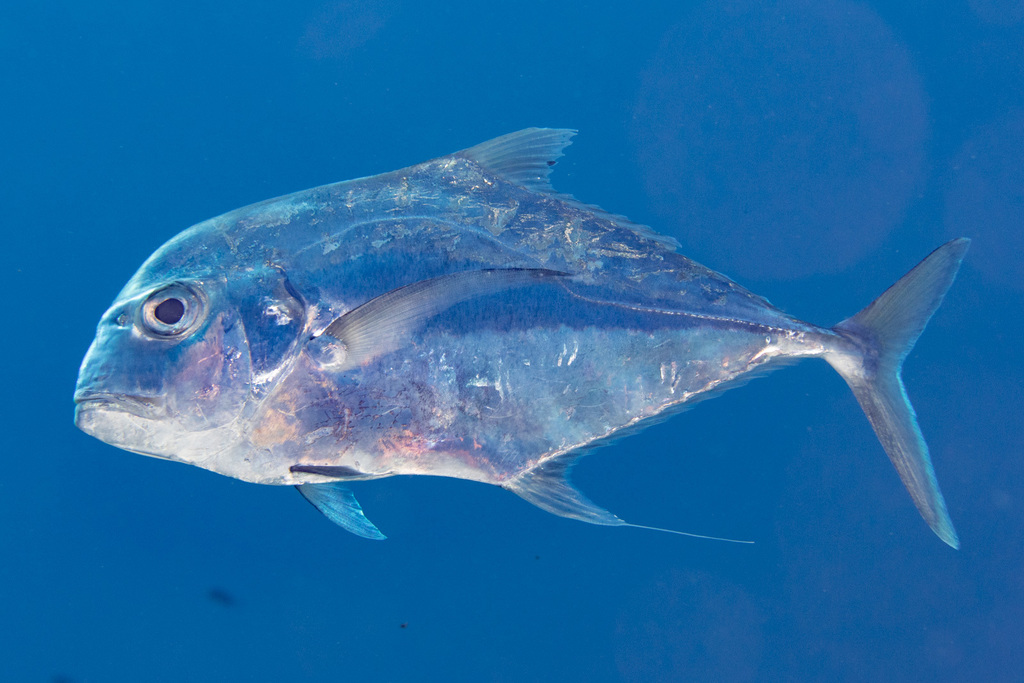
African pompano
- Family
- Carangidae
- Depth
- 60–100 m
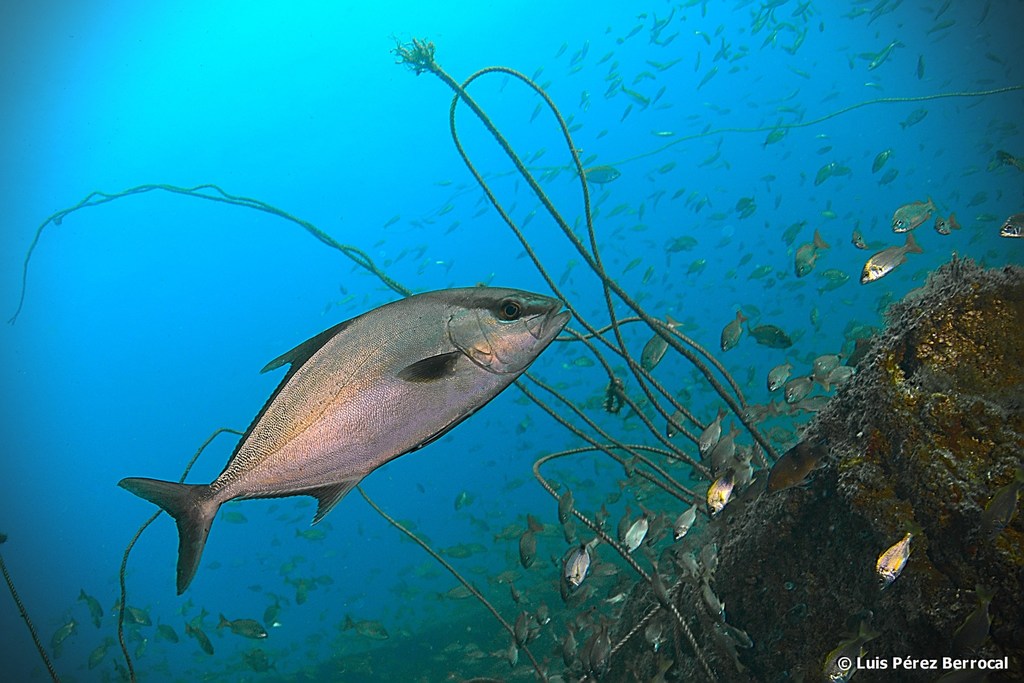
Almaco jack
- Family
- Carangidae
- Depth
- 5–245 m
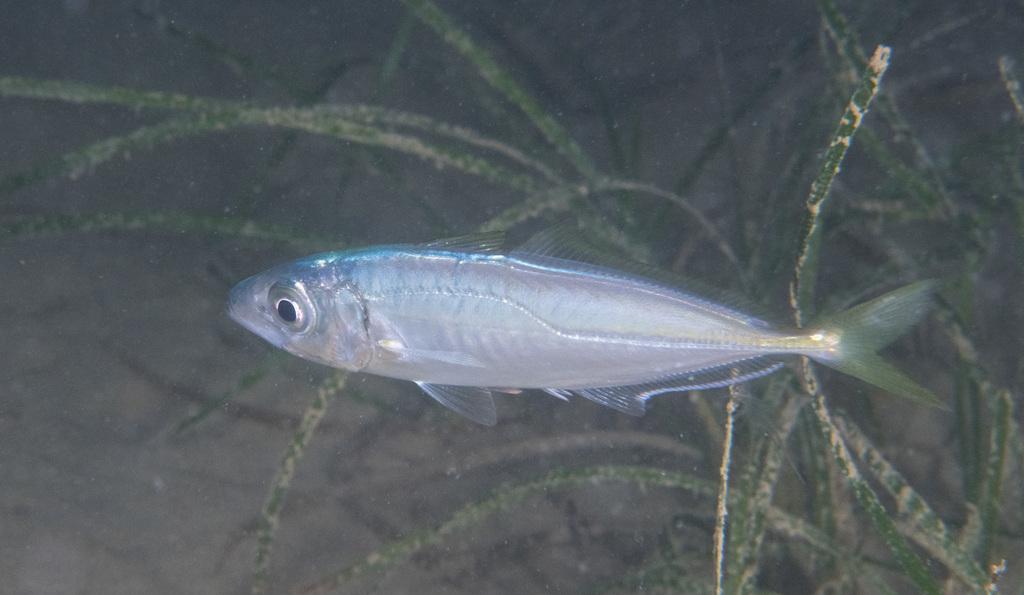
Atlantic horse mackerel
- Family
- Carangidae
- Depth
- 0–1050 m
- Season
- Jan, Feb, Mar, Apr, May, Jun, Jul, Aug, Sep, Oct, Nov, Dec
Guides for this water
Technique, gear and safety guides that fit Blue runner.