
Crevalle jack
Crevalle jack is a carangid of Atlantic continental-shelf waters, from the eastern seaboard into the Gulf and Caribbean. Adults push into rivers while young fish gather in estuaries, seagrass beds and mangroves. It lives from 1 to 350 m, reaches 124 cm and 32 kg, feeds on fish, and has a season from April to June.
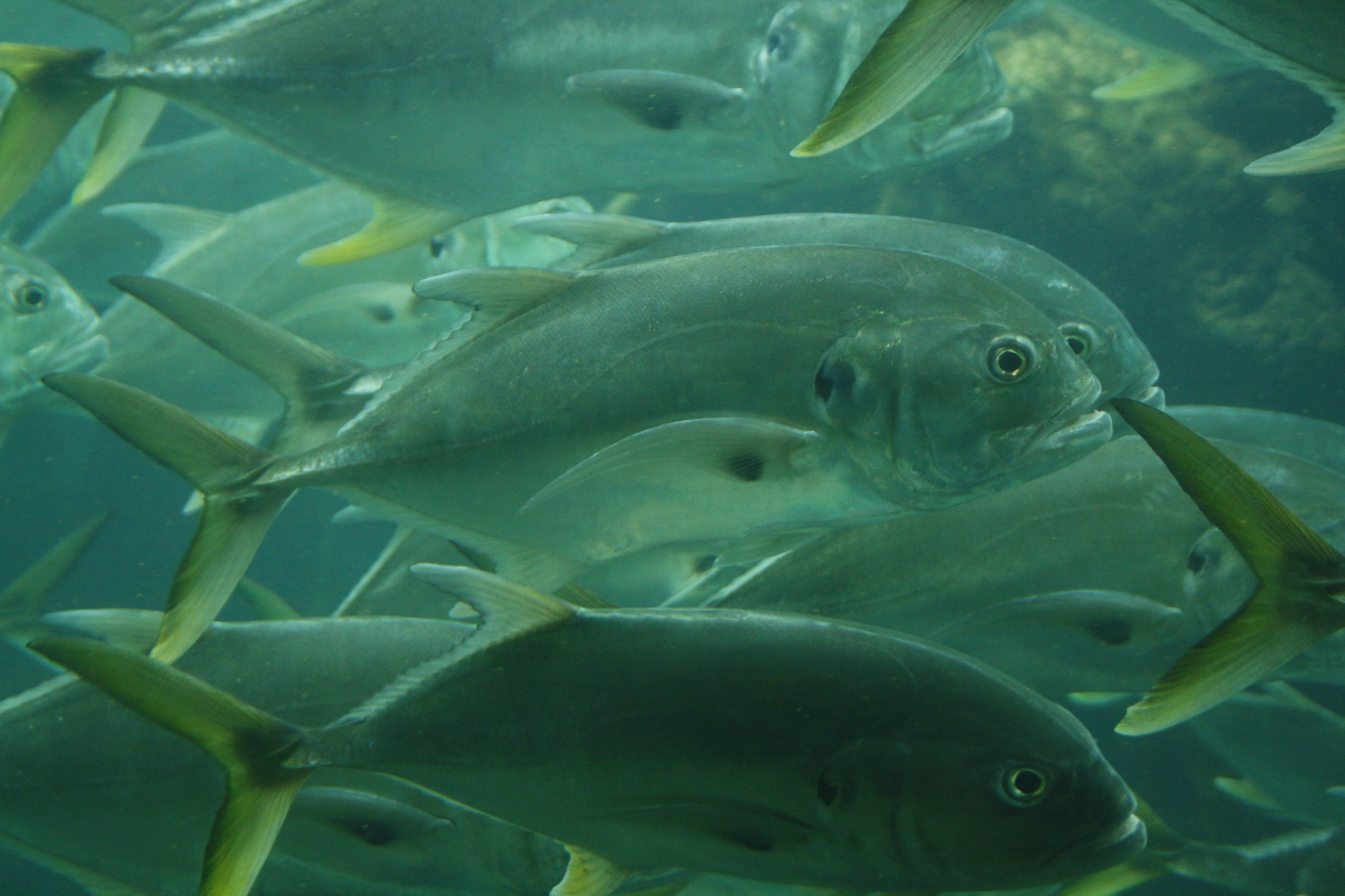
Crevalle jack (Caranx hippos) is a fish of the family Carangidae. FishBase gives its range as: Atlantic Ocean, restricted to continental shelf areas. Mediterranean excluded. It is recorded from 1 to 350 m, in subtropical water. The recorded maxima are 124 cm TL, 32 kg. Diet includes fishes. IUCN status: Least Concern (LC). Chinese name: .
One hundred twenty-nine and seventeen
The IGFA all-tackle world record for the species is 26.5 kg at 114 cm fork length and 129 cm total length, taken in Angola in December 2000. That figure is a record, not a population maximum.
At the other end, a year-long study of Majidun Creek in Lagos caught 59 specimens measuring 7.5–17.3 cm total length and weighing 2.91–72.34 g. That sample tops out at 17.3 cm and 72.34 g, against a 129 cm, 26.5 kg record.
The record fish
The 2007 revision by Smith-Vaniz and Carpenter gives the record details and records 22.7 kg or more for all three species. The record fish therefore sits at the upper end of a family-wide pattern, not at an isolated freak.
A record is a specimen that was caught, measured and accepted. It is not a growth model, and it says nothing about how many adults ever reach that size. The review uses it as a maximum, which is how it should be read.
The database maximum and the common fish
FishBase puts the maximum total length at 124 cm and the common total length at 75 cm; the published maximum weight is 32 kg. The maximum length is shorter than the IGFA record's total length; the maximum weight is heavier than the record's weight. The two “maximums” are not the same fish.
Plan around the 75 cm common length. At 75 cm it is 58 per cent of the 129 cm record; neither source gives a corresponding weight ratio.
Maturity at sixty-six
Length at first maturity is given as 66.0 cm, with the range blank. That places maturity just below the common length of 75 cm, so a fish at the common size is already mature by this measure.
The blank range is a real gap. Without it, a reader cannot tell whether maturity arrives at 60 cm in one stock and 72 cm in another. The single value is a point, not a band, and the page does not supply the band.
The creek sample
The Lagos study is a small-sample, single-creek study: 59 fish, basket traps, gill nets and cast nets, day and night collections through 2010. Length-weight analysis gave a slope of 3.35, positive allometry, and a condition factor of 0.66–1.40.
Salinity in the creek fell to 0.20 in July and August, and the paper reports that temperature, salinity and rainfall all played a role in seasonal abundance. That is a fish using water far fresher than seawater, at a size class far below the common length.
One to three hundred fifty, usually one to two hundred
Depths run from 1 m down to 350 m, usually 1 to 200 m, and describes the species as neritic over the continental shelf, common on shallow flats and present offshore. Adults ascend rivers; juveniles are abundant in brackish estuaries with muddy bottoms, near sandy beaches, on seagrass beds, and in mangroves.
That is a wide physical range held together by a single behaviour: the species follows shallow, often brackish, edge habitat. The 350 m mark belongs to the offshore end and is not where the common fish lives.
Mediterranean excluded, Mediterranean records
FishBase's distribution line reads “Atlantic Ocean, restricted to continental shelf areas. Mediterranean excluded.” GBIF's 100 records nevertheless include European Marine Waters and a Greek exclusive economic zone, alongside the Gulf of Mexico, the Eastern and Western Atlantic, and the North West Atlantic.
The 2007 review explains part of the discrepancy: historical Mediterranean records were based on literature reports, and the review assigns those specimens to C. fischeri, the West African species described in the same paper. The exclusion and the records are both real; they refer to different identifications of the same old reports.
The GBIF file also attaches realm labels that are not marine basins — Afrotropical, Australasian, Nearctic, Neotropical, Oriental, Palaearctic and Pacific Oceania — plus a locality named Cienaga La Virgen. Those are terrestrial or freshwater geographies attached to a marine fish.
They are records, not range extensions. A distribution file that accepts a realm label and a swamp name alongside an ocean basin is telling you something about its ingestion rules, and the practical response is to weigh the marine and estuarine statements more heavily than the realm names.
Gear for the common fish
Rig for the 75 cm fish, not the 129 cm one. A medium spinning rod, a 30–50 lb leader and a whole fish or a large soft plastic will handle the common class and still land an occasional larger fish. The record class needs heavier gear, but a trip built around that class will be aiming at the exception.
Fish the edges the biology describes: shallow flats, estuary mouths with muddy bottom, seagrass and mangrove margins. In the creek study the fish were caught in water that was nearly fresh in the wet season, so the upper end of the estuary is a legitimate target, not a mistake.
Keep the record and the sample in view at the same time. The 129 cm fish proves the ceiling; the 17.3 cm fish proves the floor; the 75 cm common length is the band a plan should be built around.
Where these facts come from
Check these pages before you rely on a size, range or protection status.
- FishBase — Caranx hippos — FishBase · T2
- GBIF — Caranx hippos occurrence records — GBIF · T2
- IUCN Red List — Caranx hippos — IUCN · T1
- Photo record — iNaturalist — iNaturalist · T3
Fish in the same water
These fish live in the same place.

African pompano
- Family
- Carangidae
- Depth
- 60–100 m

Almaco jack
- Family
- Carangidae
- Depth
- 5–245 m

Atlantic horse mackerel
- Family
- Carangidae
- Depth
- 0–1050 m
- Season
- Jan, Feb, Mar, Apr, May, Jun, Jul, Aug, Sep, Oct, Nov, Dec
Guides for this water
Technique, gear and safety guides that fit Crevalle jack.