
Brassy trevally
The brassy trevally is an Indo-Pacific carangid, from Zanzibar, Tanzania and South Africa east to the Caroline and Marquesas islands, north to the Ryukyu Islands and south to Australia. It is recorded as marine, brackish, reef-associated and non-migratory, at 1–50 m, in tropical water from 31°N to 34°S and 26°E to 135°W.
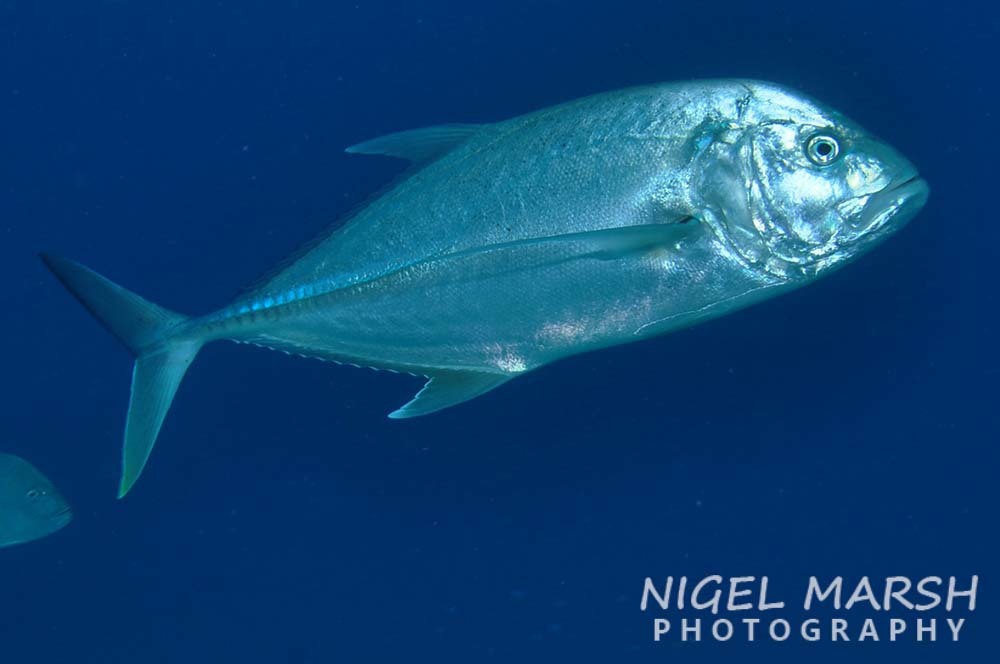
The brassy trevally is an Indo-Pacific carangid, from Zanzibar, Tanzania and South Africa east to the Caroline and Marquesas islands, north to the Ryukyu Islands and south to Australia. It is recorded as marine, brackish, reef-associated and non-migratory, at 1–50 m, in tropical water from 31°N to 34°S and 26°E to 135°W. FishBase gives a maximum of 88 cm total length, a common length of 55 cm fork length, a maximum published weight of 6.4 kg and a maximum reported age of 5 years. IUCN lists it as Least Concern, assessed on 9 March 2015.
Brass body, white shoulder, yellow tail edge
The dorsal fin has 9 spines and 21–23 soft rays; the anal fin has 3 spines and 16–19 soft rays. Colour is the field mark: brassy to yellowish green dorsally, silver on the side with scattered dark spots that become more numerous with age, a conspicuous silvery white spot just behind the upper rear edge of the opercle, a dusky upper caudal lobe and a bright yellow to dusky lower lobe with a narrow white border. The body is oblong and compressed; the breast is scaleless ventrally, usually with a small patch of prepelvic scales; the adipose eyelid is weakly developed. Against other large trevallies, the shoulder spot and the yellow lower tail edge are the practical checks; the dark spots increase with age, so young fish can be nearly clean.
Lagoons, outer reefs and river mouths
FishBase's range is the Indo-Pacific: Zanzibar, Tanzania and South Africa to the Caroline and Marquesas islands, north to the Ryukyu Islands and south to Australia. The country table includes Australia, the Caroline Islands, the Comoros, Fiji, French Polynesia, Guam, India, Indonesia, Japan, Madagascar, the Marquesas, Mauritius, Mayotte, Micronesia, Mozambique, New Caledonia, the Northern Mariana Islands, the Ogasawara Islands, Palau, Papua New Guinea, the Philippines, Réunion, the Ryukyu Islands, Samoa, Seychelles, South Africa, Sri Lanka, Taiwan region, Tanzania, Timor-Leste, Tonga and Vanuatu. Adults live on lagoon and seaward reefs and occasionally enter rivers; juveniles are found in estuaries; they swim high above the bottom, may be solitary or schooled, and adults feed primarily on fishes. GBIF's 1,863 records are led by Australia (600), Japan (323), Mozambique (249), New Caledonia (152), Mayotte (109), Taiwan region (49), French Polynesia (47), South Africa (46), Guam (39) and Fiji (36); iNaturalist has a taxon for the species.
No spawning table
FishBase records no spawning months and no water temperature. The fish is marked tropical and its range spans 31°N to 34°S, so it covers a wide tropical and subtropical band, but the season in any one place still depends on local temperature and fishing reports. The only ecological clues are the habitat split: adults on lagoon and outer reefs, juveniles in estuaries. As with other trevallies, warm water and concentrated baitfish usually mean better bites, but that is genus-level reasoning, not a record, and no months are asserted.
Lures along the reef edge
Shore and boat fishing both work, with lure fishing and trolling as the mainstream methods. Use minnows, pencils, poppers and small metal jigs along lagoon edges and the outer reef; adults eat fish, so profile matters more than colour. Juveniles in estuaries take small soft plastics and micro-minnows retrieved slowly. From a boat, troll along the reef edge a notch faster than you would for bottom species, keeping the lure in the mid-water column; when fish are busting the surface, send the lure past the edge of the school rather than through the middle. Do not rig for the 88 cm record; rig for the 55 cm common length.
Medium tackle is enough
A medium lure rod or shore rod, a 4000–5000 spinning reel, 1.5–2 braid and a 30–40 lb fluorocarbon leader are enough. The fish works reef edges, so the leader must resist abrasion, but it does not pull like a giant trevally and heavy tackle is unnecessary. The 88 cm figure is a maximum and 6.4 kg a maximum published weight; everyday fish are much smaller. No maturity length is recorded, so there is no defensible release size; releasing fish near the maximum and keeping a middle-sized fish is the conservative choice.
Eating and the rules
Recorded uses are minor commercial fisheries, commercial aquaculture and gamefishing. FishBase calls it an excellent food fish; steam, braise or soup it, and bleed, gut and ice promptly. The threat field says harmless and there is no ciguatera report, but large reef-associated trevallies should still follow local advice. In Taiwan region, the Fisheries Agency and local governments manage inshore fishing through closed areas, closed seasons, gear restrictions and minimum sizes, and recreational anglers must follow local notices. Hong Kong SAR's Fisheries Protection Ordinance regulates fishing methods, and marine parks and reserves prohibit angling and collecting. Southeast Asian states differ widely: Malaysia, Indonesia, the Philippines and Thailand each set size and closed-season rules, and core zones of marine protected areas are usually no-take. Check the current local notice.
What the record leaves open
The page uses FishBase taxonomy, morphology, distribution, environment, biology, use and IUCN entries, with the country table for range and GBIF/iNaturalist for occurrence. There are no spawning months, no temperature band and no maturity length, and no estimates are added. is the FishBase Chinese name; , and are local southern-Chinese and Taiwanese labels kept as aliases.
How to catch it
Lure fishing
Fished with the listed approach, matched to the recorded depth and size.
Trolling
Fished with the listed approach, matched to the recorded depth and size.
Where these facts come from
Check these pages before you rely on a size, range or protection status.
- FishBase — Caranx papuensis — FishBase · T2
- GBIF — Caranx papuensis occurrence records — GBIF · T2
- IUCN Red List — Caranx papuensis — IUCN · T1
- Photo record — iNaturalist — iNaturalist · T3
Fish in the same water
These fish live in the same place.

African pompano
- Family
- Carangidae
- Depth
- 60–100 m

Almaco jack
- Family
- Carangidae
- Depth
- 5–245 m

Atlantic horse mackerel
- Family
- Carangidae
- Depth
- 0–1050 m
- Season
- Jan, Feb, Mar, Apr, May, Jun, Jul, Aug, Sep, Oct, Nov, Dec
Guides for this water
Technique, gear and safety guides that fit Brassy trevally.