
Peruvian morwong
Peruvian morwong is a southeast Pacific fish recorded from Paita in Peru to Talcahuano in Chile. It reaches about 44 cm, though that figure is assumed from the genus average rather than measured, matures at about 24.6 cm and has a published weight of 1 kg. No depth band is recorded for it, so the entry rests on range and size more than on fishing detail.

The Peruvian morwong reaches 44 cm, with a 24.6 cm maturity estimate, a 1.0 kg weight record and no published depth. FishBase places it from Paita in Peru to Talcahuano in Chile, and GBIF holds 1,683 records, 1,453 of them Chilean. The page's own biology note flags the maximum size as assumed from the genus average, which makes the 44 cm figure provisional.
44 cm, 1.0 kg, and a size caveat
The maximum length is 44.0 cm TL and the maximum published weight is 1.0 kg. The maturity estimate is 24.6 cm, with no range. No common length and no maximum age are published.
The biology text says: "Maximum size assumed to be as average for the genus; replace with data asap (RF)." That is a direct warning from the page: the 44 cm figure is an assumption as well as a record. The 1.0 kg weight and the 1.174 weight-length ratio are consistent with the 44 cm length, but consistency does not remove the caveat. Treat 44 cm as the current published maximum, not as a verified species limit.
Benthopelagic, subtropical, no depth
The environment line is marine, benthopelagic, subtropical, with coordinates from 5°S to 37°S and 81°W to 70°W. It contains no depth range, no substrate and no temperature. The habitat keyword list is empty.
The latitude span is 32 degrees, from northern Peru to central Chile. A benthopelagic fish with no depth figure can be fished near the bottom or slightly above it, but the page does not assign a band. The substrate field is empty as well, leaving the editorial tags of rocky shore, reef and coastal as the only structural information.
Paita to Talcahuano, with 1,453 Chilean records
FishBase gives the range as the Southeast Pacific, from Paita in Peru to Talcahuano in Chile. GBIF holds 1,683 records: 1,453 from Chile, 193 from Peru, two from Bolivia, one from Brazil and one from Ecuador. iNaturalist has no exact match under the FishBase name.
The Bolivian, Brazilian and Ecuadorian singles sit outside the published range and are treated as record errors until a source says otherwise. The Chilean cluster is 86 percent of the total. The Peruvian share is 11 percent, which is smaller than the range text implies but still a real record set.
A morwong under two genus names
FishBase still files the species under Cheilodactylus variegatus, while WoRMS and the Catalog of Fishes accept Chirodactylus variegatus. iNaturalist and Wikipedia use Chirodactylus variegatus. Wikipedia also notes that the species is traditionally placed in Cheilodactylidae, while FishBase places it in Latridae.
The names are synonyms, not separate fish. They do affect record matching: a search under one genus will miss records filed under the other. The English names are Peruvian morwong and bilagay, also spelled bilagai; the Spanish name pintadilla is also recorded. The FishBase Chinese names are 䱵 and 䱵.
No diet, no spawning, no depth
The biology field contains only the size caveat. There is no diet keyword, no spawning record and no habitat keyword. The only ecological facts are benthopelagic and subtropical.
No prey item and no spawning month is published. The page gives no temperature preference. Bait and timing cannot be derived from the record; they can only be matched to the rocky and reef terrain the page lists.
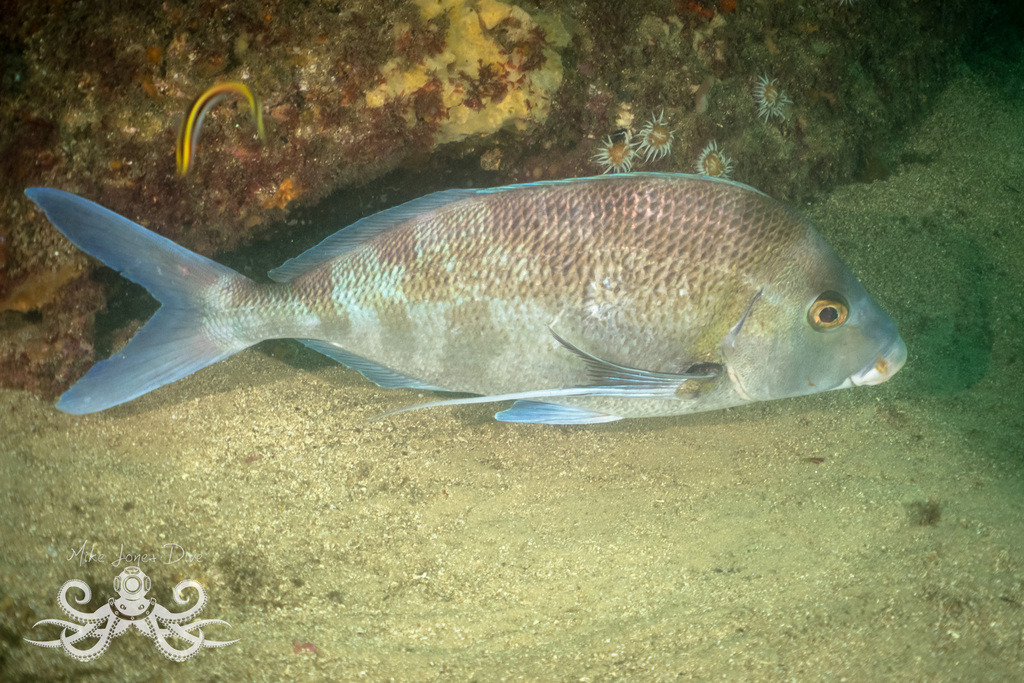
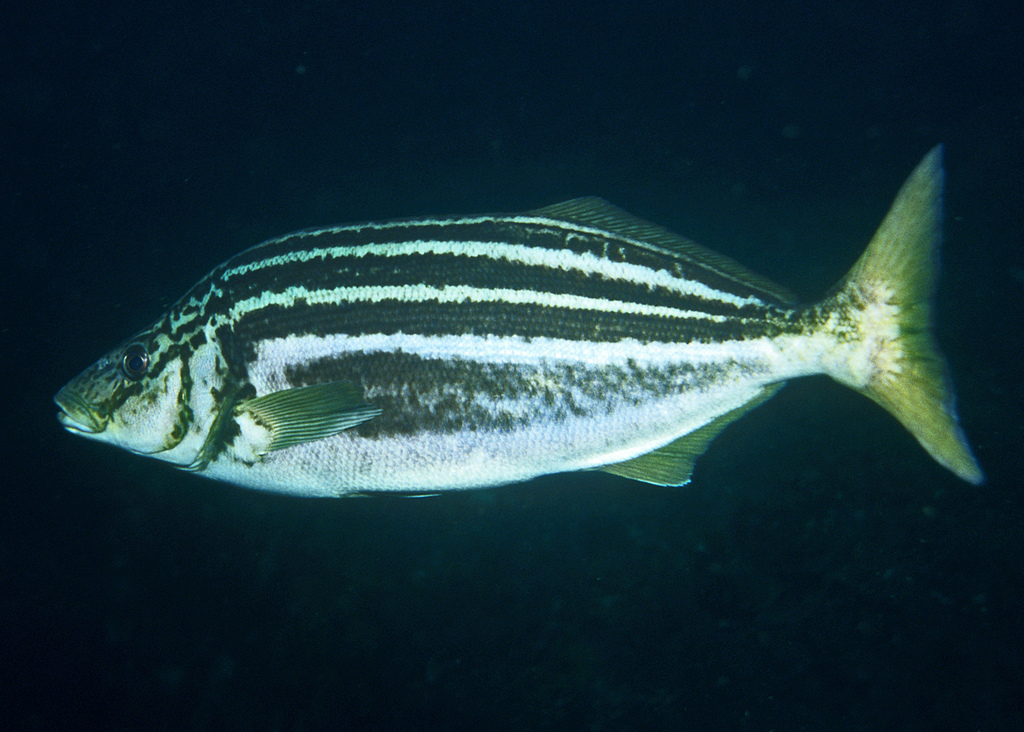
The page does not say which depth, which current or which part of the reef. It also lists no similar species, so the genus, the locality and a photograph carry the identification.
Shore casting and rock fishing are mainstream
Shore casting and rock fishing are both mainstream; boat bottom fishing is secondary. The page attaches no region and no depth band to either method. The terrain tags are rocky shore, reef and coastal. The 24.6 cm maturity estimate is 56 percent of the maximum length and is a biological reference, not a legal release line.
The 44 cm maximum and 1.0 kg weight set the upper tackle scale, while the maturity estimate is 56 percent of that maximum length. The page gives no gear specification, no line class and no bait. On rock and reef, the leader is the part that meets the substrate.
Minor commercial, Not Evaluated
The human-uses field says "Fisheries: minor commercial". The IUCN category is Not Evaluated, and both CITES and CMS are Not Evaluated. The species is harmless to humans.
Not Evaluated means no assessment exists, not that the stock is healthy. The page publishes no landings series and no local abundance figure. The 1,683 GBIF records are occurrence records; the 11 percent Peruvian share and the 86 percent Chilean share describe sampling as much as distribution.
Chilean and Peruvian rules, no numbers
In Chile, SUBPESCA sets the recreational rules and SERNAPESCA enforces them; a recreational licence, daily limits, minimum sizes and closed seasons (veda) apply, and marine protected areas include AMCP-MU sites and Parque/Reserva Marina designations such as Juan Fernández and Nazca-Desventuradas. In Peru, PRODUCE sets the fisheries rules and IMARPE provides the scientific assessment; management relies on minimum sizes, closed seasons and area measures, and SERNANP's Reserva Nacional de Paracas and Reserva Nacional San Fernando do not allow recreational fishing.
No bag limit, minimum size or closed-season date is given here. The species is recorded from both countries, so the rule that applies is the rule of the port. Check the current licence, bag and protected-area map before the trip.
Where these facts come from
Check these pages before you rely on a size, range or protection status.
- FishBase — Chirodactylus variegatus — FishBase · T2
- GBIF — Chirodactylus variegatus occurrence records — GBIF · T2
- IUCN Red List — Chirodactylus variegatus — IUCN · T1
- Photo record — iNaturalist — iNaturalist · T3
Fish in the same water
These fish live in the same place.

Guides for this water
Technique, gear and safety guides that fit Peruvian morwong.