
Sand weakfish
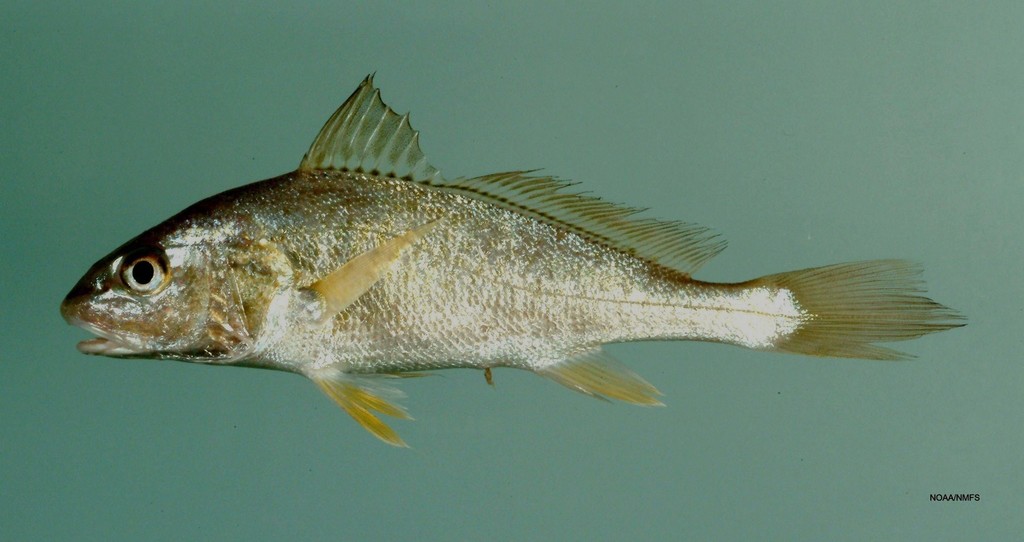
Sand weakfish is a sciaenid of the western Atlantic, from Florida and the Gulf of Mexico to the Bay of Campeche. It lives in subtropical water, reaches 63.5 cm TL and 2.8 kg, can live five years, and feeds on fish.

Sand weakfish (Cynoscion arenarius) is a fish of the family Sciaenidae. FishBase gives its range as: Western Atlantic: Florida, USA and Gulf of Mexico to Bay of Campeche, Mexico. The fin formula is IX–XI dorsal spines with 25–29 soft rays and II anal spines with 10–12 soft rays. It is recorded in subtropical water. The recorded maxima are 63.5 cm TL, 2.8 kg, 5 years. Diet includes fishes. IUCN status: Least Concern (LC). Chinese name: .
Identification
The fish carries a cluster of English names in the three sources: sand seatrout (FishBase's AFS name), sand weakfish (FishBase's FAO name and iNaturalist's preferred name), sand trout, white seatrout, white trout and white weakfish. Wikipedia opens with "sand seatrout, sand weakfish or white trout" and adds that it may be a subspecies of the common weakfish, C. regalis. The batch list gives as the Chinese name; FishBase prints . A label on a list does not identify the fish.
The body is. FishBase gives a 63.5 cm TL maximum, a 35 cm TL common length, 2.8 kg maximum weight, 5 years maximum age and 14 cm length at maturity. The fin formula is IX–XI dorsal spines with 25–29 soft rays and II anal spines with 10–12 soft rays. The mouth is large and oblique with a prominent lower jaw, as in the other Cynoscion; Wikipedia's lead calls it a drum found in the western Atlantic. iNaturalist has 799 observations under taxon 179623. The label problem is not academic: a "white trout" on a market sheet may be this fish or another white-fleshed sciaenid.
Habitat and distribution
FishBase places it in the western Atlantic from Florida and the Gulf of Mexico to the Bay of Campeche, Mexico, with two countries in the table, the United States and Mexico. It is marine and brackish, demersal and subtropical, between 30°N and 18°N and 98°W and 80°W. No depth range is recorded. Habitat keywords are sand, estuary and coast, which is a more useful statement than a missing number: the fish is a soft-bottom coastal and estuarine species, not a reef fish. Wikipedia adds only "western Atlantic Ocean". The 799 iNaturalist records are concentrated where observers are, so they sharpen the picture of the northern Gulf but do not replace a depth range.
Season and fishing approach
No spawning month is recorded in FishBase, and neither of the other sources supplies one. The working facts are the sand/estuary/coastal habitat, the 63.5 cm maximum with a 35 cm common length and the demersal habit. Fish on or near the bottom over sand, in estuaries and along the coast; a bottom rig with a fish bait is the direct translation of the diet keyword "fishes". Because the species tolerates brackish water, an estuary mouth and the lower reaches of a coastal bay are worth trying, but the sources give no salinity split, so the boundary is a local observation. The "white trout" label means the first job is to confirm the species before applying any size rule; the second job is to write down depth, salinity and tide, because the record has no season to copy.
Edibility and regulations
The uses recorded on FishBase are commercial landings and gamefish use; Wikipedia adds the western Atlantic range and the possible subspecies link but no catch or market detail. The Red List entry, dated 14 February 2020, is Least Concern. Only Mexico and the United States appear in the country table, and neither source states a legal minimum, a harvest cap or a closed season for either country; the unresolved question of whether this form is a subspecies of C. regalis means any rule written for weakfish has to be checked against its definition.
Where these facts come from
Check these pages before you rely on a size, range or protection status.
- FishBase — Cynoscion arenarius — FishBase · T2
- GBIF — Cynoscion arenarius occurrence records — GBIF · T2
- IUCN Red List — Cynoscion arenarius — IUCN · T1
- Photo record — iNaturalist — iNaturalist · T3
Fish in the same water
These fish live in the same place.

Acoupa weakfish
- Family
- Sciaenidae
- Depth
- 1–20 m
- Season
- Jan, Feb, Mar, Apr, May, Jun, Jul, Aug, Sep, Oct, Nov, Dec
Atlantic croaker
- Family
- Sciaenidae
- Depth
- ≤ 100 m
- Season
- Jan, Feb, Mar, Apr, May, Jun, Jul, Aug, Sep, Oct, Nov, Dec
Bighead croaker
- Family
- Sciaenidae
- Depth
- ≤ 90 m
- Season
- Jan, Mar, Apr, May, Jun, Jul, Aug, Sep, Oct, Nov, Dec
Guides for this water
Technique, gear and safety guides that fit Sand weakfish.