
Silver seatrout
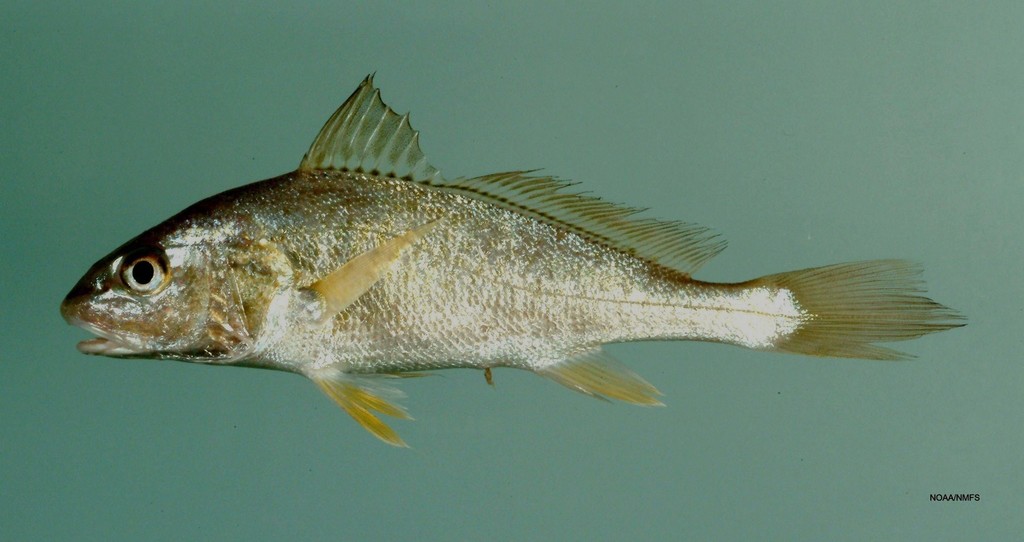
Silver seatrout is a Sciaenidae croaker of shallow Gulf sand from 2 to 18 m, with a maximum of 36 cm and a common length near 25 cm. It feeds on crustaceans and small fish, spawns from May to December, and is caught on light jigs, shrimp and cut bait around passes and beach troughs.

Silver seatrout is a Sciaenidae croaker of shallow Gulf sand from 2 to 18 m, with a maximum of 36 cm and a common length near 25 cm. It feeds on crustaceans and small fish, spawns from May to December, and is caught on light jigs, shrimp and cut bait around passes and beach troughs.
Identification
Silver seatrout is a small, slim croaker with a pale grey-green back, an almost white belly and a soft, slightly translucent look. It is noticeably slimmer through the body than sand seatrout, and it lacks the brassy sheen and dark spots of a speckled trout.
FishBase gives 36 cm total length, a common length of 25 cm and maturity at about 16 cm, with a maximum recorded age near 1.2 years. That short life is the number that matters: the stock turns over quickly and most fish handled are young.
Local names are unreliable. Silver seatrout and sand seatrout are both called white trout, and silver seatrout is also misidentified as Cynoscion regalis. Judge the fish by body depth and head profile, not by what the dock calls it.
Distribution and Habitat
FishBase records the species from Maryland to northeastern Florida and throughout the Gulf of Mexico, with a separate report from the Campeche Bank in Mexico. It is a shallow, sandy-water fish rather than a reef species.
Depth is 2 to 18 m. It sits over sand along beaches, at river mouths and around bay passes, and it tolerates brackish water. The practical result is that it shares the flats, troughs and channel edges that hold sand seatrout, often in slightly clearer or saltier water.
Habits and Diet
The diet is mainly crustaceans and small fishes. Silver seatrout work close to the bottom and pick prey off sand instead of chasing bait high in the water column, so a lure that stays down outperforms one burned across the surface.
They school loosely and become vulnerable when current stacks bait against a pass or a beach trough. Spawning is recorded from May through December, and Texas fish were recorded spawning from May to October off Port Aransas.
Fishing Methods
Light tackle is enough. Cast soft plastics on 1/4 to 1/2 oz heads across sand flats and troughs, or fish live shrimp under a popping cork along a pass on moving water. The strike usually comes on the fall or just after a twitch.
At night, dock lights and bridge lights gather small bait and the seatrout that follow it. A small jerkbait or a live shrimp drifted through the edge of the light works, and wading the surf is productive when the water is clean enough to see the trough.
Gear and Approach
An 8 to 12 lb braid outfit, a 15 to 20 lb leader and a 1/0 to 2/0 light wire hook cover most situations. Keep the drag light, because the mouth is soft and a hard hookset tears out.
Fish the last of the falling tide and the first push of the flood around a pass. Anchor uptide and let baits swing back naturally; a bait dragged against the current looks wrong and is often refused.
Seasonal Window
Late spring through autumn is the reliable window, matching the May to December spawning record. Winter fish move into deeper bay water and the bite slows, though they do not leave the estuary system entirely.
Water clarity matters more than temperature here. A cold front that muddies the beach usually kills the surf bite for several days, while a clean green tide after a calm spell pulls fish back into the troughs.
Edibility and Handling
The flesh is white, mild and flaky, and the fish is a standard Gulf pan fish. It is best fried or cooked whole; small fish are easier to scale and gut than to fillet, and the frame makes good stock.
Bleed and ice quickly, because a 25 cm fish spoils faster than a grouper. Keep them in an ice slurry, clean them the same day, and do not stack warm fish in a bucket.
Regulations and Conservation
Federal waters set no bag or size limit for silver seatrout. The species is not on the federal reef fish table and has no federal seasonal closure.
Florida treats it as an unlisted species, so the default rule applies: 100 lb or 2 fish per person per day, whichever is greater. Louisiana sets no state size or bag limit. Mississippi does not list it; the state's white trout entry refers to sand seatrout (Cynoscion arenarius), not to this species. Alabama sets no species limit, and Texas does not list it either.
The IUCN Red List lists silver seatrout as Least Concern, assessed 15 October 2019. Rules change yearly, so check the current state notice before keeping fish.
How to catch it
Jigging
1/4 1/2
Popping cork
Night light fishing
Where these facts come from
Check these pages before you rely on a size, range or protection status.
- FishBase — Cynoscion nothus — FishBase · T2
- GBIF — Cynoscion nothus occurrence records — GBIF · T2
- IUCN Red List — Cynoscion nothus — IUCN · T1
- Photo record — iNaturalist — iNaturalist · T3
Fish in the same water
These fish live in the same place.

Acoupa weakfish
- Family
- Sciaenidae
- Depth
- 1–20 m
- Season
- Jan, Feb, Mar, Apr, May, Jun, Jul, Aug, Sep, Oct, Nov, Dec
Atlantic croaker
- Family
- Sciaenidae
- Depth
- ≤ 100 m
- Season
- Jan, Feb, Mar, Apr, May, Jun, Jul, Aug, Sep, Oct, Nov, Dec
Bighead croaker
- Family
- Sciaenidae
- Depth
- ≤ 90 m
- Season
- Jan, Mar, Apr, May, Jun, Jul, Aug, Sep, Oct, Nov, Dec
Guides for this water
Technique, gear and safety guides that fit Silver seatrout.