
Gulf weakfish
Gulf weakfish is a sciaenid endemic to the Gulf of California, where it is also called corvina. It lives in subtropical water, reaches 70 cm TL and 2.4 kg, and is listed as Vulnerable. The name splits between Gulf corvina and Gulf weakfish.
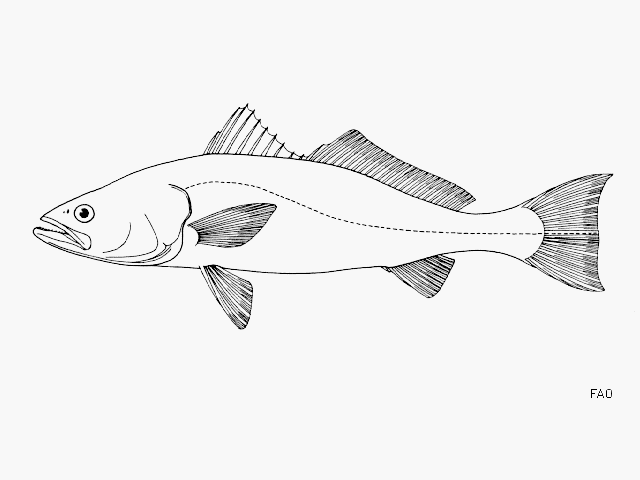
Gulf weakfish (Cynoscion othonopterus) is a fish of the family Sciaenidae. FishBase gives its range as: Eastern Central Pacific: Gulf of California. Dorsal spines number 10–11 and dorsal soft rays 23–27; the anal fin carries two spines and 10–11 soft rays. It is recorded in subtropical water. The recorded maxima are 70 cm TL, 2.4 kg. IUCN status: Vulnerable (VU). Chinese name: .
Identification
FishBase gives a 70 cm TL maximum, a 2.4 kg maximum weight and a 29.5 cm length at maturity, with common length and maximum age absent. Dorsal spines number 10–11 and dorsal soft rays 23–27; the anal fin carries two spines and 10–11 soft rays. The CIBNOR review describes an elongated, relatively slender body, a straight nape profile, a large oblique mouth, a prominent lower jaw, a chin without pores or barbel, sharp teeth in one or two rows and a pair of canine-like teeth at the tip of the upper jaw; the swim bladder has a pair of horn-shaped anterior appendages. Colour is a metallic blue back, silver belly, dark streaks on the upper half, greyish pectoral axils, dark distal fins and yellow pelvic and anal fins. iNaturalist holds 8 observations under taxon 98866. The identification is a large-mouthed, slender Gulf croaker with yellow lower fins, not a generic "corvina"; FishBase's English names split between Gulf corvina and the FAO's Gulf weakfish.
Habitat and distribution
FishBase places it in the eastern central Pacific, Gulf of California, with Mexico as the only country; it is marine and brackish, benthopelagic and subtropical, with habitat keyword coastal and no depth. The CIBNOR review calls it endemic to the Gulf of California, with a preference for sandy, soft bottom in the upper gulf, and describes its reproduction in the brackish channels of the Colorado River delta. It migrates annually from February to May into the Upper Gulf of California and Colorado River Delta Biosphere Reserve to spawn. The review also records that the estuary's salinity has risen from a historical 20–25 to 38–42, which it treats as a stress on reproduction. That is a distribution statement with a date and a condition attached: the fish is not uniformly spread through the gulf, and the northern estuary is a seasonal destination whose water chemistry has changed.
Season and fishing approach
The record's ceiling is 70 cm, the legal minimum in Mexico is 65 cm, and maturity is at 29.5 cm. A 70 cm "record" only 5 cm above the legal minimum is an unusual shape: the fishable window is narrow, and a trophy is barely larger than a keepable fish. Spawning runs February–May, with catches peaking in March and April, and spawning is synchronized with spring tides after the first and third lunar quarters, in two- to three-day windows. The fishery uses gillnets of 14.6 cm mesh and 293 m length, set as an enclosure. For a rod-and-line angler the sources give no method, so the transferable facts are the season, the soft bottom and the estuary channel; treat the first trip as a search for the March–April aggregation, not as a hunt for a 70 cm fish.
Edibility and regulations
Here the regulations are specific rather than absent. The fishery is quota-managed under NOM-063-PESC-2005, with a management plan, a national fisheries chart entry since 2012 and an advisory committee. The minimum catch size is 65 cm, the gillnet specification is fixed at 14.6 cm mesh and 293 m length, and the annual quota is recommended by IMIPAS. On the Red List the species is Vulnerable, assessed 15 October 2019, and iNaturalist carries the same VU flag. The review also records the market: whole eviscerated fish, swim bladder ("buche") and gonad, with the bladder reaching 600 pesos per kg in 2018. The regulatory contrast is the point: a 70 cm record sits only 5 cm above a 65 cm legal floor, so the law, not the record book, defines a keepable fish.
Where these facts come from
Check these pages before you rely on a size, range or protection status.
- FishBase — Cynoscion othonopterus — FishBase · T2
- GBIF — Cynoscion othonopterus occurrence records — GBIF · T2
- IUCN Red List — Cynoscion othonopterus — IUCN · T1
- Photo record — iNaturalist — iNaturalist · T3
Fish in the same water
These fish live in the same place.

Acoupa weakfish
- Family
- Sciaenidae
- Depth
- 1–20 m
- Season
- Jan, Feb, Mar, Apr, May, Jun, Jul, Aug, Sep, Oct, Nov, Dec
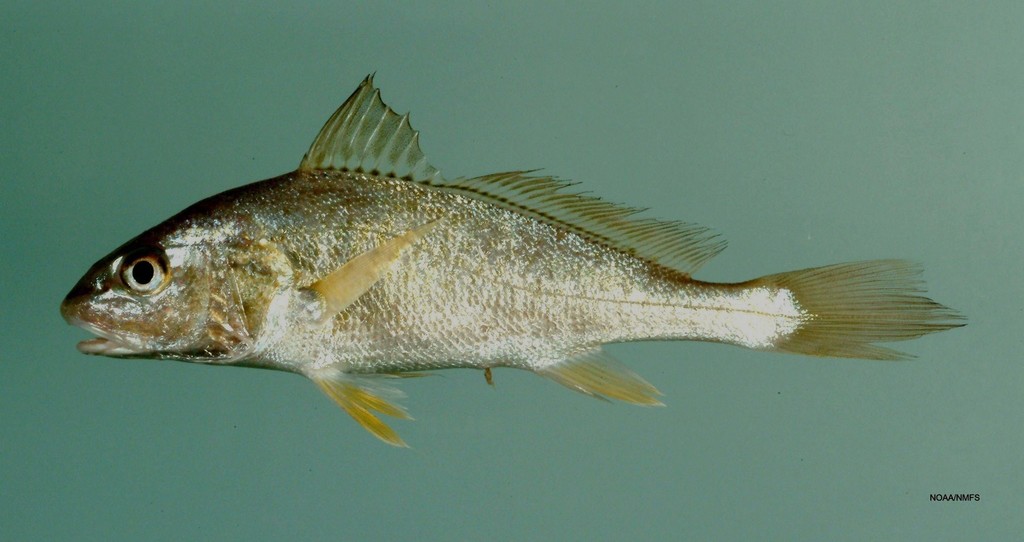
Atlantic croaker
- Family
- Sciaenidae
- Depth
- ≤ 100 m
- Season
- Jan, Feb, Mar, Apr, May, Jun, Jul, Aug, Sep, Oct, Nov, Dec
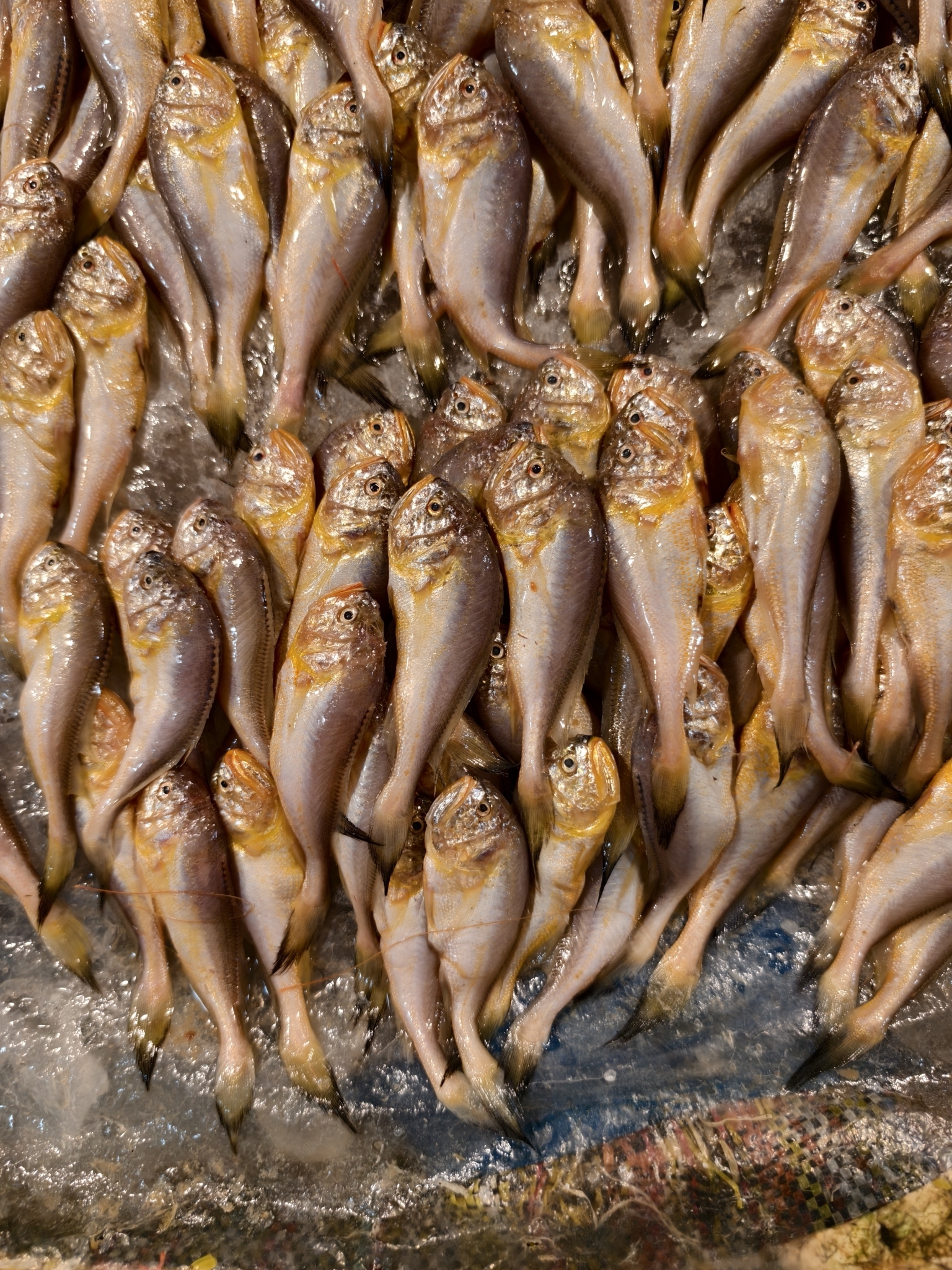
Bighead croaker
- Family
- Sciaenidae
- Depth
- ≤ 90 m
- Season
- Jan, Mar, Apr, May, Jun, Jul, Aug, Sep, Oct, Nov, Dec
Guides for this water
Technique, gear and safety guides that fit Gulf weakfish.