
Opalescent inshore squid
This animal has no single name that travels. On a California dock it is market squid; in a catalogue it is the opalescent inshore squid; the federal agency that regulates the fishery titles its page California market squid; and in Chinese it is . The names matter because each one opens a different shelf of documents, and only one shelf holds the rules that decide whether you may fish tonight.
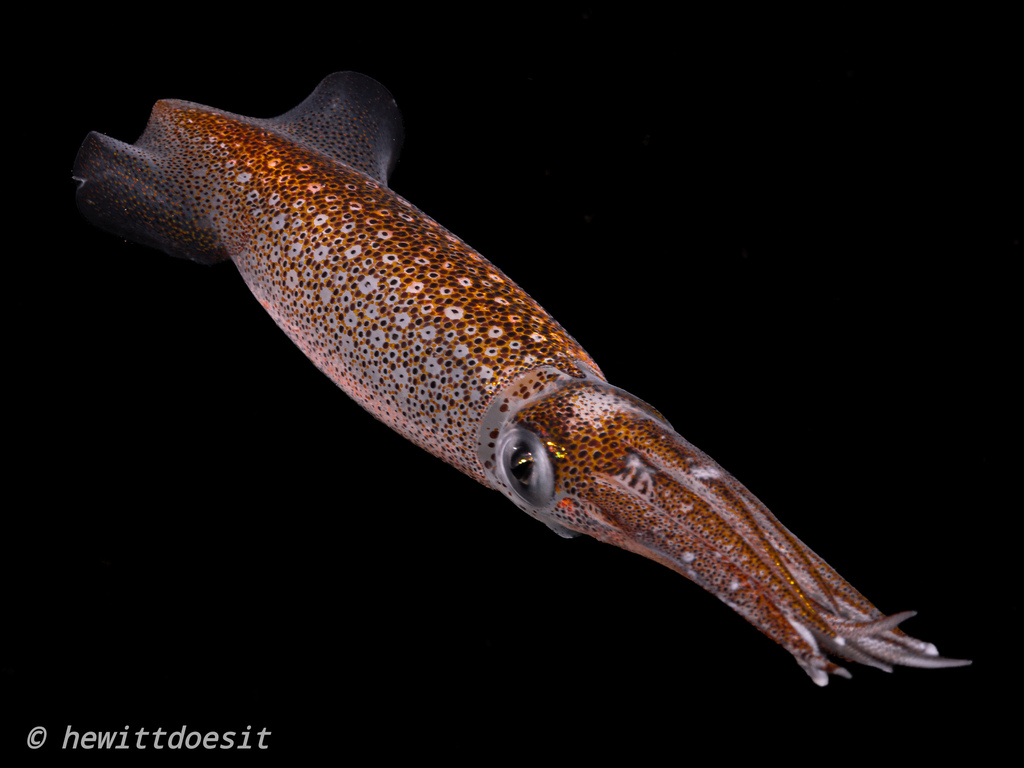
This animal has no single name that travels. On a California dock it is market squid; in a catalogue it is the opalescent inshore squid; the federal agency that regulates the fishery titles its page California market squid; and in Chinese it is . The names matter because each one opens a different shelf of documents, and only one shelf holds the rules that decide whether you may fish tonight.
The names do different jobs
The catalogue name answers who the animal is. The trade name answers what it is sold as. In this case they are not the same word: a database entry under the opalescent inshore squid will not be found by someone typing "market squid", and the reverse is equally true.
That is not a bibliographic curiosity. It is the first practical obstacle in front of anyone trying to work out what is legal. Search the wrong name and you find a species account, not a regulation. Search the right one and the closure dates appear.
The name the rulebook uses
NOAA's page for the species is headed California market squid, and it is the page that carries the management summary. The state plan that governs the fishery, the landing records and the closures are all filed under that trade name. If you want to know the rules for tonight, "market squid" is the string that finds them.
This is worth stating plainly because the opposite is intuitive. Scientists name animals; agencies regulate fisheries; the two vocabularies only partly overlap, and the overlap is where the useful documents live.
The name the catalogue prefers
Opalescent inshore squid is the standard English name in the reference lists, and it appears in the FAO and AFS columns of the common-name table rather than in the trade columns. A reader looking up the species in a museum checklist or a regional fauna will meet that name and not the other.
The consequence is symmetrical: the two literatures barely cross-reference each other. Fishery reports say market squid and describe landings; taxonomic accounts say opalescent inshore squid and describe fin proportions. Neither is wrong, and neither contains everything.
No Chinese name to look under
The Chinese-language record for this species is empty; the name falls back to the Latin binomial because no accepted Chinese name was found. That changes what a Chinese-speaking buyer or angler can search. There is no standard string that leads to this animal's regulations, and the generic words used on menus and in markets describe a category rather than a species.
The workaround is to search in English under the trade name, then read the rule. For a fisher, the name on the licence and the name on the boat are what matter, and both are in English.
Small, shallow, and over sand
The species is pelagic in habit, recorded from 15 metres down to 1000, and small: 19.2 centimetres mantle length for males, 17.9 for females, with a maximum published weight of 148 grams. A squid that size is not a trophy animal; the fishing is about numbers, not about one big individual.
The measurement is mantle length rather than total length, so the figure describes the body without the arms and tentacles. An animal that looks longer than 19 centimetres on the deck is not necessarily a larger squid; it may be an ordinary one with its arms extended. Where a rule is written in mantle length, measure the mantle and ignore the rest.
The commercial fishery works nearshore water over sandy bottom, at night, using lights to bring the animals up. That description is the whole tactical map for a recreational angler: sand, shallow, dark, and a light.
A weekend is closed
The fishery is closed from Friday noon until Sunday noon so that spawning runs uninterrupted. For anyone who fishes on weekends, that is the single most consequential line on this page: Saturday is not available, and neither is Friday afternoon.
The season also splits by headland. North of Point Conception, mainly around Monterey Bay, the fishery operates from April through September; south of it, the active period runs October through March. The same animal, two calendars, decided by where the boat is.
Nine months of spawning
Spawning is recorded in every month from January to August and again in November. A population that spawns across most of the year is why the closure is written as a weekly pause rather than as a seasonal ban: there is no single month to protect, so the rule protects the rhythm instead.
That also explains the two calendars. The northern and southern fisheries are timed to the spawning concentrations on their own stretch of coast, and the weekend gap sits on top of both.
Where the records sit
The occurrence records held for this species are overwhelmingly American, with California accounting for most of the remainder: of 6 195 records, 4 005 are from the United States and 2 111 from California, with a handful from Mexico. The pattern follows the fleet and the observers rather than the full range, which the catalogue extends from 62°N to 26°N along the eastern Pacific.
iNaturalist adds the diver's view: 2 829 observations, mostly inshore, often of animals on egg beds. That is a good way to learn what a spawning concentration looks like and a poor way to estimate how many squid there are.
Where these facts come from
Check these pages before you rely on a size, range or protection status.
- FishBase — Doryteuthis opalescens — FishBase · T2
- GBIF — Doryteuthis opalescens occurrence records — GBIF · T2
- IUCN Red List — Doryteuthis opalescens — IUCN · T1
- Photo record — iNaturalist — iNaturalist · T3
Fish in the same water
These fish live in the same place.
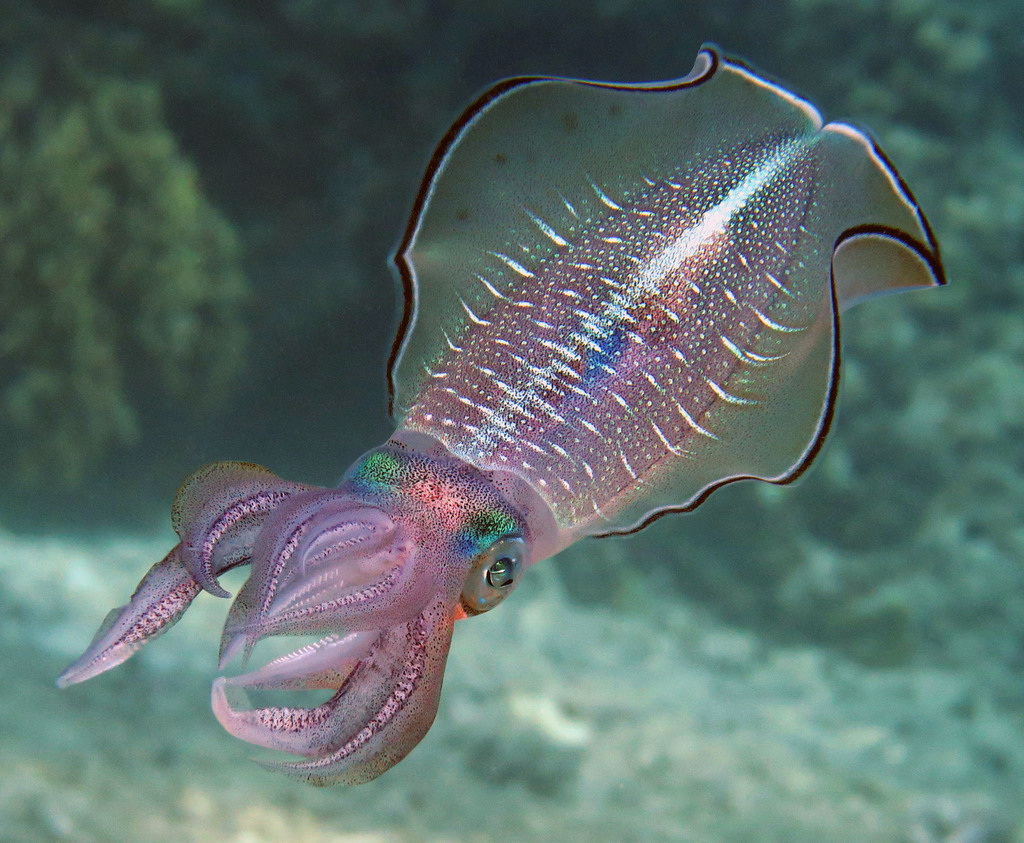
Bigfin reef squid
- Family
- Loliginidae
- Depth
- 0–100 m

European squid
- Family
- Loliginidae
- Depth
- 0–500 m
- Season
- Jan, Feb, Mar, Apr, Jun, Jul, Aug, Sep, Oct, Nov, Dec

Longfin inshore squid
- Family
- Loliginidae
- Depth
- 0–400 m
Guides for this water
Technique, gear and safety guides that fit Opalescent inshore squid.