
Bigfin reef squid
Bigfin reef squid is an inshore squid of the Indo-Pacific, from Japan and Australia to New Zealand, Hawaii and the East African coast. It lives from the surface to 100 m in tropical water, reaches 40.1 cm mantle length, and feeds on fish and algae. Eging, boat fishing or handline is the usual approach.
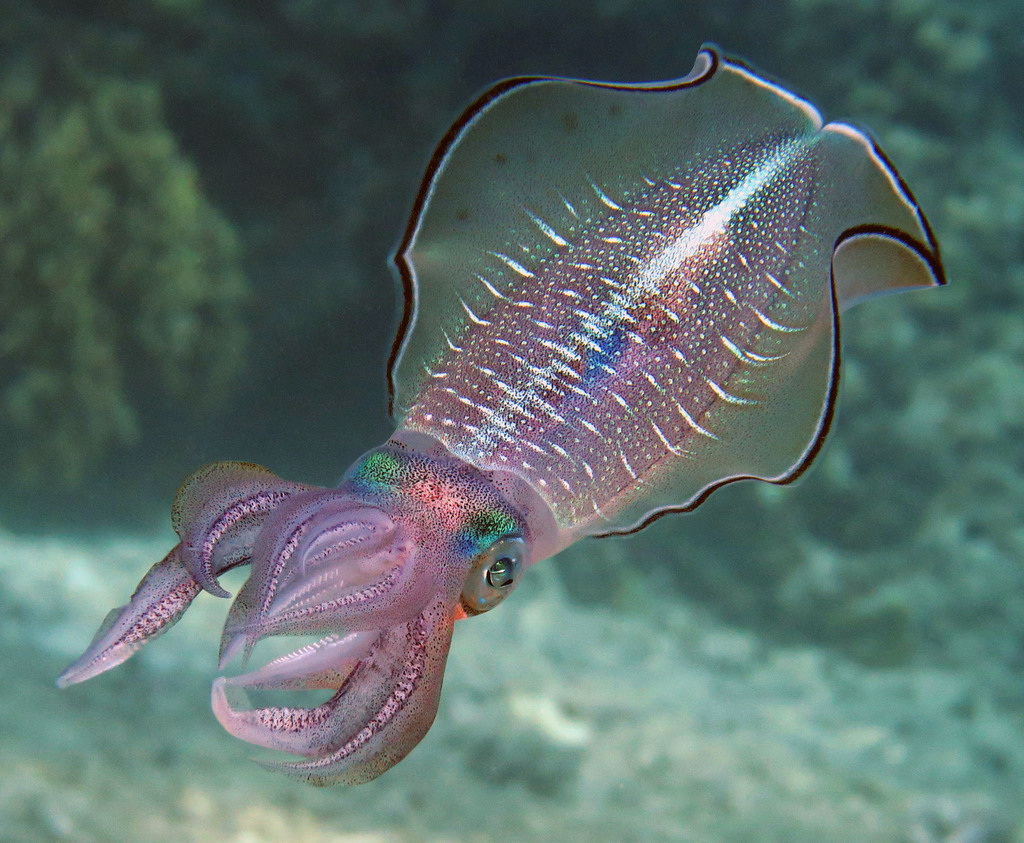
Bigfin reef squid (Sepioteuthis lessoniana) is a cephalopod of the family Loliginidae. SeaLifeBase gives its range as: Indo-Pacific: from Japan to Australia and New Zealand coasts, from Hawaii to the East African coast, north to Red Sea and south to Madagascar. Introduced in the Mediterranean Sea. It is recorded from 0 to 100 m, in tropical water. The recorded maxima are 40.1 cm ML, 0.0018 kg. Diet includes fishes and algae. IUCN status: Data Deficient (DD). Chinese name: アオリイカ .
The pair that cannot both be right
The page gives both figures in the same block: 40.1 cm ML in the male/unsexed column, and 1.80 g as the maximum published weight. Divide the weight by the length and you get 0.045 g per centimetre of mantle. Even without knowing the girth of a squid, that ratio is far below any plausible body: a 40 cm cylinder of seawater weighs tens of grams at a cross-section of a single square centimetre. The pair is internally inconsistent, and the source offers no second weight to rescue it.
That does not mean the page is worthless. It means one of the two entries is not a measurement of the same body, or not in the unit the reader assumes. It could be a juvenile record reused as a maximum, a transcription error, or a weight recorded in a different unit and converted twice. Which of those happened is not stated. What it does say is "max. published weight: 1.80 g (Ref. 275)". Report it as a recorded value, not as the weight of a 40 cm squid.
What 1.80 g would actually mean
A 1.80 g squid is a post-larval or very young juvenile. It is not a maximum for a species that reaches 40.1 cm ML. If you accept 1.80 g as a real measurement, the only consistent reading is that the weighed animal was tiny and that the figure should never have been placed in a "maximum" slot beside a 40 cm length.
The practical consequence is simple: do not build tackle, bait size or expectations around 1.80 g. Do not write "average weight 1.8 g" in a log. If you catch a bigfin reef squid, weigh it and write down your own number; the source does not supply a usable weight profile to compare against.
Mantle length is a body axis, not a total length
The 40.1 cm is ML, mantle length. It runs from the tip of the mantle to its posterior end and excludes the arms and tentacles. A fish's total length (TL) is a different axis, and so is a squid figure measured from tail fin to arm tips. A 40 cm ML loliginid is a substantial animal; a 40 cm TL fish is a different shape entirely.
This matters whenever the page is compared with another page. Put a 40.1 cm ML squid beside a 40 cm TL fish and the two are not equivalent. If a regional guide quotes total length, the number will be larger than the mantle figure for the same animal. Mixing the two axes is how a measurement problem turns into a false comparison.
No common length, no maturity
The same block gives "Maturity: Lm ? range ? - ? cm" and leaves the common length empty. Those blanks are not zeros. They mean the page has no maturity length and no typical length to offer. You cannot derive a harvest slot, a minimum size or a "normal" catch from this record.
The correct treatment is to leave the blanks visible. A reader who needs a local minimum size must get it from a local regulation, not from an empty field. Filling the gap with "about 20 cm" would turn a missing value into a false fact, and the 40.1 cm maximum would then be read as the top of a range that was never published.
The 0–100 m band and the brackish label
The habitat block describes a demersal animal in brackish water, depth 0–100 m, tropical climate. The 0 is a surface record and the 100 is a maximum; the page gives no usual band. So the line is a search envelope, not a fishing depth. It tells you the species has been recorded from the surface down to 100 m, not that every metre in between is equally productive.
The brackish flag is also a label rather than a salinity measurement. The distribution text describes an Indo-Pacific coastal range from Japan to Australia and New Zealand, with introductions in the Mediterranean. A coastal squid can enter brackish water without being an estuarine specialist. Treat "brackish" as one recorded condition, not as the species' home.
A species complex complicates "the species"
The Wikipedia extract says the bigfin reef squid is a species complex, and that studies in 1993 indicated it may comprise several cryptic species that are very similar and closely related. That is directly relevant to a measurement problem. If the name covers more than one lineage, a length or weight attached to the name may come from different populations, and a single anomalous weight is even less likely to describe "the" animal.
It also changes how to read the field guides. Two guides can disagree about size without either being wrong, because they may be describing different members of the complex. The honest position is to keep the name with "complex" attached when the provenance is unclear, and to avoid treating one figure as the species-wide truth.
Data Deficient, one distribution record
IUCN listed it as Data Deficient in July 2014. GBIF's distribution table holds exactly one record for the accepted taxon: Libya, flagged as introduced, taken from the Global Register of Introduced and Invasive Species. That is the whole table. The native Indo-Pacific range does not appear in it at all. iNaturalist carries 2,968 observations, evidence of yet another kind.
One introduced-country record is a useful warning about databases. A distribution table is not a range map; it is a list of what one contributing source happened to submit. Nothing in that single record says the species is absent from Japan or Australia, and nothing in it says Libya holds the only population. Do not turn one row into a distribution statement, and do not turn DD into a warning label.
What to write on your own catch
Record mantle length from the tip of the mantle to its posterior end, not from the arm tips; record whole-body weight after draining; note the date, the habitat and the depth. Keep your numbers separate from the source's 1.80 g entry, because that entry is the one value on the page that cannot be used as a target. If you are working in the Mediterranean, note that the species is introduced there, and check the local rules before keeping catch.
The page's most useful contribution is not its size profile. It is the combination of a 40.1 cm mantle, a 0–100 m envelope and a species-complex warning. Used together, they say: this is a small-to-medium loliginid whose name covers more than one form, and the published weight beside it is a record to question, not a number to match.
How to catch it
Eging
Egi (squid jig) fishing, a Japanese-style approach.
Boat fishing
Fished from a boat, with the approach adjusted to the recorded depth.
Handline
Handline fished vertically; simple and direct.
Where these facts come from
Check these pages before you rely on a size, range or protection status.
- FishBase — Sepioteuthis lessoniana — FishBase · T2
- GBIF — Sepioteuthis lessoniana occurrence records — GBIF · T2
- IUCN Red List — Sepioteuthis lessoniana — IUCN · T1
- Photo record — iNaturalist — iNaturalist · T3
Fish in the same water
These fish live in the same place.

European squid
- Family
- Loliginidae
- Depth
- 0–500 m
- Season
- Jan, Feb, Mar, Apr, Jun, Jul, Aug, Sep, Oct, Nov, Dec

Longfin inshore squid
- Family
- Loliginidae
- Depth
- 0–400 m
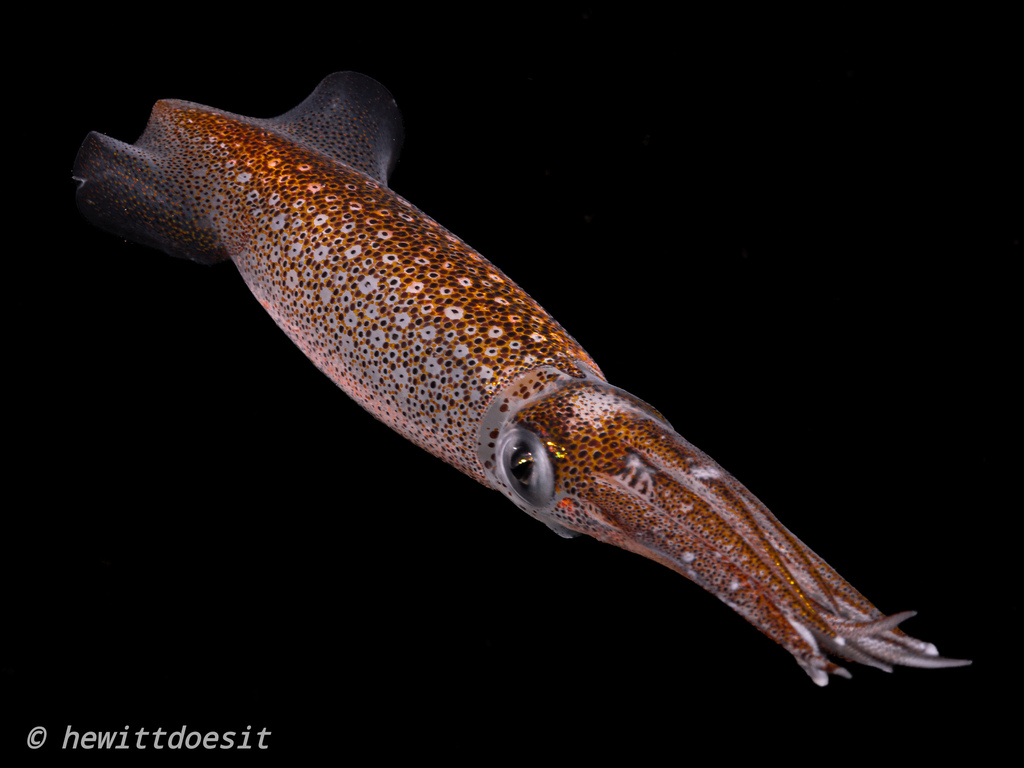
Opalescent inshore squid
- Family
- Loliginidae
- Depth
- 15–1000 m
- Season
- Jan, Feb, Mar, Apr, May, Jun, Jul, Aug, Nov
Guides for this water
Technique, gear and safety guides that fit Bigfin reef squid.