
Rainbow runner
Rainbow runner is a Carangidae jack of oceanic and coastal surface water from 0 to 150 m, usually 2 to 10 m, reaching 180 cm and a common 90 cm. It feeds on zooplankton crustaceans and small fish, schools around floating debris, and is taken on small jigs, poppers and trolled lures.
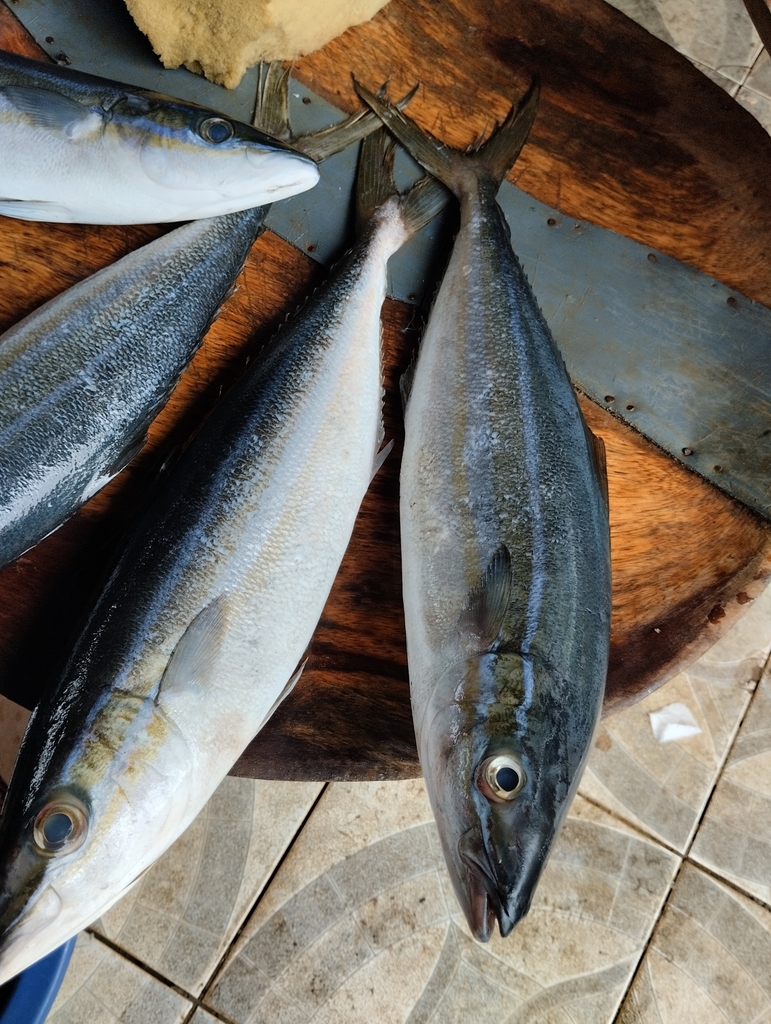
Rainbow runner is a Carangidae jack of oceanic and coastal surface water from 0 to 150 m, usually 2 to 10 m, reaching 180 cm and a common 90 cm. It feeds on zooplankton crustaceans and small fish, schools around floating debris, and is taken on small jigs, poppers and trolled lures.
Identification
Rainbow runner is a fusiform, compressed jack with a blue-green back and two narrow blue stripes running along the flank. The tail is distinctly yellow, and the head is small and pointed compared with an amberjack.
FishBase gives 25 to 30 soft dorsal rays and 2 anal spines with 18 to 22 soft rays, a fin formula that fits the slender body. Maximum length is 180 cm, common length 90 cm, maturity about 65 cm and maximum age 6 years.
The two stripes and yellow tail separate it from lesser amberjack and banded rudderfish at a glance. A big runner is long and torpedo-shaped; an amberjack of the same weight is deeper through the shoulder.
Distribution and Habitat
In the western Atlantic the species runs from Massachusetts and the northern Gulf of Mexico to Rio de Janeiro, and it is also widespread across the Indo-Pacific. It is a warm-water fish that appears in the Gulf when the surface layer warms.
Depth is 0 to 150 m but usually 2 to 10 m. Adults hold in oceanic and coastal surface water, often near reefs, and they gather around floating logs, weed and other debris. Large schools are common.
Habits and Diet
Rainbow runners feed on invertebrates, mainly larger zooplankton crustaceans, and on small fishes. They are fast, mid-water hunters rather than bottom feeders, and a bait presented at the surface gets more attention than one on the bottom.
Spawning is recorded from January to June in Brazilian waters, so the Gulf spawning window is not well defined in the fact base. FishBase lists a maximum age of 6 years, which makes this a fast-growing, short-lived pelagic species.
Floating structure is the practical key. Weed lines, logs, pallets and current seams concentrate bait, and the runners are rarely far behind.
Fishing Methods
Cast small metal jigs or poppers at the edge of flotsam and retrieve fast. The strike often comes within the first few turns, and a follower that refuses a fast lure will usually take one that is ripped away and paused.
Light trolling at 6 to 8 knots with a small feather or soft lure works along current seams and weed lines. Live bait drifted near the surface also produces, especially when the fish are schooled but not feeding aggressively.
Gear and Approach
A 7 ft fast rod with a 4000 to 6000 size reel, 20 to 30 lb braid and a 30 to 40 lb leader handles most runners. The mouth is small and the teeth are not heavy, so wire is unnecessary and cuts bites.
Set the drag before the first run, because a 90 cm runner leaves fast and jumps. Keep the rod loaded and pump rather than winding against a screaming drag; most lost fish are cut on the boat or lost to slack.
Seasonal Window
Warm months are the window, and the fish follow warm surface water and flotsam rather than a fixed calendar. In the Gulf they are most reliable from late spring through autumn.
Calm, blue water with visible weed lines is the best condition. Wind breaks up the surface structure and scatters the debris that holds fish, so a flat day after a calm night is worth more than a hot day with chop.
Edibility and Handling
Rainbow runner is a good food fish with firm, pale flesh that works well raw, grilled or seared. FishBase notes it is marketed fresh, salted, dried and frozen and used for sashimi.
Bleed it immediately and put it in an ice slurry; the flesh is lean and turns soft quickly if the fish is left on deck. Large individuals carry a ciguatera risk, so keep smaller fish and release the big ones.
There is no reported threat other than ciguatera, and the species is not a bottom fish, so barotrauma is rarely an issue on release.
Regulations and Conservation
Federal waters set no bag or size limit for rainbow runner, and it is not on the federal reef fish table. There is no federal seasonal closure for the species.
Florida treats it as an unlisted species, so the default rule applies: 100 lb or 2 fish per person per day, whichever is greater. Louisiana does not list it. Mississippi does not list it. Alabama sets no species limit, and Texas does not list it either.
The IUCN Red List lists rainbow runner as Least Concern, assessed 21 August 2012. Rules change yearly, so confirm the current state notice before keeping fish.
How to catch it
Lure fishing
Trolling
6 8
Drift fishing
Where these facts come from
Check these pages before you rely on a size, range or protection status.
- FishBase — Elagatis bipinnulata — FishBase · T2
- GBIF — Elagatis bipinnulata occurrence records — GBIF · T2
- IUCN Red List — Elagatis bipinnulata — IUCN · T1
- Photo record — iNaturalist — iNaturalist · T3
Fish in the same water
These fish live in the same place.

African pompano
- Family
- Carangidae
- Depth
- 60–100 m

Almaco jack
- Family
- Carangidae
- Depth
- 5–245 m

Atlantic horse mackerel
- Family
- Carangidae
- Depth
- 0–1050 m
- Season
- Jan, Feb, Mar, Apr, May, Jun, Jul, Aug, Sep, Oct, Nov, Dec
Guides for this water
Technique, gear and safety guides that fit Rainbow runner.