
Atlantic goliath grouper
Goliath grouper is the one fish here where the first decision is legal, not tactical. It reaches 250 cm and 455 kg, matures at 128 cm, and US law allows a catch of zero, so a hooked fish is one to release unharmed rather than one to land. Heavy tackle, a harness and hands kept away from the gills are safety requirements; where it is protected, the aim is not to hook one at all.
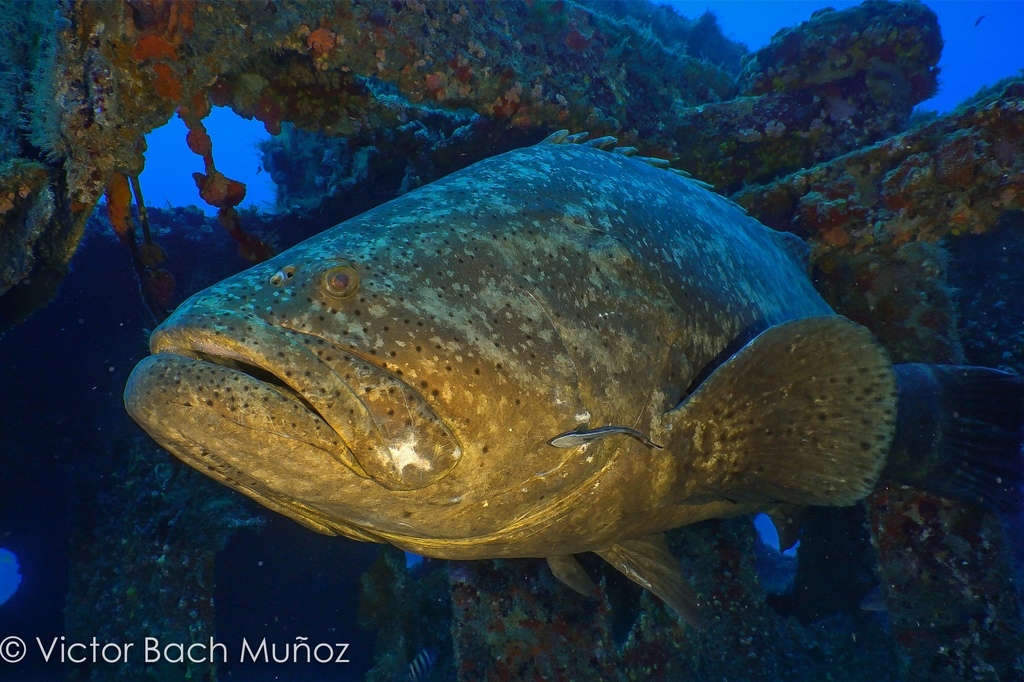
Goliath grouper is the one fish here where the first decision is legal, not tactical. It reaches 250 cm and 455 kg, matures at 128 cm, and US law allows a catch of zero, so a hooked fish is one to release unharmed rather than one to land. Heavy tackle, a harness and hands kept away from the gills are safety requirements; where it is protected, the aim is not to hook one at all.
Identification
The depth band for this fish starts at zero metres. That is unusual for a grouper: it means the species can be in water you could stand in, and it explains why a 250 cm fish is discussed in the same sentence as river mouths and coastal flats. The record tops out at 250 cm and 455 kg; the common length is 150 cm, and the oldest fish reported reached 37 years.
The record puts the spawning threshold at 128 cm. That is a release rule, not a growth table: anything below 128 cm goes back, and 128 cm is already a fish larger than most anglers will ever see. The spawning stock is not the small end of the population; it is the part that most fishing never touches.
Its dorsal fin carries 15 or 16 soft rays behind the spines, and the anal fin is short: three spines and eight soft rays. The current English name is goliath grouper, with Atlantic goliath grouper as the FAO form and jewfish as the older vernacular. The old name still appears in older regulations and older catch photos, which is one reason a search for the species has to try both.
Habitat and behaviour
The environment line is brackish and reef-associated, 0 to 100 m, usually to about 46 m. The habitat words are reef, rocky, muddy, estuary, coastal and cave. Read as a depth band, the shallow end is not a beach: it is structure that reaches the surface — river mouths, coastal flats, rocky shore, caves — and the deep end is a different set of marks. The band is occupied differently at different points, which is why a flat chart with one depth contour tells you almost nothing about where to fish.
Crabs and fish form the prey base. That fits an ambush predator that takes large prey near structure. The 46 m usual limit also defines the practical band: most encounters happen in water a boat can work with ordinary gear, and the 100 m maximum is the exception rather than the target.
Seasonal window
The record carries two spawning windows in two places: January and February in Ceará, Brazil, and June to September in the eastern Gulf of Mexico. They are two populations on two calendars, not one event measured twice. In each place, the aggregation is the vulnerable moment, and the window is the period when a taken fish is lost to the breeding stock.
Because the two windows are in different hemispheres, a single "grouper season" does not exist across the range. The useful rule is local: find out which window applies to the coast you are fishing, and treat the aggregation as a place to leave alone rather than a place to fish.
Gear and approach
A 455 kg ceiling and a 150 cm common length put this in a class of its own. Heavy conventional tackle, a harness, and a drag that can be locked are the minimum; a rod that can pull a hooked fish clear of the bottom in 40 m is not the same rod that casts a bait to a mangrove edge. The species is listed as traumatogenic, which is a polite way of saying a big one can injure you: do not put hands near the gill plates, do not lift a large fish aboard, and do not let a hooked fish thrash inside the boat.
Circle hooks, heavy leader, and a plan for releasing at the rail or in the water belong in the kit. Because the fish can be very large, the release should be decided before the hook-up: measure, photograph, and cut free without exhausting the animal.
Edibility and regulations
NOAA Fisheries records that harvest of goliath grouper has been closed in federal waters of the southeastern United States since 1990, and in the US Caribbean since 1993, and that the closure has been maintained by the regional councils. Florida state waters allow a limited harvest. That is the jurisdiction line that matters: the same fish is protected in federal water and takeable under a state rule, so the answer depends on which side of the boundary the boat is on.
Assessed 20 November 2016, its Red List category is Vulnerable. Minor commercial fishing and gamefishing are the uses named. The range sentence also contains a name trap: the Eastern Pacific population is a different species, Epinephelus quinquefasciatus, and the western Atlantic populations are described as discrete. A regulation written for "goliath grouper" in the Pacific is not a regulation for this fish.
Where to look
The GBIF distributions endpoint returns 87 records for the taxon, including Eastern and Western Atlantic declarations, a Bahia Solano mangrove record from Colombia, Afrotropical, Nearctic, Neotropical and Palaearctic regions, and an East Pacific record. That East Pacific entry is the name problem in map form: the written range assigns the Pacific fish to E. quinquefasciatus. The rest of the range is Florida to southern Brazil, including the Gulf of Mexico and the Caribbean, plus Senegal to Congo in the eastern Atlantic and a rare Canary Islands record. iNaturalist holds 794 observations under taxon 100110.
Look in the shallower part of the 0–46 m band, on structure that reaches shallow water: river mouths, mangrove edges, rocky shore, caves. Then check the jurisdiction before you plan to keep anything.
The band in practice
The depth band is the whole article in one line: zero to 100 m, usually to 46. The shallow end explains the estuary and coastal habitat words and the shore access; the deep end explains the cave and reef marks and the boat work. The two spawning windows sit at opposite ends of the calendar, and the two jurisdictions sit on opposite sides of a boundary. A 128 cm maturity line tells you that the fish worth protecting is the large one, and the 455 kg ceiling tells you why that large fish is also the dangerous one. Read the band, then read the rule, then decide whether the trip is a release or a take.
Where these facts come from
Check these pages before you rely on a size, range or protection status.
- FishBase — Epinephelus itajara — FishBase · T2
- GBIF — Epinephelus itajara occurrence records — GBIF · T2
- IUCN Red List — Epinephelus itajara — IUCN · T1
- Photo record — iNaturalist — iNaturalist · T3
Fish in the same water
These fish live in the same place.
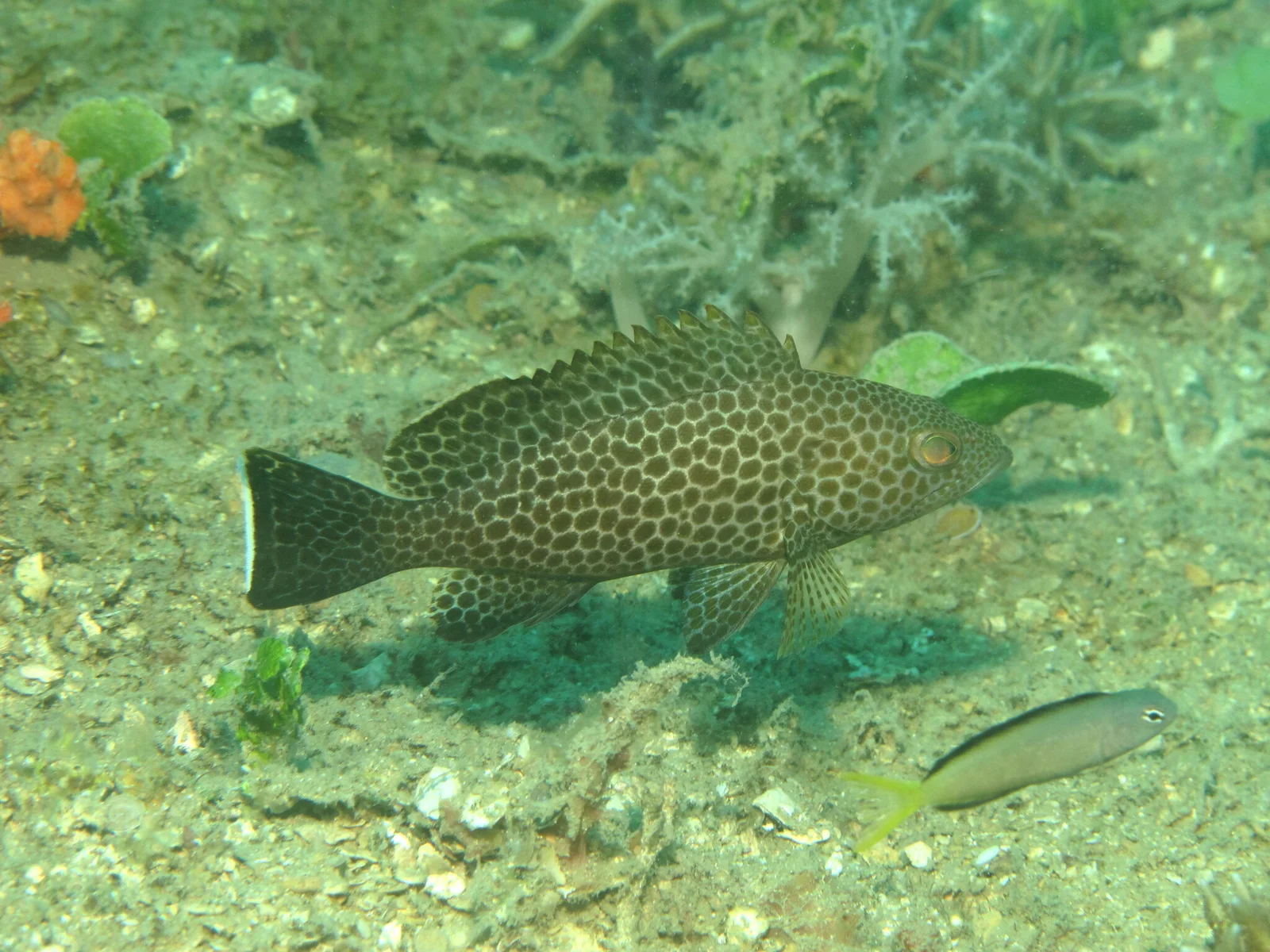
Areolate grouper
- Family
- Epinephelidae
- Depth
- 6–200 m

Black grouper
- Family
- Epinephelidae
- Depth
- 60–250 m
- Season
- Jan, Feb, Mar, Apr, May, Jun, Jul, Aug, Sep, Oct, Nov, Dec

Blacksaddle coral grouper
- Family
- Epinephelidae
- Depth
- 4–100 m
- Season
- Oct, Nov
Guides for this water
Technique, gear and safety guides that fit Atlantic goliath grouper.