
Golden trevally
Golden trevally is a large, deep-bodied carangid of the Indo-Pacific, from KwaZulu-Natal and Japan across to Baja California and down to Ecuador. It is the only species in its genus, which helps explain its unusual build. It works the top 80 m of tropical water on a diet of crustaceans and small fish, and fish reach 120 cm TL and 15 kg.
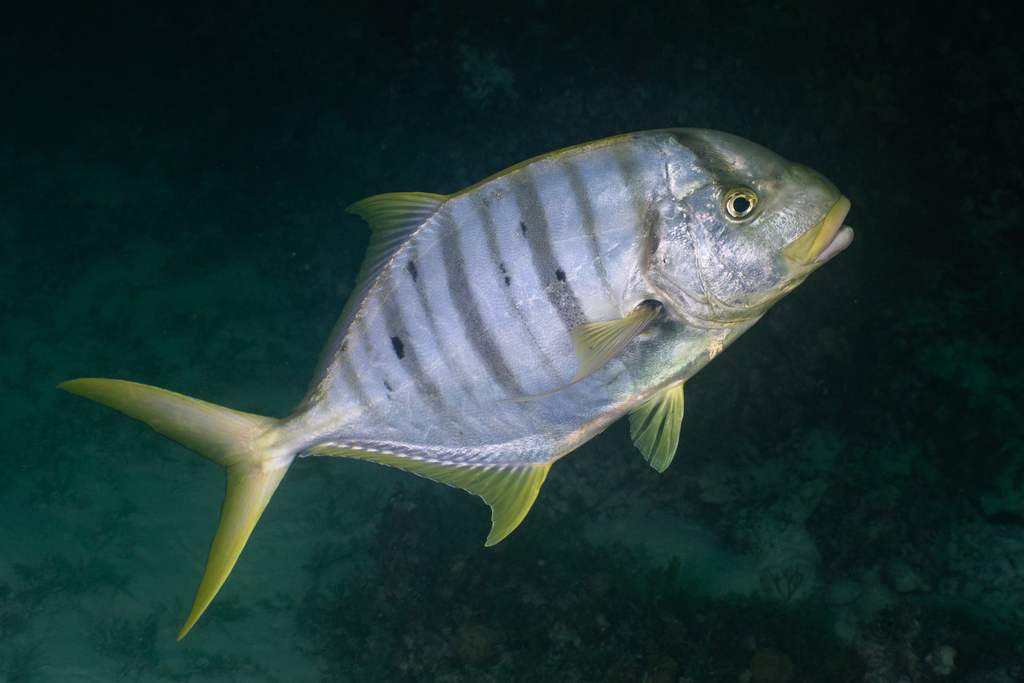
Golden trevally (Gnathanodon speciosus) is a fish of the family Carangidae. FishBase gives its range as: Indo-Pacific: from Kwazulu-Natal, South Africa, north to Mie Prefecture, Japan and east to southwestern coast of Baja California Sur, Mexico and Gulf of California to Ecuador. The single member of its genus, Gnathanodon speciosus is a large jack with 18–20 dorsal soft rays, plus an anal fin of three spines and 15–17 soft rays. It is recorded from 0 to 80 m, in tropical water. The recorded maxima are 120 cm TL, 15 kg. Diet includes crustaceans and fishes. IUCN status: Least Concern (LC). Chinese name: .
Identification
The single member of its genus, Gnathanodon speciosus is a large jack with 18–20 dorsal soft rays, plus an anal fin of three spines and 15–17 soft rays. The total-length maximum is 120 cm, the common fork length 75 cm, the heaviest published specimen 15 kg, and maturity arrives at 32.5 cm. Age is missing. Vernacular names diverge between pages: golden trevally, golden kingfish, banded trevally and king trevally all occur; the Chinese label used here is . A monotypic genus makes the scientific name the dependable index, because the common names are shared with other jacks.
Habitat and distribution
Marine, reef-associated and tropical, 0–80 m, between 35°N and 31°S: so runs the classification. From KwaZulu-Natal the prose range goes north to Mie Prefecture in Japan and east to the south-western Baja California Sur coast and the Gulf of California. More than 80 territories fill the country list, Australia, Japan, Mexico, the Galápagos and numerous Pacific island groups among them. Wikipedia describes a wide tropical and subtropical distribution from South Africa to Central America. Taxon 194896 has 1426 iNaturalist observations.
Season and fishing approach
Neither spawning months nor age data exist, leaving local observation as the only season source. Names cause a practical problem: a rulebook or landings table may file this fish as golden, banded or king trevally, and only the scientific name links those entries. Sand and deep water are the habitat keywords inside a 0–80 m span, and crustaceans and fish form the diet. At a 75 cm common length the fish belongs in the medium-heavy class, with 120 cm and 15 kg as extremes. The 32.5 cm maturity length is far below that common size, so most fish in the usual class are mature adults. Commercial aquaculture, gamefish use and minor commercial fishing all appear, and aquarium sale is documented; one animal consequently moves through several markets under several labels.
Edibility and regulations
Least Concern, assessed 9 March 2015, is the IUCN category. CITES and CMS have not assessed the species. It is taken in small commercial landings, farmed, pursued as game, and sold to aquariums. The three sources leave legal minimums and daily takes unstated. With more than 80 country entries and four or more English names, Gnathanodon speciosus is the identifier to use in any regulation search, not a market label. The 32.5 cm maturity figure is a biological threshold; the sources do not translate it into a legal minimum.
Where these facts come from
Check these pages before you rely on a size, range or protection status.
- FishBase — Gnathanodon speciosus — FishBase · T2
- GBIF — Gnathanodon speciosus occurrence records — GBIF · T2
- IUCN Red List — Gnathanodon speciosus — IUCN · T1
- Photo record — iNaturalist — iNaturalist · T3
Fish in the same water
These fish live in the same place.

African pompano
- Family
- Carangidae
- Depth
- 60–100 m

Almaco jack
- Family
- Carangidae
- Depth
- 5–245 m

Atlantic horse mackerel
- Family
- Carangidae
- Depth
- 0–1050 m
- Season
- Jan, Feb, Mar, Apr, May, Jun, Jul, Aug, Sep, Oct, Nov, Dec
Guides for this water
Technique, gear and safety guides that fit Golden trevally.