
Spear squid
The description of this squid and the fishery for it do not sit on the same shelf. A catalogue entry calls it pelagic and puts it in the top hundred metres; the stock assessment that decides its catch describes a bottom trawl, working grounds where the animals are taken in the net. Both statements are true, and neither is useful without the other.
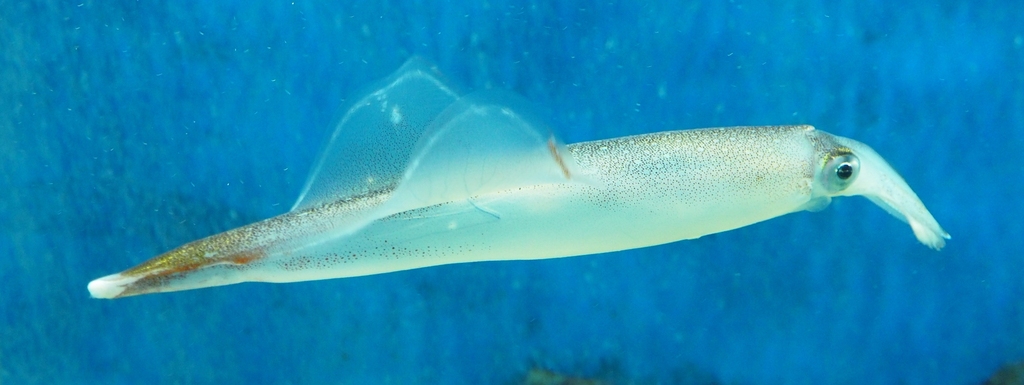
The description of this squid and the fishery for it do not sit on the same shelf. A catalogue entry calls it pelagic and puts it in the top hundred metres; the stock assessment that decides its catch describes a bottom trawl, working grounds where the animals are taken in the net. Both statements are true, and neither is useful without the other. Reading the labels against the fishery is the whole job of this page.
Pelagic is the wrong shelf
The catalogue records the species as pelagic, from the surface to 100 metres. Pelagic describes how the animal swims, not where it is caught. The Japanese assessment, which is built from landings, puts the great majority of the catch in otter trawls working the bottom.
The assessment also describes the animal's own movement: it does not migrate across whole oceans the way the Japanese common squid does, but it does move deeper as it grows to feed, and returns to shallower water to spawn. That is a vertical life, spent near the bottom for much of it, which is why a bottom net takes it and a midwater net mostly does not.
For an angler, the label is a trap. Fishing the upper water because the database says pelagic would be fishing away from the animal. Work the bottom, and treat the shallow spawning return as the exception rather than the rule.
Subtropical is the wrong latitude
The catalogue describes a subtropical range from 44° north to 30° north. The fishery disagrees about where the species matters. In 2024, the northern area from Iwate to Chiba produced 2 381 of the 2 546 tonnes landed, and the assessment notes that the northern share has been 84 to 98 percent of the total since 2012.
A subtropical label read literally points a fisher south. The landings point north. The likely explanation, which the assessment raises rather than settles, is that the main distribution has shifted north with warming water. Whatever the cause, the practical reading is unambiguous: this is a northern fishery now, and the southern grounds are the remnant.
Least Concern is the wrong scale
The global assessment for the species is Least Concern, dated 2015. The same animal is managed as two areas, and the two areas do not agree. The northern stock is judged at a high level with a flat trend; the central and southern stock is judged at a medium level with a declining trend.
A category assigned to the species as a whole cannot see that split. If your boat works south of Shizuoka, the global category tells you nothing about the water in front of you, and the regional judgment tells you almost everything.
Forty centimetres, one year
The maximum mantle length is 40 centimetres, and the maximum reported age is one year. A squid with a one-year life has no slow rebuild available to it. The spawning stock that produces next season is this season's animals, so the whole cycle is decided within twelve months, and a bad recruitment year is felt immediately rather than absorbed.
That is why the management numbers are set annually and why they move. It is also why a size limit would be a poor tool here: almost every animal in the water is in its first and only year.
The season is a direction of movement
The assessment does not date the spawning run; it describes its direction. The animals feed and grow in deeper water, then move shallow to spawn, so the shallow window and the spawning window are the same window. For a fisher that is more useful than a month: when the squid are up on the shallow grounds, they are there to breed, and the catch taken then comes out of the spawning stock.
That matters most in the central and southern area, where the stock is already judged to be declining. A shallow haul there during the spawning period removes animals at the moment they reproduce, in the only year they have.
Bottom trawl, by area
The assessment separates three gear patterns along the coast. In the north, otter trawl from Kanayamazawa to the Boso area takes nearly all of the catch. In the centre, single-boat trawl and a small bottom trawl out of Aichi take the bulk. In the south, two-boat trawl dominates.
For anyone reading a landing figure, the gear matters as much as the area. A change in the northern otter trawl fleet shows up as a change in the stock index, because that fleet is what the index is built from. A change in the southern two-boat fleet is measured against a much smaller and more variable sample.
Two thousand eight hundred and fifty tonnes
The 2026 allowable catch is set at a target of 2 850 tonnes and a limit of 3 560 tonnes, with the target calculated as 0.8 of the limit. Landings in 2024 were 2 546 tonnes, below both figures.
The gap between target and limit is the part worth understanding. The target is the catch expected to keep the stock stable given the uncertainty in the assessment; the limit is the most that the reference rule would tolerate. A year that lands between the two is not a failure, but it is also not the number to plan against.
Where the records sit
The occurrence records for this species are few and overwhelmingly Japanese: 167 in total, of which 77 are from Japan, three from South Korea and one from Malaysia. The catalogue range, which runs from the north-west Pacific southward, is broader than the records; the records follow the survey and museum effort.
iNaturalist holds 15 observations. That is enough to see the animal and not enough to say anything about where it lives, which is the general condition of a small, short-lived squid that is mostly counted in nets rather than photographed.
Where these facts come from
Check these pages before you rely on a size, range or protection status.
- FishBase — Heterololigo bleekeri — FishBase · T2
- GBIF — Heterololigo bleekeri occurrence records — GBIF · T2
- IUCN Red List — Heterololigo bleekeri — IUCN · T1
- Photo record — iNaturalist — iNaturalist · T3
Fish in the same water
These fish live in the same place.
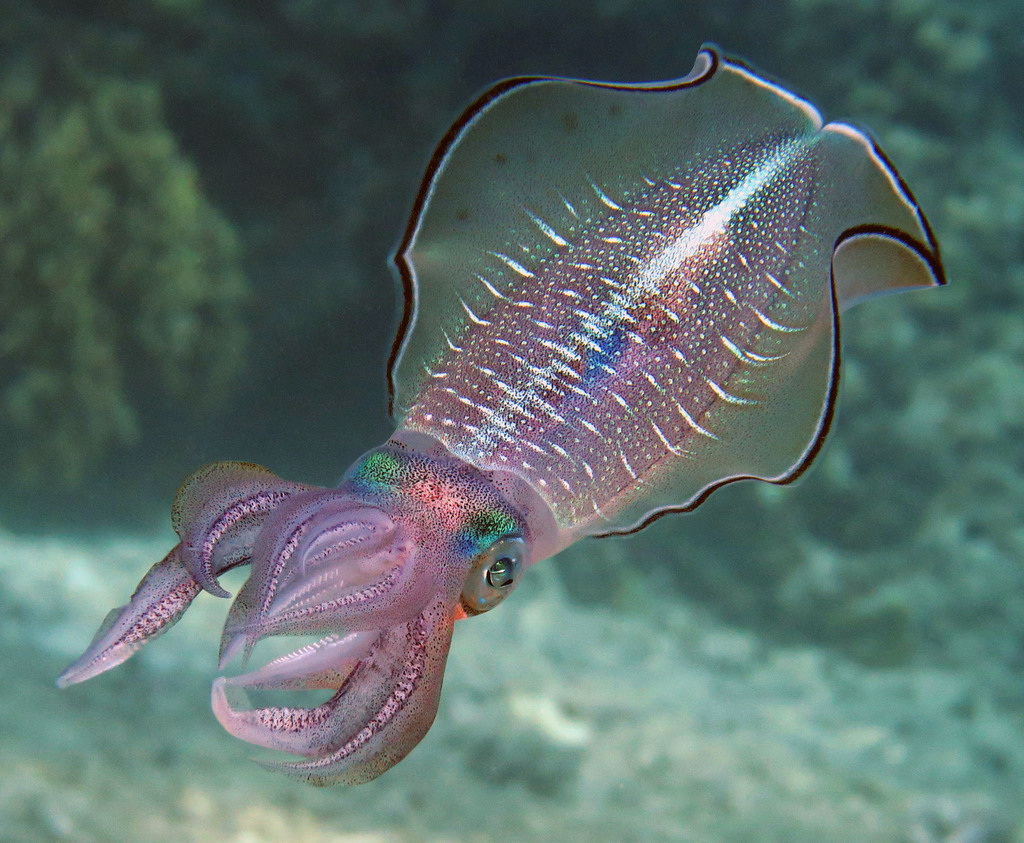
Bigfin reef squid
- Family
- Loliginidae
- Depth
- 0–100 m

European squid
- Family
- Loliginidae
- Depth
- 0–500 m
- Season
- Jan, Feb, Mar, Apr, Jun, Jul, Aug, Sep, Oct, Nov, Dec

Longfin inshore squid
- Family
- Loliginidae
- Depth
- 0–400 m
Guides for this water
Technique, gear and safety guides that fit Spear squid.