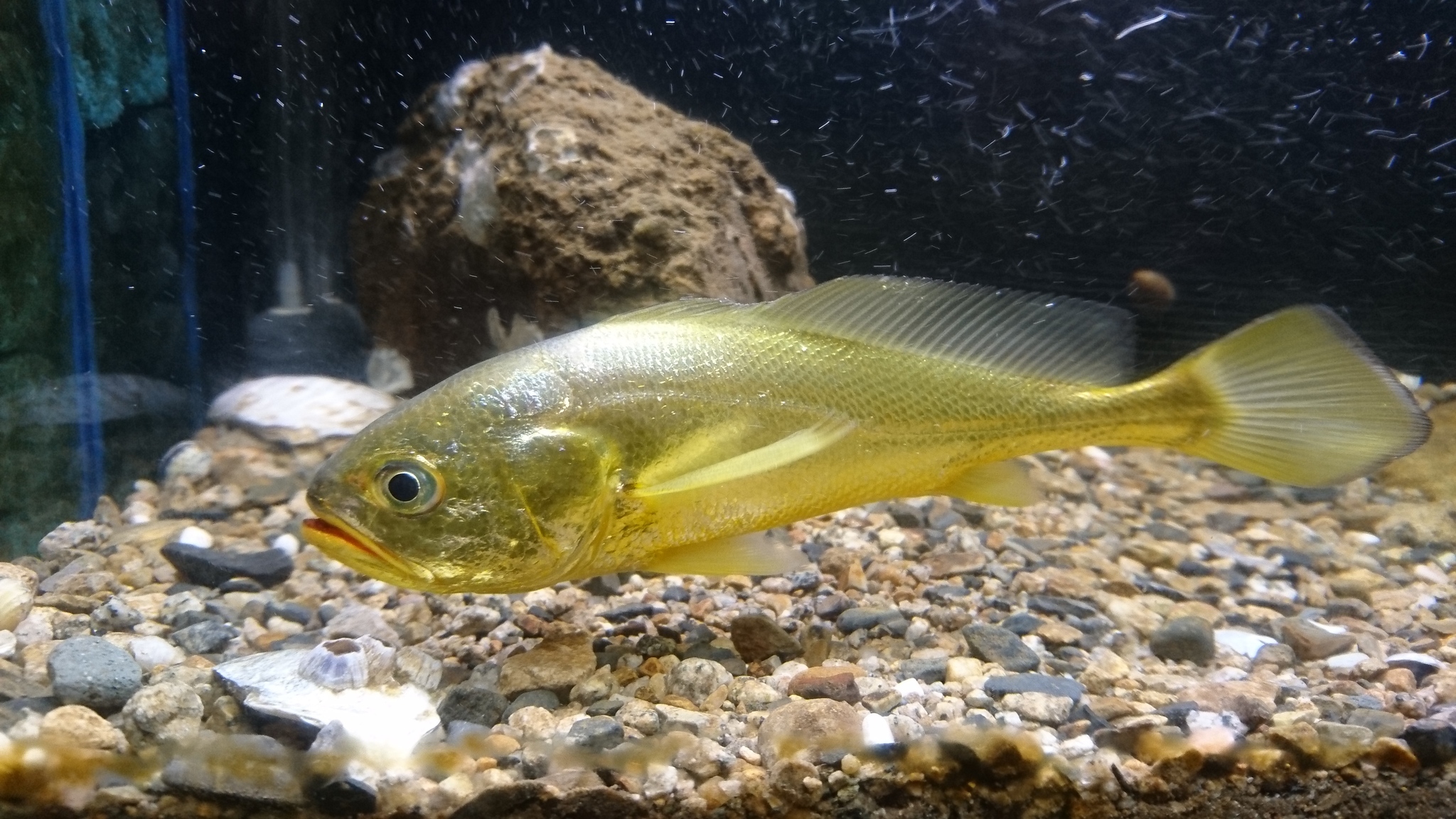
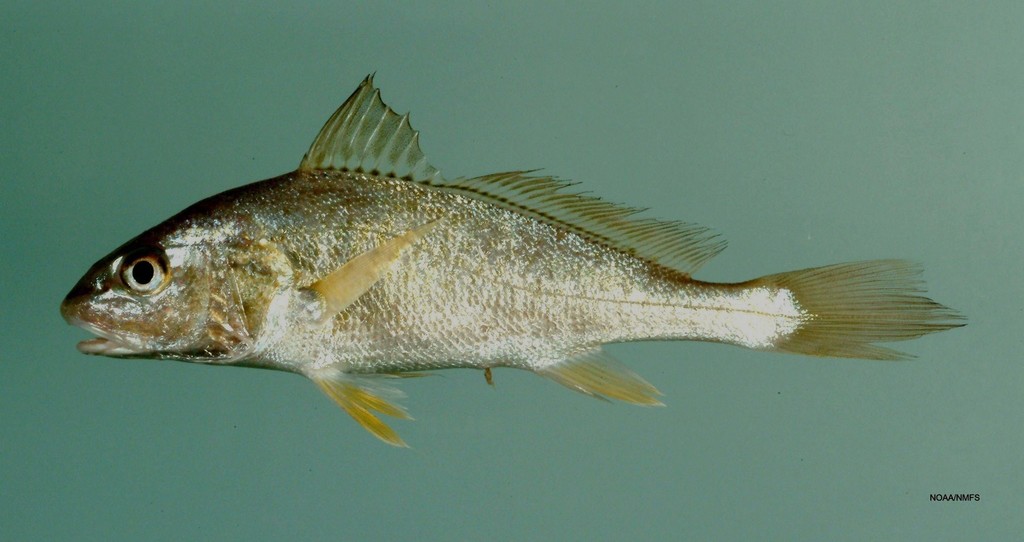
Large yellow croaker (Larimichthys crocea) is a fish of the family Sciaenidae. FishBase gives its range as: Northwest Pacific: from central Vietnam to South Korea and Japan, Yellow and East China seas. It is recorded from 0 to 120 m, in temperate water. The recorded maxima are 80 cm TL, 6 years. Diet includes crustaceans and fishes. IUCN status: Critically Endangered (CR). Chinese name: .
The fish, and why it looks expensive
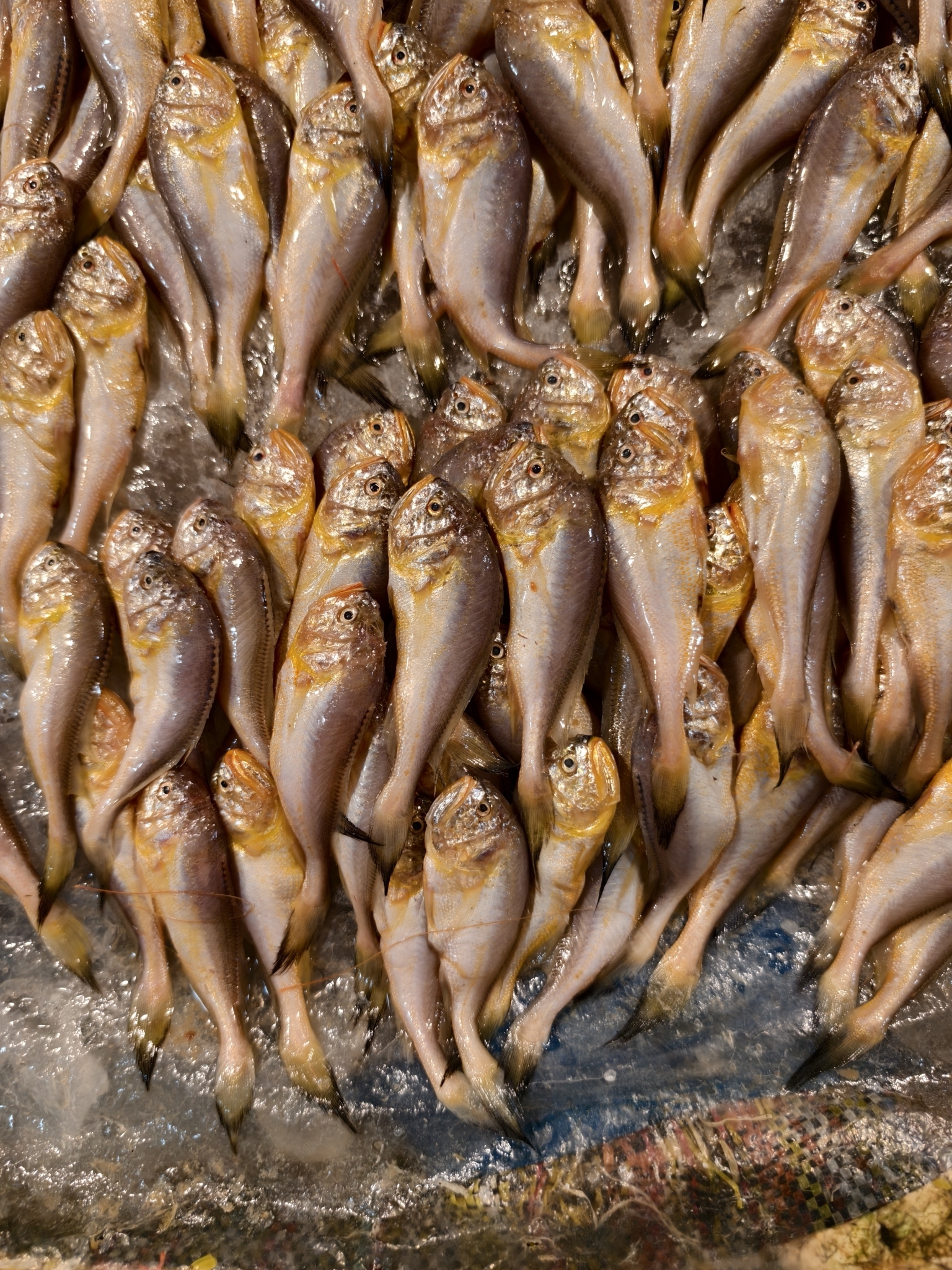
Fresh specimens carry a gold wash over the body. The soft-rayed portions of the dorsal and anal fins are mostly covered with scales, and the rear part of the pectoral fin is not black. The counts that identify it are 9–10 dorsal spines and 30–35 soft dorsal rays, two anal spines with 7–9 soft rays, and 25–26 vertebrae; the body is fusiform with an oval cross-section. In the hand that reads as a fish built for steady swimming rather than bursts, with a flank that catches light. The gold is also a freshness signal: it is one of the first things to dull after a fish has been out of the water too long, which is why market photographs and dock photographs rarely look like the same animal.
Where the bottom makes sense
FishBase places the species from 0 to 120 m over muddy or muddy-sandy ground, in coastal waters and estuaries, and describes it as benthopelagic and oceanodromous. The range runs through the northwest Pacific from central Vietnam north through the Yellow and East China seas to South Korea and Japan. GBIF's preserved records lean hard on China — 1,303 of 1,649 — with Taiwan region, Korea, Japan and Vietnam behind it. For a boat angler that suggests a search rule rather than a mark: find the mud, then find where the mud meets sand, a channel edge or an estuary mouth, and work the slope instead of the flat. Because the fish is recorded as a wanderer, yesterday's producing spot is not a promise; current, bait and the state of the tide are the variables you can actually control.
The spawning table is not a calendar
The spawning list gives January, March, April, May, June, October, November and December, with separate entries for the East China Sea (April–June), Luisha Bay in Guangdong (October–December) and Hong Kong SAR (January, March, April, October–December). That is a table of recorded spawning, not a forecast that fishing will be easy in those months. Spawning aggregations are exactly the kind of event that attracts both fish and regulation, so the best-looking week of the year may also be the one a local stock is protected from. Treat the months as a reason to ask questions before booking, not as a booking calendar.
Presenting a bait to a crustacean feeder
The diet record is short: crustaceans and fishes. That is enough to choose a bait profile — a whole or cut shrimp, a small crab, a strip of fish — and enough to explain why a slow, low presentation beats a fast one. The approved methods for this line are boat bottom fishing, anchored or drifting, and slow-pitch jigging with a controlled fall and short lifts. Both keep the offering in the lower part of the water column, where a benthopelagic croaker is built to feed. In deep water the difficulty is not finding fish but keeping contact: a strong current lifts line and bait off the bottom, so a lead that holds and a braid that telegraphs a soft take matter more than a long cast.
The soft-mouth problem
Nothing in the record describes the mouth, so this is inference rather than a source fact: a fish that feeds on crustaceans and small fishes usually takes by suction and crushes with teeth at the back of the throat rather than seizing a bait and running. Expect the take to feel like extra weight or a single dull knock, not a tearing run. A sharp hook, a light drag and steady pressure will land more fish than a hard strike; pumping the rod against a soft mouth is how hooks tear out. The same reasoning applies at the net: support the body, and do not lift a heavy fish by the line.
A record that says Critically Endangered
The IUCN assessment is CR (Critically Endangered), dated 30 June 2016, and FishBase lists the species as highly commercial, with commercial aquaculture and aquarium use. Those facts sit awkwardly together, and that is the useful lesson: the farmed fish in the market and the wild fish on the coast are not the same story. A CR listing is a reason to be careful with large breeders, not a reason to assume every croaker is rare. The source does not include verified national regulation text, so size limits, closures and bag limits remain a local question to ask before keeping a fish.
What the numbers leave out
FishBase's published maximum weight for this species is 243.6 g, which does not fit an 80 cm fish; that field was left empty here rather than copied across. Maturity is recorded at 17 cm, a reminder that the big fish are old fish and that a box of small ones is not automatically a sign of a healthy stock. No temperature range appears in the source. Nor does it tell you which bait is sold near your harbour, which ramp is open, or how the tide behaves on your coast; those are local facts, and they are the ones that decide a trip.
Where the record points
GBIF holds 1,649 preserved occurrences and iNaturalist carries 62 observations for the taxon. Both show where people have recorded the fish, not where to fish. For a first trip, use the country and habitat signals to choose a coast, then use a chart and a sounder to find mud near a channel or an estuary mouth. The rest is time on the water.
How to catch it
Boat bottom fishing
Anchored or drifting boat, bait or lure worked near the recorded bottom.
Slow pitch jigging
Slow-pitch jigging with a controlled fall and short lifts.
Regulations before you keep it
These are the published regulations for this fish. Read the number first. The notice below it is the actual regulation.
Minimum size2
Body length ≥255 mm
China — Fujian · CN-FJ
Fujian commercial catch standard (Fujian Fisheries Notice 2018 No. 114): the minimum catch size for large yellow croaker is body length ≥ 255 mm; smaller individuals count as juveniles. The notice does not address recreational angling, so whether an angler must release an undersized fish depends on the local fisheries authority.
Body length ≥20 cm
China — Hainan · CN-HI
Hainan commercial catch standard: the minimum catch size for large yellow croaker is body length ≥ 20 cm. This is a standard for commercial catches set by a provincial regulation, not a rule for recreational angling; whether an angler must release an undersized fish should be confirmed with the local fisheries authority.
Season / closure1
From 12:00 on May 1 to 12:00 on September 1, September 16 or August 16, depending on the area
China — national · CN-NATIONAL
All Chinese coastal waters (MAR Notice 2023 No. 1): the summer moratorium starts at 12:00 on 1 May and ends at 12:00 on 1 September, 16 September or 16 August depending on the sea area, and applies to capture operations. All gear types except hook-and-line are closed; rod-and-line fishing is outside the moratorium gear list, but hook-and-line vessels must still report port entry and exit, and coastal provinces may adopt stricter measures.
The closure has three area-based windows, all starting at 12:00 on May 1 and ending at 12:00 on September 1, September 16 or August 16.
Every record above names its source and the date it was retrieved. See the regulation register for the full list, or how to read these regulations.
Where these facts come from
Check these pages before you rely on a size, range or protection status.
-
FishBase — Larimichthys crocea
— FishBase · T2
-
GBIF — Larimichthys crocea occurrence records
— GBIF · T2
-
IUCN Red List — Larimichthys crocea
— IUCN · T1
-
Photo record — iNaturalist
— iNaturalist · T3