
Leerfish
Leerfish is a large coastal carangid of the Mediterranean, eastern Atlantic and western Indian Ocean, where South African anglers call it garrick. It lives from the surface to 50 m in subtropical water, reaches 200 cm TL and 50 kg, with a common length around 100 cm. Its season runs from September to November.
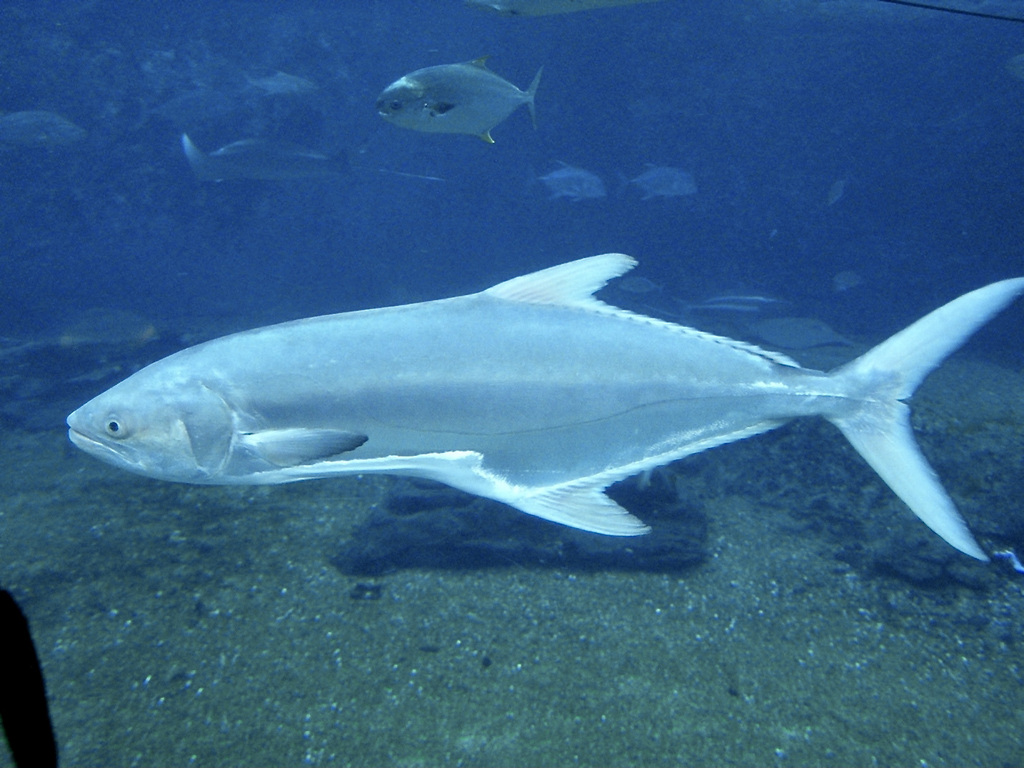
The same fish reaches a buyer under two names. In South Africa it is a garrick; in the Mediterranean it is a leerfish. The page uses the South African name for the title and the Mediterranean name for the common-name field, and the split is not cosmetic: the market and the dense wild records sit at opposite ends of the range. That distance is the subject of this article.
Two names on two counters
FishBase lists the species as Lichia amia and gives "Leerfish" as the English common name. The site's own title uses "Garrick", the South African game-fish name, and the alias list carries both. A buyer in Spain, Italy or Turkey and an angler in KwaZulu-Natal are describing one species, but they are not looking at the same fishery.
The page records commercial fisheries and gamefish use. It gives no market price and no aquaculture entry. So the commercial value of this fish is recorded only at the landing end, with no farm-gate price to compare against it. The commercial label and the 100 cm typical fish are the only market-side facts on the page.
The 200 cm record and the 100 cm slab
The figures read 200 cm TL maximum, 100 cm TL common, 50 kg heaviest published, and a maturity range beginning at 60 cm with no Lm point. Age is blank. The record fish is twice the common fish in length, 200 cm against 100 cm, and the maturity range starts at 60 cm, 40 cm below the common length.
That spread matters on a market counter. A 100 cm leerfish is a normal adult, not a trophy; a 200 cm fish is a record. The 50 kg weight belongs to the record end, and the page gives no common weight to convert the 100 cm fish into a routine kilogram figure. A buyer who hears "50 kg leerfish" should treat it as a record, not as a size grade.
Where the fish in the market comes from
The distribution text runs from the southern Bay of Biscay to South Africa, including the Mediterranean, and adds the western Indian Ocean from South Africa to Maputo Bay. The occurrence data does not spread evenly across that text. GBIF returns 1,453 present records, with 865 from South Africa, 109 from Spain, 52 from Italy, 45 from Turkey, 43 from Croatia, 36 from Mozambique, 31 from France and 31 from Senegal. iNaturalist carries 298 observations under the same accepted name; that is a thinner photographic record than the occurrence set, and it sits in the same southern African and Mediterranean centres.
South Africa holds about three-fifths of the records; the Mediterranean countries together hold a much smaller share. That is the market-versus-wild gap in one table. The fish sold in Mediterranean ports sits at the northern and eastern edge of the range, while the dense population signal is southern African. A trip plan built on the market's map would start in the wrong place.
The 2014 LC assessment and what it does not say
The IUCN entry is Least Concern, assessed on 19 May 2014. The page gives no population trend, no stock estimate and no regional breakdown. Least Concern is therefore a global label from a single assessment date, not a statement that every local fishery is healthy.
The label is not a harvest rule. The page records commercial and gamefish use, and stops: no bag limit, no minimum size and no closure date for South Africa, which holds 865 of the 1,453 GBIF records, or for the Mediterranean states that take the same fish. The 2014 finding covers extinction risk at the global scale, and it reaches no market or marina on its own.
Estuaries and lower rivers
The habitat text puts the species in coastal pelagic water, estuaries and lower rivers, with juveniles in estuaries. The environment line adds brackish and a depth range of 0–50 m. This is a shallow, coastal fish, not an offshore blue-water species, and the estuary is part of its routine range rather than an accidental stray.
The juvenile use of estuaries is the part that connects the market to the nursery. A fishery that takes large adults in coastal water and a nursery that depends on estuarine habitat are two ends of the same life cycle. The page records the pattern but gives no nursery size, no estuary name and no juvenile growth figure; those blanks stay blank.
Spawning off Natal in September–November
The spawning table has one entry: off Natal, South Africa, in September–November. That is a single recorded area and a single season, not a range-wide spawning map. The page does not give a second spawning ground in the Mediterranean or West Africa.
The record sits in the same region that holds 865 of the 1,453 GBIF records. That coincidence is useful: the dense record center and the recorded spawning ground are both southern African. It does not prove that the Mediterranean fish never spawn, because the absence of a record is not a record of absence. It does mean that a September–November spawn is a South African statement, and carrying it to the Mediterranean is an extrapolation.
The wavy lateral line and no scutes
The identification notes are the market's best defence. The body is elongate, there are no scutes, the lateral line is irregular and wavy, the back is brown, the fin lobes are black, and juveniles carry bars. The absence of scutes separates it from the jack family's scuted members, and the wavy lateral line is visible on a whole fish even when the colour has faded on ice.
The alias list adds leerfish, garrick, palomino and several local names. Those names are not unique to this species across the whole region, and a market label can be a local word for more than one carangid. The physical marks are the part that survives the counter.
What to buy and what to release
The maturity range starts at 60 cm. That is the only biological floor on the page; it is not the same as an Lm estimate, because the page gives no Lm point. A fish below 60 cm is below the start of the recorded maturity range, and a fish at 100 cm is a common adult. The 200 cm and 50 kg figures are the record end and should not set a buying expectation.
The taxonomy adds one more check. WoRMS accepts Lichia amia (Linnaeus, 1758) and treats Scomber amia, Caranx amia, Caesiomorus amia, Campogramma vadigo, Centronotus vadigo, Hypacantus amia and Porthmeus argenteus as synonyms it does not accept. Any catch entered under one of those older combinations can drop out of a present-day name search, and a local fishery then looks smaller in the database than it is.
Where these facts come from
Check these pages before you rely on a size, range or protection status.
- FishBase — Lichia amia — FishBase · T2
- GBIF — Lichia amia occurrence records — GBIF · T2
- IUCN Red List — Lichia amia — IUCN · T1
- Photo record — iNaturalist — iNaturalist · T3
Fish in the same water
These fish live in the same place.

African pompano
- Family
- Carangidae
- Depth
- 60–100 m

Almaco jack
- Family
- Carangidae
- Depth
- 5–245 m

Atlantic horse mackerel
- Family
- Carangidae
- Depth
- 0–1050 m
- Season
- Jan, Feb, Mar, Apr, May, Jun, Jul, Aug, Sep, Oct, Nov, Dec
Guides for this water
Technique, gear and safety guides that fit Leerfish.