
Northern kingfish
Northern kingfish is a small sciaenid of the western Atlantic, from Massachusetts south to Florida and across the Gulf of Mexico to Yucatan. It reaches 46 cm TL with a common length of 30 cm, 1.1 kg and a maximum age of four years, and matures at about 25.6 cm. April to August is the season. Shore casting, small hook rigs and boat bottom fishing are the methods listed.

The northern kingfish is a small sciaenid of the western Atlantic, found from Massachusetts south to Florida and across the Gulf of Mexico to Yucatan. FishBase records a maximum length of 46 cm TL, a common length of 30 cm, a maximum published weight of 1.1 kg and a maximum reported age of four years; males and unsexed fish reach maturity at about 25.6 cm. It is a surf-zone and estuary fish rather than an offshore target, and most anglers meet it while fishing light tackle from beaches, inlets and piers.
Identification
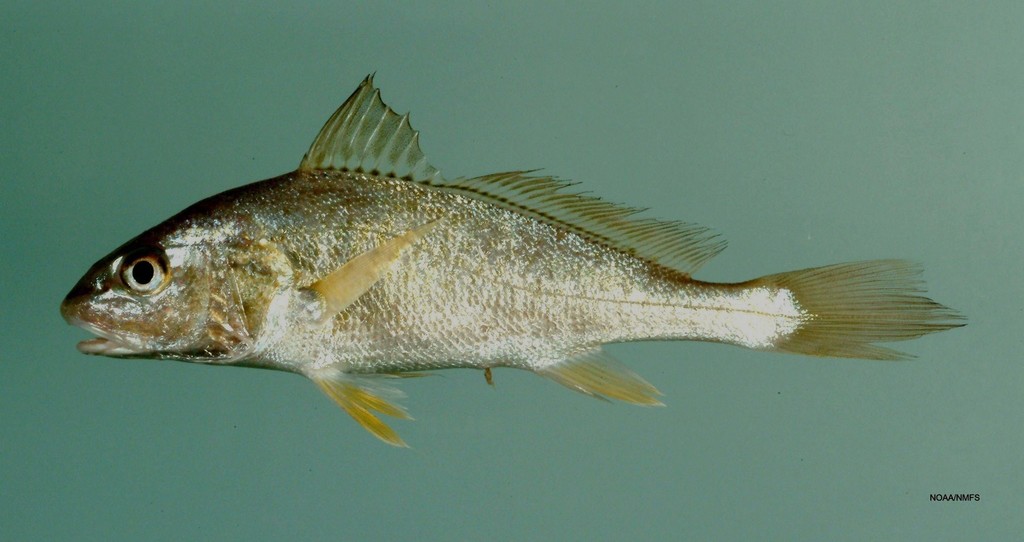
The body is fusiform and normally proportioned, with a pointed snout and a small mouth. The diagnostic feature of the genus is a single short barbel on the chin, which separates kingfishes from the barbel-less drums that share the same surf. Northern kingfish show a silvery to grey-brown body with several oblique dark bars along the flank, and the first dorsal fin carries a long, filament-like leading spine. The caudal fin is slightly concave. FishBase's page for this species records the body shape but does not publish a fin formula or a full diagnosis, so the field marks above should be checked against the photographs and against local identification guides before a fish is kept.
The combination that matters on the beach is a pointed snout, one chin barbel and dark oblique bars. Spot, Atlantic croaker and weakfish can occur in the same surf; spot lack the barbel and have a rounder body, croaker are deeper-bodied with a different bar pattern, and weakfish grow much larger and have a different mouth shape.
Habitat and behaviour
Adults usually live in shallow coastal water over sand to sandy mud, and they are common in the surf zone and in estuaries. Juveniles may enter tidal rivers and creeks of low salinity, so the nursery range extends well inland of the open beach. The recorded depth range starts at 10 m, and the species is classified as marine and brackish, demersal and subtropical.
The diet recorded by FishBase is worms, crustaceans and fishes. On the beach this translates into a fish that works the bottom in the wash, picking up small crustaceans and worms rather than chasing baitfish high in the water. It is rarely a long-range migrator in the way that striped bass are, but it moves with water temperature and with the seasonal position of the surf zone.
Seasonal window
FishBase's spawning table records April and May at Beaufort, North Carolina, and June through August in Delaware Bay and off New Jersey. The overall record runs from April to August. That is a spawning signal, not a guarantee of a bite: the practical window for shore anglers runs from late spring into autumn, with the warmest months producing the most consistent action in the Mid-Atlantic and the cooler ends of the range stretching into spring and autumn.
In practice, the best hours are usually the moving tide, especially the first two hours of a flood or the last two of an ebb, when bait is pulled through the troughs. A light onshore wind that colours the water slightly often helps in the surf. Water temperature matters more than the calendar: fish slide into the wash when the surf zone warms, and they leave it when winter storms strip the beach.
Gear and approach
A light surf outfit is enough: a 2.4–3.0 m rod rated for 1–3 oz, a 3000–4000 size reel, 10–15 lb braid and a 20–30 lb fluorocarbon leader. Use a fish-finder or high-low rig with a 1–2 oz sinker in calm surf and heavier in a running sea. Hook sizes from a No. 2 to a 1/0 are appropriate for the small mouth; circle hooks reduce deep hooking and make release easier.
Bait can be a small piece of shrimp, squid strip or bloodworm, and a thin strip of fish belly works when the water is clear. Small soft plastics and teaser flies catch fish when the surf is calm and the bait is tiny. Keep the bait fresh and change it often; kingfish are not a species that rewards a big, static bait.
Play the fish firmly but not aggressively. The mouth is soft and the hooks are small, so a steady pressure with a light drag lands more fish than a locked-down drag. For release, wet your hands, support the body and return the fish without lifting it by the jaw.
Edibility and regulations
FishBase records the species as a minor commercial catch and as a gamefish. The flesh is white, mild and flaky, and it is one of the better small surf fish for the table; kingfish are commonly fried or used in fish tacos. Clean them quickly and keep them cold.
The IUCN Red List category is LC (Least Concern), assessed on 23 January 2020. The species is harmless to humans, and FishBase records no CITES or CMS listing. Federal waters set no size, season or bag limit for northern kingfish; Mid-Atlantic and South Atlantic states may add size or creel limits, so check the rule where you land the fish before keeping a catch.
Where to look
GBIF holds 2,325 occurrence records for the matched taxon, with the largest country counts in the United States (2,177) and Mexico (83). FishBase's distribution runs from Massachusetts to southern Florida and across the Gulf of Mexico to Yucatan. The habitat keywords are sandy, muddy, estuary and coastal. These are distribution signals, not spot coordinates: fish the surf troughs, inlet mouths and estuary channels, then check local access and conditions.
How to catch it
Shore casting
Fished with the listed approach, matched to the recorded depth and size.
Small hook rig
Fished with the listed approach, matched to the recorded depth and size.
Boat bottom fishing
Fished with the listed approach, matched to the recorded depth and size.
Where these facts come from
Check these pages before you rely on a size, range or protection status.
- FishBase — Menticirrhus saxatilis — FishBase · T2
- GBIF — Menticirrhus saxatilis occurrence records — GBIF · T2
- IUCN Red List — Menticirrhus saxatilis — IUCN · T1
- Photo record — iNaturalist — iNaturalist · T3
Fish in the same water
These fish live in the same place.

Acoupa weakfish
- Family
- Sciaenidae
- Depth
- 1–20 m
- Season
- Jan, Feb, Mar, Apr, May, Jun, Jul, Aug, Sep, Oct, Nov, Dec
Atlantic croaker
- Family
- Sciaenidae
- Depth
- ≤ 100 m
- Season
- Jan, Feb, Mar, Apr, May, Jun, Jul, Aug, Sep, Oct, Nov, Dec
Bighead croaker
- Family
- Sciaenidae
- Depth
- ≤ 90 m
- Season
- Jan, Mar, Apr, May, Jun, Jul, Aug, Sep, Oct, Nov, Dec
Guides for this water
Technique, gear and safety guides that fit Northern kingfish.