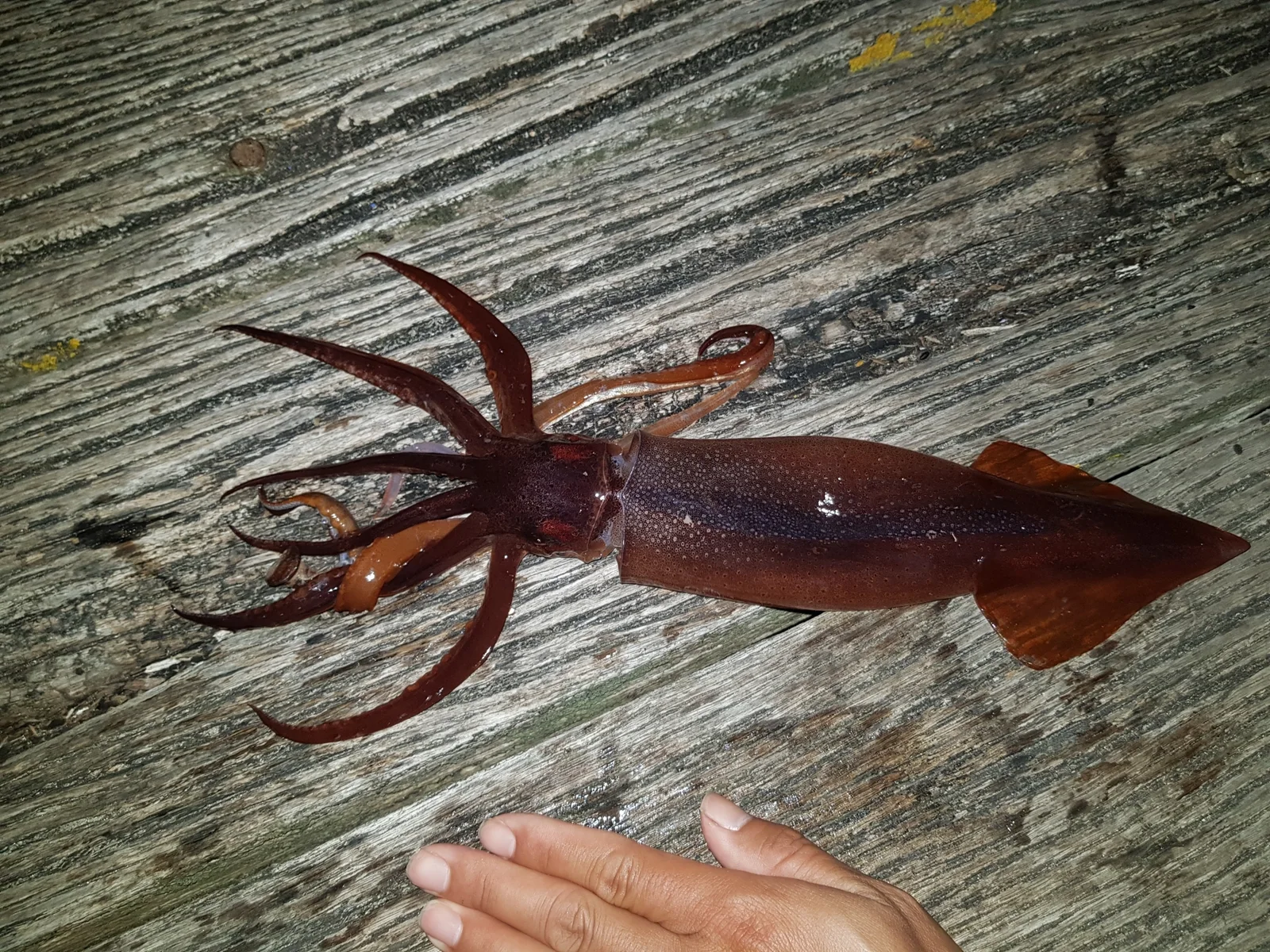
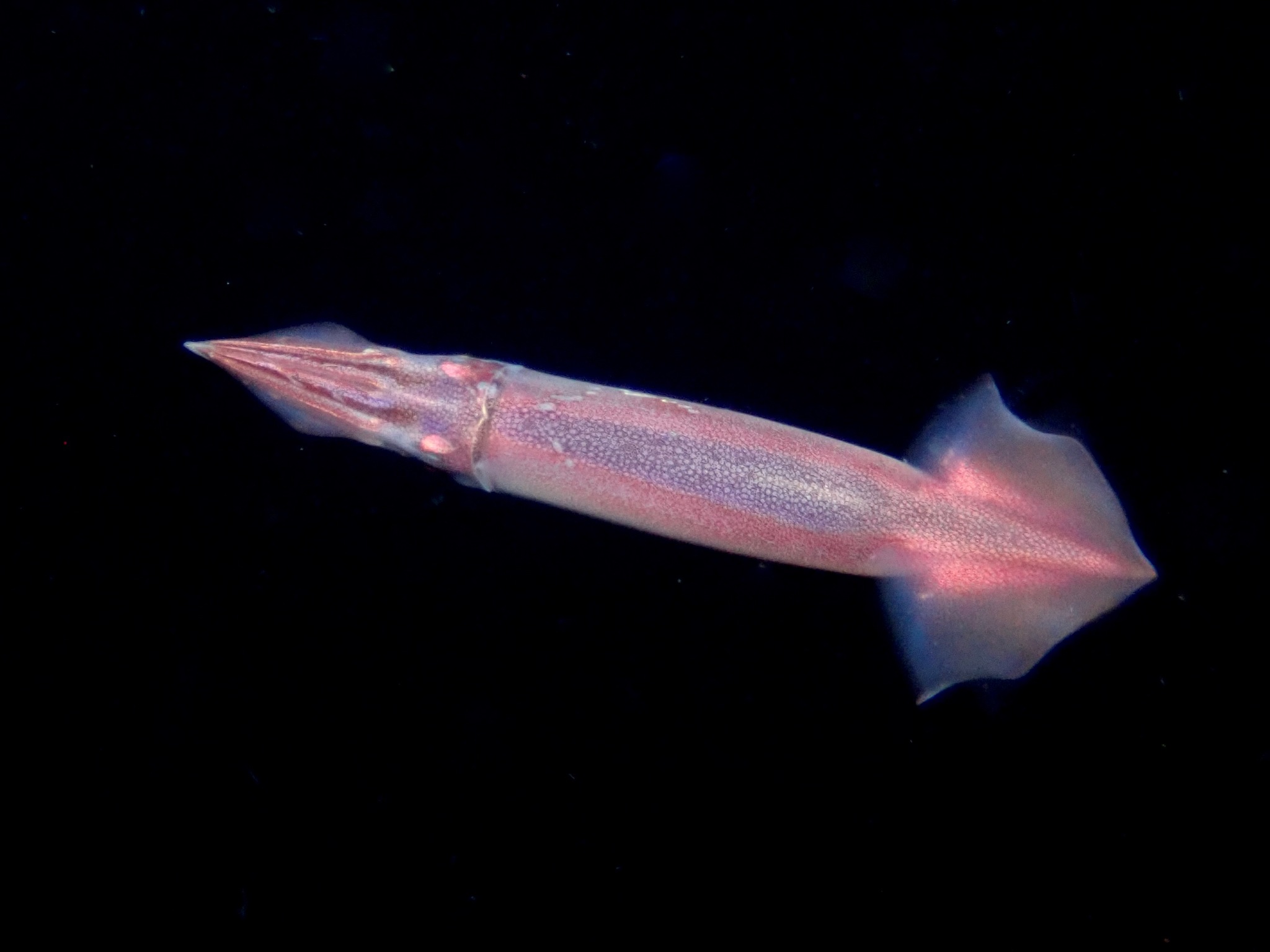
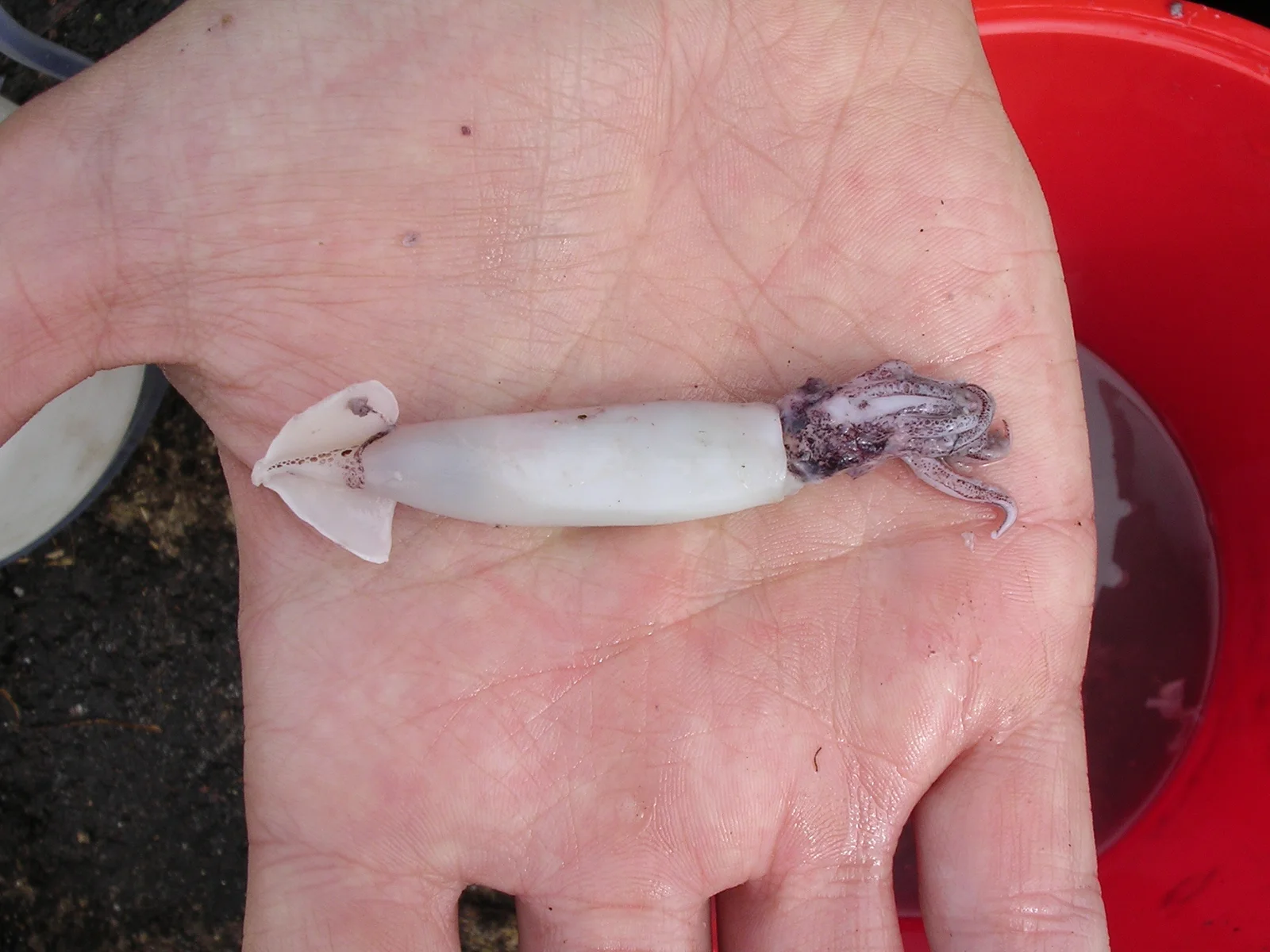
This is an ommastrephid squid: family Ommastrephidae, order Oegopsida. The naming is the first thing to get straight, because four different labels are attached to this one animal in the sources checked here. The approved Chinese name, arrow squid, AU , is an editorial composition rather than a name taken from the species page.
Four names, one animal
The iNaturalist page gives the preferred common name as Gould's Flying Squid. Wikipedia lists the alternative labels as "the Gould's squid, Gould's flying squid, or arrow squid". The approved Chinese line carries " " with "arrow squid, AU" in brackets. So the same taxon appears under a possessive name, a shorter possessive name, and a generic fishery word.
None of these is a misidentification in itself. They are vernacular names, and vernacular names travel. The problem starts when one of them is used as if it were an identifier. "Arrow squid" on a market board or in a logbook does not tell you which ommastrephid is in the box.
The empty alias table
The SeaLifeBase page for this species was checked for its common-name tables. The English, Chinese and Japanese tables came back empty, even though the page itself carries "Gould's flying squid" as the title name. The page is not contradicting itself here; the name table and the title simply come from different parts of the record.
For a reader this matters in a practical way. If you try to confirm the name against the source's own alias list, you will find nothing to confirm. The names in circulation come from iNaturalist and Wikipedia instead. A blank table is not evidence that no names exist. It is evidence that this page has no name rows to offer.
"Arrow squid" is a word, not a key
The word "arrow squid" describes a shape and a fishery habit, not a species. It is applied loosely to fast, slender squid that show up in catches. The sources here attach it to Nototodarus gouldi, but attaching a label is not the same as defining a taxon.
That distinction has consequences at the cleaning table. Two catches sold as arrow squid can be different species with different mantle lengths and different depth ranges. If your identification stops at the market name, your length record stops being comparable to anyone else's.
The genus is not a loligo
The taxonomy is unambiguous in the sources: class Cephalopoda, order Oegopsida, family Ommastrephidae, subfamily Todarodinae. This is not a Loliginidae squid, despite the fact that both families are sold as "squid" and both are cooked the same way.
The difference is visible in the body. Ommastrephids are the flying-squid group, built for open water, with a mantle that narrows to a pointed tip. The name "flying squid" is not decoration: these animals can leave the water in a jet-propelled glide. Coastal anglers who hear "squid" usually picture a shallow-water loliginid; this is not that animal.
35 cm male, 40 cm female
The male/unsexed column lists 35.0 cm ML; a female reaches 40 cm ML; the top weight is 800 g. Mantle length is measured on the mantle, not from the arm tips, so these are body-axis figures rather than total lengths.
The page checked here leaves common length, length at first maturity and maximum age all unstated. iNaturalist's summary repeats a claim that the animals live up to one year, but that is a summary sentence, not an age field, and it is not the same kind of record.
Those two missing fields leave no way to state a routine size or a size at maturity. Both blanks stay blanks.
The 50–300 m usual band
The habitat block gives a pelagic-oceanic animal, 0–700 m deep, most records between 50 and 300 m, subtropical. The usual band is the useful part: it says where the species is most often recorded, not where it can never be.
The habitat keywords sit oddly beside that line. They list estuary, slope and continental shelf. The database can hold an estuary keyword beside an oceanic squid without error, but the pairing warns you about how the keywords were assembled. Treat "estuary" as one recorded association, not as the place to start looking for an oceanic squid.
There is no spawning-window record for this species. Rather than borrow a season from related squid, the field stays blank.
Three rows, two registries
The GBIF distribution table has three rows for the accepted taxon: a global IUCN assessment, Australia, and the New Zealand Exclusive Economic Zone, the last two catalogued by WoRMS. That is a distribution statement at the level of countries and large marine areas, not a set of fishing marks.
The United Nations Environment Programme's species register supplied both the Australian row and the New Zealand Exclusive Economic Zone row; the third is a global IUCN assessment. iNaturalist has 18 observations in total. Registry entries record where a species has been catalogued, not where a boat should stop, and the Wikipedia extract's account of the New Zealand and Australian fisheries sits alongside that without adding a location.
Writing the entry
Write the scientific name, not just "arrow squid". Record mantle length from the mantle tip to the posterior end, whole weight after draining, the date, and the depth if you were fishing deep. If you are in New Zealand waters, note that the species is treated there as a commercial fishery resource, and check the current national rules before keeping catch.
The names are the part most likely to be lost between the boat and the database. A log that says "arrow squid, 35 cm" cannot be checked later; a log that says "Nototodarus gouldi, 35 cm ML" can. The animal does not change when the label does, but the record does.
How to catch it
Boat fishing
Fished from a boat, with the approach adjusted to the recorded depth.
Trolling
Trolled from a moving boat; suits roaming or pelagic species.
Handline
Handline fished vertically; simple and direct.
Regulations before you keep it
These are the published regulations for this fish. Read the number first. The notice below it is the actual regulation.
Bag limit1
15 squid per day · 30 in possession
Australia — Tasmania · AU-TAS
Tasmania allows 15 Gould's squid per day and 30 in possession.
Tasmania closes squid fishing on the north coast from 1 September to 31 October and in the south-east from 15 October to 14 November (2024–2026); taking or possessing squid, or having a jig on a line, is prohibited during the closure.
Squid - Goulds | 15 | 30 | - | -
Every record above names its source and the date it was retrieved. See the regulation register for the full list, or how to read these regulations.
Where these facts come from
Check these pages before you rely on a size, range or protection status.
-
FishBase — Nototodarus gouldi
— FishBase · T2
-
GBIF — Nototodarus gouldi occurrence records
— GBIF · T2
-
IUCN Red List — Nototodarus gouldi
— IUCN · T1
-
Photo record — iNaturalist
— iNaturalist · T3