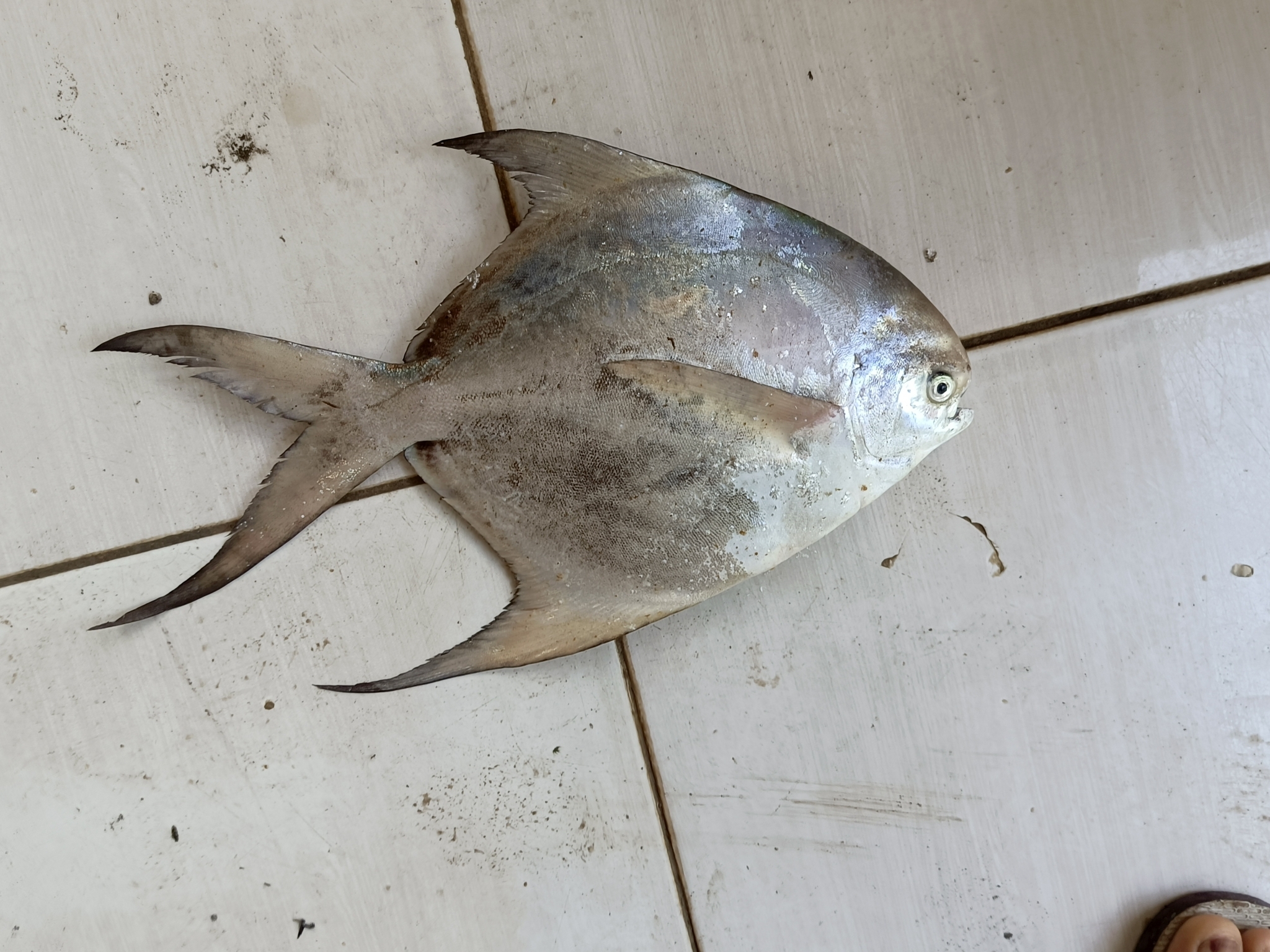
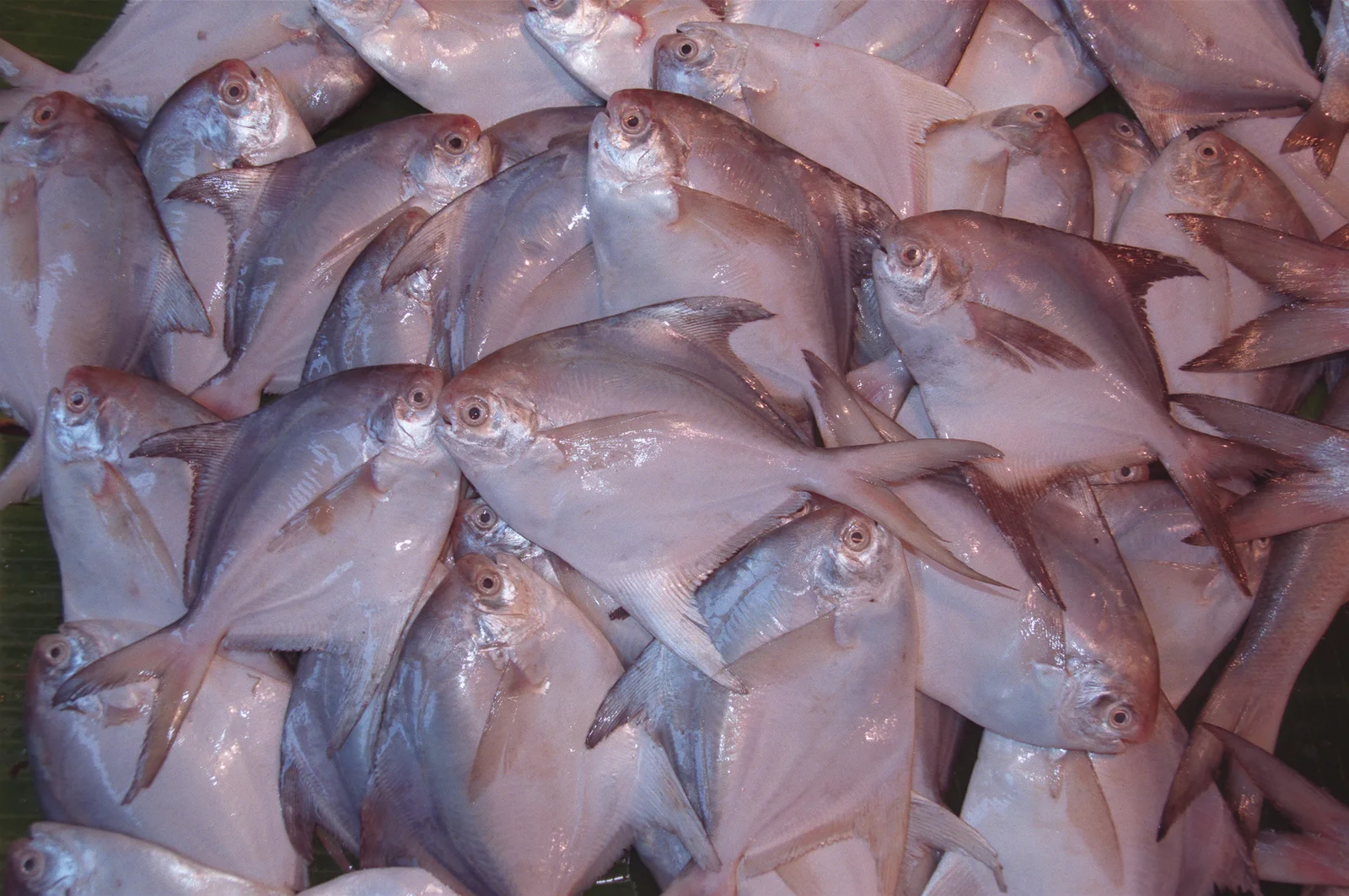
The grey pomfret is a small, deep-bodied pomfret of the Indo-West Pacific, recorded to 15.9 cm and known from a thin set of coastal records stretching from India to Japan. It is a fish of the market more than of the rod, and the public record leaves most of its biology unstated.
Identification
Pampus cinereus belongs to the Stromateidae, the pomfrets and butterfishes — laterally compressed, silvery, small-mouthed fishes with a deeply forked tail. Within Pampus the reliable characters are counts rather than colours: FishBase gives 37–41 soft dorsal rays, 36–41 soft anal rays and 36 vertebrae for this species.
Those numbers are high, and they are the practical defence against the commonest error in the group. Pomfrets are routinely reported under a single local name across several species, so a fish identified only by its Chinese market name — , , are all in circulation — may be a different Pampus entirely. Counting fin rays, not comparing photographs, is what separates them.
The maximum recorded length is 15.9 cm. No common length, weight or age is published for the species, so the record describes a ceiling, not a typical fish.
WoRMS carries the name as an accepted species under AphiaID 273994.
Habitat and distribution
FishBase gives the range as the Indo-West Pacific: India, north to Japan, south to the Malay Peninsula including Thailand, and adds "probably throughout its range" — a phrase that signals how patchy the records are rather than a confident distribution.
The occurrence data is sparse but consistent with that: 112 GBIF records in total, led by China with 52, then Malaysia 18, India 12 and Thailand 8. iNaturalist holds a single observation for the taxon. A record set this thin cannot distinguish a genuinely uncommon fish from a commonly confused one, and the difference matters.
The species is marine and benthopelagic, in subtropical water, with no depth band published. There is no temperature range, no substrate note and no habitat description beyond the milieu term.
Season and fishing approach
No spawning season, maturity length, age or diet composition is recorded for Pampus cinereus. Whatever an angler knows about when pomfrets appear, it comes from local experience, and no published source consulted for this page supports a season.
What the record does support is gear. Pomfrets are soft-bodied, small-mouthed fishes taken on small baits or lures fished in the water column rather than on the bottom, and the benthopelagic classification points to fishing just off the seabed rather than on it. The listed methods — a boat working near the recorded level, or a float rig set to hold at that level — follow from the mouth size and the milieu, not from a species-specific technique.
Edibility and regulations
FishBase lists no fisheries, aquaculture, gamefish or aquarium use for the species, which is a statement about the database rather than about the fish: pomfrets are eaten across their range and appear in markets. The IUCN category is Not Evaluated, the species is harmless to humans, and it is absent from CITES and CMS.
Because it is unassessed, no size limit or bag limit specific to Pampus cinereus is published in the sources used here. General coastal fisheries rules where it is caught still apply.
How to catch it
Boat bottom fishing
Anchored or drifting boat, bait or lure worked near the recorded bottom.
Float fishing
Float rig set at the depth where the fish is holding.
Regulations before you keep it
These are the published regulations for this fish. Read the number first. The notice below it is the actual regulation.
Minimum size2
Fork length ≥180 mm
China — national · CN-NATIONAL
National standard (MOA Notice 2018 No. 3): the minimum catch size for grey pomfret in the Bohai, Yellow, East China and South China Seas is fork length ≥ 180 mm; smaller individuals count as juveniles. This is a standard for commercial catches. The notice does not address recreational angling, so whether an undersized fish must be released by an angler depends on the local fisheries authority.
National and Zhejiang tiers both apply: national fork length ≥180 mm, Zhejiang ≥155 mm; the stricter (≥180 mm) governs.
Weight ≥110 g, or fork length ≥155 mm
China — Zhejiang · CN-ZJ
Zhejiang commercial catch standard (Zhejiang Fisheries Notice 2015 No. 7): the catch size for grey pomfret is ≥ 110 g, or fork length ≥ 155 mm, applied as either a weight or a length threshold. The notice does not address recreational angling, so whether an angler must release an undersized fish depends on the local fisheries authority.
National and Zhejiang tiers both apply: national fork length ≥180 mm, Zhejiang ≥155 mm; the stricter (≥180 mm) governs.
Season / closure1
From 12:00 on May 1 to 12:00 on September 1, September 16 or August 16, depending on the area
China — national · CN-NATIONAL
All Chinese coastal waters (MAR Notice 2023 No. 1): the summer moratorium starts at 12:00 on 1 May and ends at 12:00 on 1 September, 16 September or 16 August depending on the sea area, and applies to capture operations. All gear types except hook-and-line are closed; rod-and-line fishing is outside the moratorium gear list, but hook-and-line vessels must still report port entry and exit, and coastal provinces may adopt stricter measures.
The closure has three area-based windows, all starting at 12:00 on May 1 and ending at 12:00 on September 1, September 16 or August 16.
Every record above names its source and the date it was retrieved. See the regulation register for the full list, or how to read these regulations.
Where these facts come from
Check these pages before you rely on a size, range or protection status.
-
FishBase — Pampus cinereus
— FishBase · T2
-
GBIF — Pampus cinereus occurrence records
— GBIF · T2
-
IUCN Red List — Pampus cinereus
— IUCN · T1
-
Photo record — iNaturalist
— iNaturalist · T3