No recreational fishing allowed
United States — federal (Atlantic) · US-FED-ATL
Federal Atlantic rules close the recreational windowpane flounder fishery.
Windowpane Flounder No recreational fishing allowed.

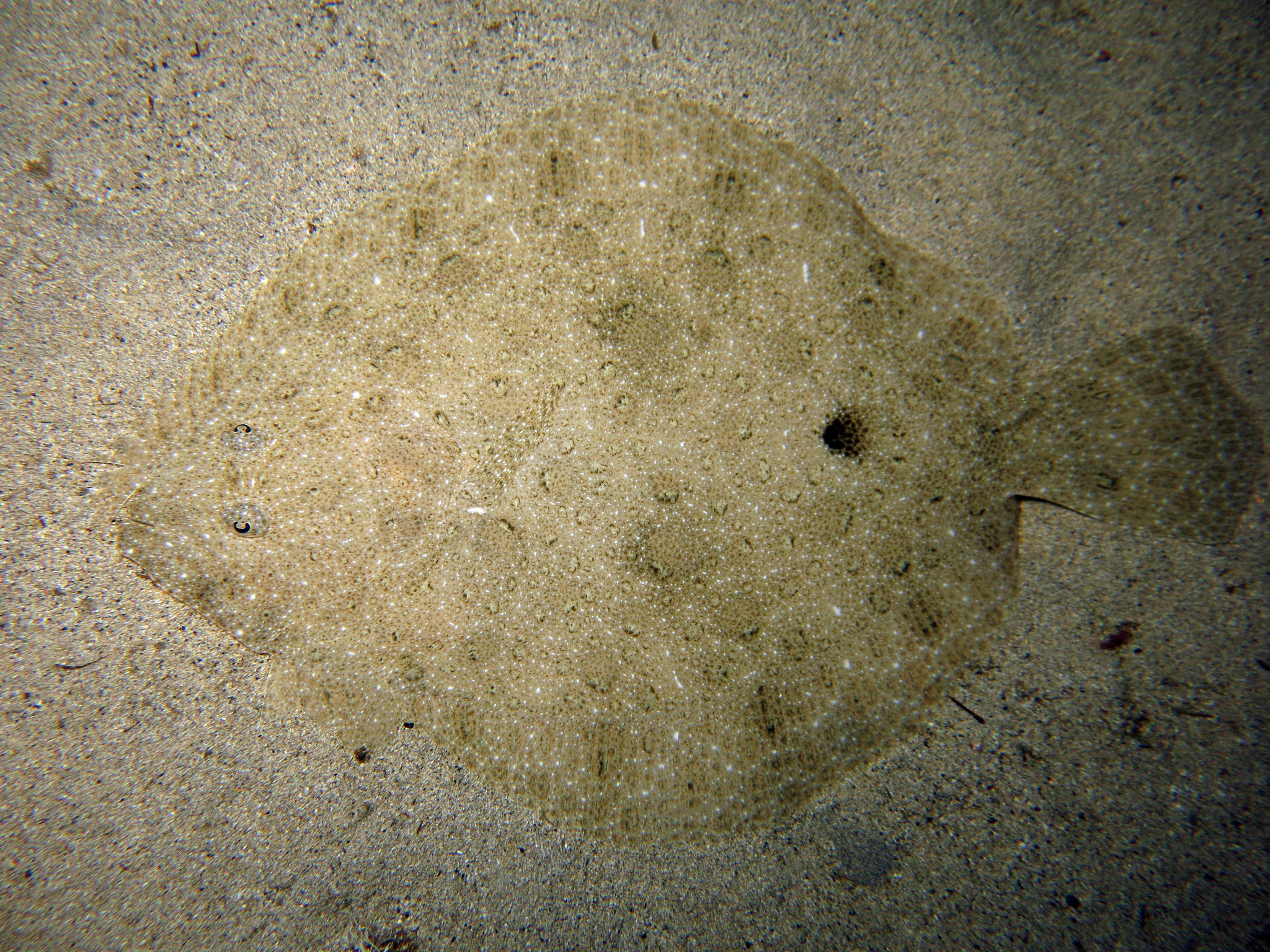
The windowpane is the translucent flatfish of the northwest Atlantic, common on sandy bay bottoms from New Jersey to Massachusetts. Its thin, light-passing body gives the fish and the family their names. It is usually a bycatch of fluke and winter flounder trips, taken on small baits dragged slowly over clean sand in shallow water.

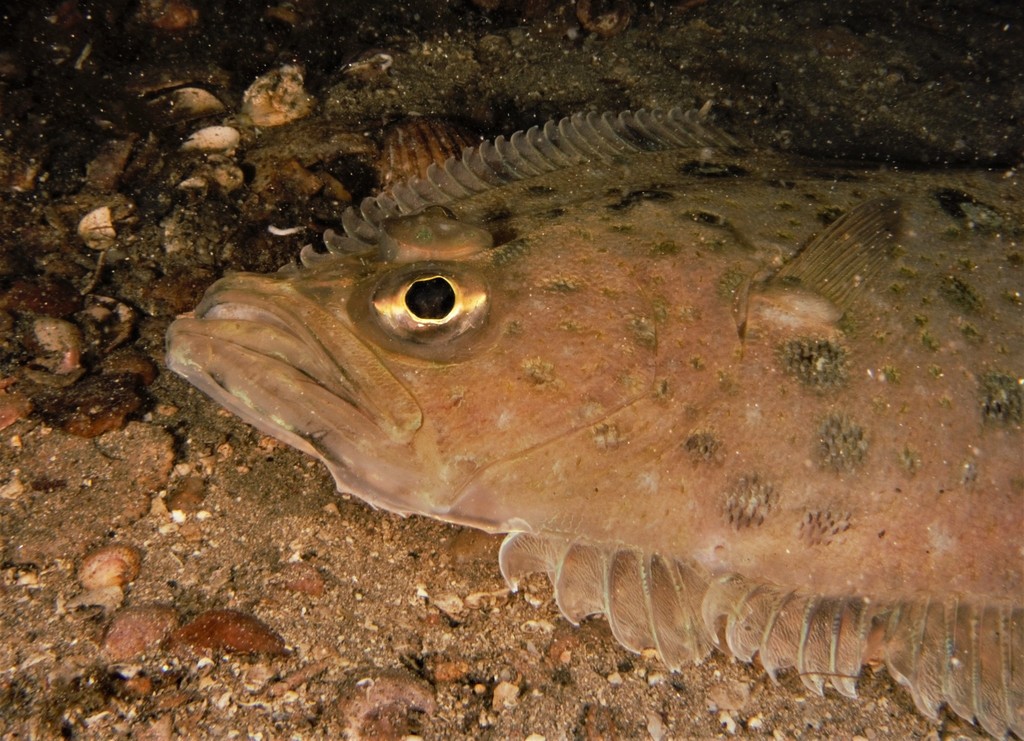
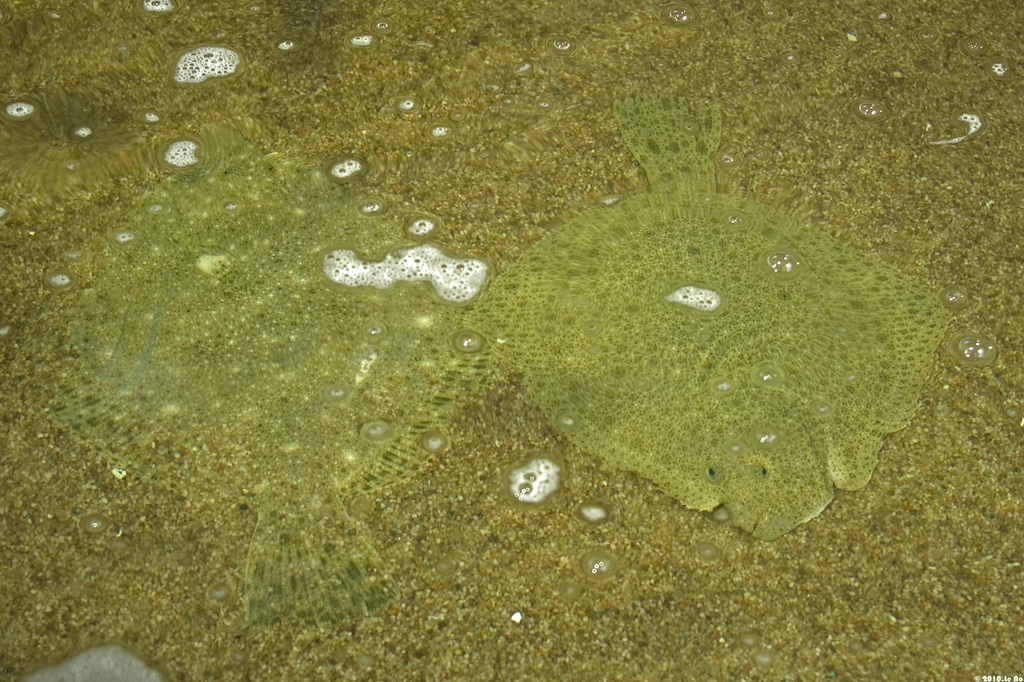
The windowpane is the flatfish you can read a newspaper through. Its body is thin and translucent enough that light passes through the flesh, which is where both the English name and the family name come from, and it is common enough on the sandy bottom of the northwest Atlantic that almost anyone who has fished a bay from New Jersey to Massachusetts has seen one without knowing what it was.
Scophthalmus aquosus was described by Mitchill in 1815 and belongs to the Scophthalmidae, the turbots, a family of left-eyed flatfishes with a rough, almost scaleless upper surface. WoRMS carries the name as accepted.
The transparency is not a trick of the photograph. The species is described in the FAO species identification guide as having a body so thin and translucent that the dark pigment of the blind side shows through, and the common name has been in English use since the colonial period. FishBase lists "windowpane" as the American Fisheries Society accepted name and "windowpane flounder" as the FAO name.
Chinese usage has no single settled name either: FishBase records as the FAO rendering and as a vernacular, both of which describe the same "glass turbot" idea.
The range is a single, unbroken western Atlantic strip: from the Gulf of St. Lawrence and Nova Scotia south to Florida. GBIF holds 37,672 records, 27,402 of them from the United States and 10,151 from Canada — a distribution weighted toward the northern half of the range, which is where the shelf is widest and the trawl surveys are densest. iNaturalist, which depends on photographs rather than nets, has only 360 observations, a reminder that this is a fish most people meet as bycatch rather than as a target.
It is also present in most bays and estuaries along the US coast south of Cape Cod, and north of Cape Cod it stays mostly in nearshore water.
Here the sources disagree in an instructive way. FishBase gives a depth range of 55–73 m; the FAO account used by the Virginia Institute of Marine Science says the species lives in relatively shallow water, less than 110 m, and is most abundant from 1–2 m to usually less than 56 m; Wikipedia splits the difference at 5–73 m.
All three are describing the same fish. The FAO figure is an abundance description, the FishBase figure is a captured record range, and the discrepancy is a useful reminder that a depth field in a database is a summary of what has been caught, not a habitat map. What the biology says is more consistent: this is a shallow-shelf flatfish of sand, sand-silt and mud, and it moves deeper as it grows.
Adults are euryhaline, recorded at salinities from 5.5 to 36.0 ‰, which is why the species turns up well inside estuaries. They are also sensitive to low oxygen: few individuals are collected where dissolved oxygen falls below 3 mg/l. For an angler working a back bay in late summer, that is a real constraint — the fish will avoid the stagnant pockets even when the depth and bottom look right.
The spawning season is unusually long and, in the Middle Atlantic Bight, apparently split. Spawning begins in February or March in inner shelf water, peaks in the Middle Atlantic Bight in May, extends onto Georges Bank through the summer, and continues into autumn at the southern end of the range. In the Middle Atlantic Bight the species shows two peaks, one in spring and one in autumn.
Spawning happens in the evening or at night, on or near the bottom, at 6–21 °C. The eggs are buoyant, spherical, 0.9–1.4 mm across, with a single oil globule. Females mature at 3–4 years and about 22 cm total length.
FishBase's headline figures are 45.7 cm total length and a maximum reported age of 7 years. The FAO account adds the weight that FishBase leaves out: the species seldom exceeds 350–400 g. A seven-year-old fish of 45 cm and 400 g is a thin, fast-growing flatfish, not a heavy one.
Juveniles and adults feed on small crustaceans — especially mysids and decapod shrimps — along with fish larvae and small fishes. That is a diet built on what drifts or swims just above the bottom, which is why the species is caught so often in trawls towed for other flatfish.
The predator list is long and reads like a who's who of the northwest Atlantic demersal community: spiny dogfish, thorny skate, goosefish, Atlantic cod, black sea bass, weakfish and summer flounder, with juveniles taken most heavily.
That position in the food web explains the fishery. A thin, small, low-value flatfish that lives where trawls work and is eaten by everything larger than itself is exactly the profile of a bycatch species.
FishBase records the species under "Fisheries: commercial". The FAO account is more precise: the windowpane is not targeted by commercial fisheries, but is caught as bycatch in bottom trawl fisheries and rendered into fishmeal.
The landing history follows that role. Landings in the Gulf of Maine–Georges Bank region peaked in 1991 at about 2,800 t, then fell sharply and have stayed below 1,000 t; global landings total 43,850 t from 1950 to 2024. The mid-1980s increase in the northern part of the range is attributed not to demand for windowpane but to fleets moving offshore and targeting alternative species as the stocks of more marketable flatfish declined.
The FAO account states plainly that the stock is considered overexploited. Against that, the IUCN Red List assessed the species as Least Concern in 2021. Both can be true at once: a wide-ranging species with a large population can be globally secure while a particular fished stock is depleted.
In US federal waters the windowpane is managed inside the Northeast Multispecies (Groundfish) Fishery Management Plan, and it is split into two stocks, northern and southern windowpane flounder.
The management is not built around landing it. For fishing year 2025, the common pool possession limit for windowpane flounder is "possession prohibited", alongside ocean pout and Atlantic wolffish. The stock is also handled as a choke species for the scallop fishery: under 50 CFR 648.90, the Atlantic sea scallop fishery receives sub-ACLs equal to 21% of the northern windowpane ABC and 36% of the southern windowpane ABC.
In plain terms: the federal rules mostly exist to limit how many windowpanes die in other people's nets, not to allocate them to a windowpane fishery. State rules inside three miles are separate and vary by state.
IUCN Least Concern, an accepted name in WoRMS, 37,672 GBIF records and a federal management plan: by the usual measures this is a well-documented species.
And yet the biology is thinner than that list suggests. There is no diet composition by weight or season in the sources used here, no growth curve in FishBase, no larval description, and the depth range depends on which database you open. The two figures that a angler would actually want — what a legal fish weighs and how old it is — are a 350–400 g ceiling from a 2002 FAO guide and a 7-year maximum from a reference FishBase has been carrying for decades.
That is the honest state of the page: a fish everybody catches and almost nobody studies for its own sake. If you catch one, the useful things to record are length, weight and depth — the three numbers the literature is shortest on.
Anchored or drifting boat, bait or lure worked near the recorded bottom.
These are the published regulations for this fish. Read the number first. The notice below it is the actual regulation.
Federal Atlantic rules close the recreational windowpane flounder fishery.
Windowpane Flounder No recreational fishing allowed.
Massachusetts closes the recreational windowpane flounder fishery.
Windowpane Flounder N/A Closed Prohibited
Every record above names its source and the date it was retrieved. See the regulation register for the full list, or how to read these regulations.
Check these pages before you rely on a size, range or protection status.
These fish live in the same place.
Technique, gear and safety guides that fit Windowpane.