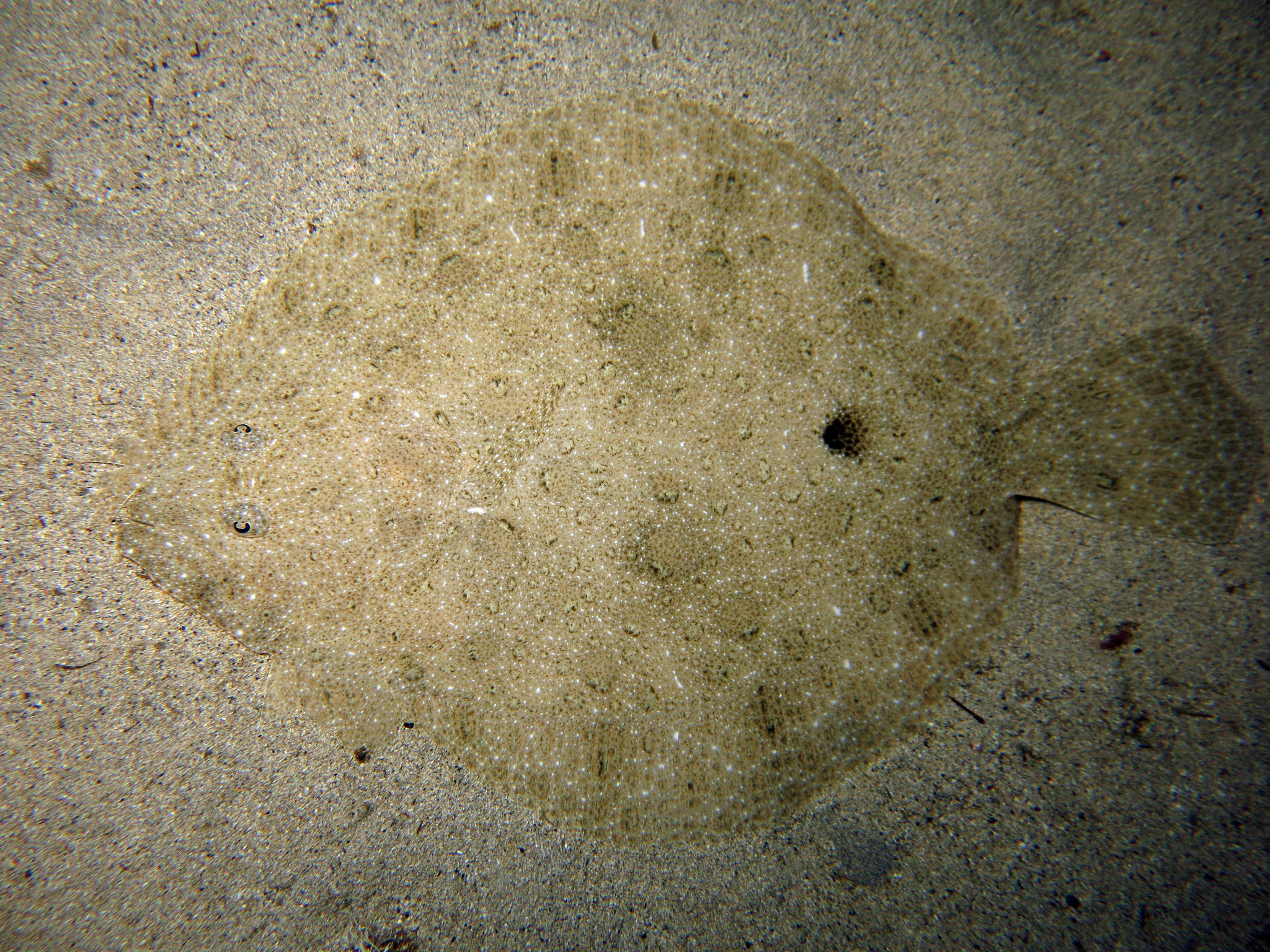
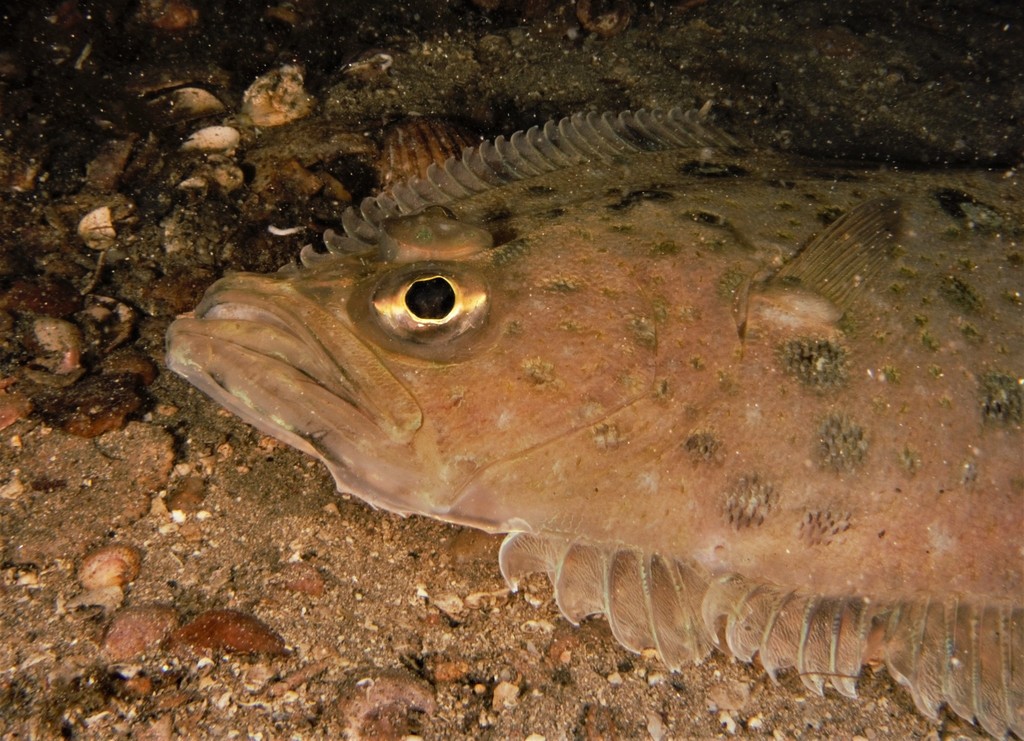
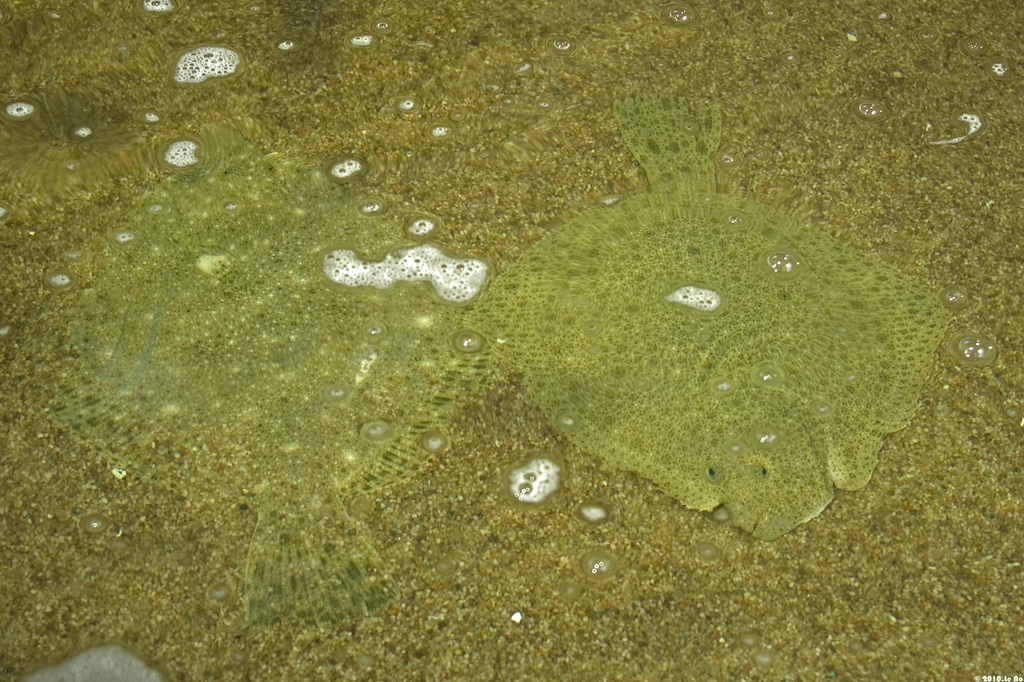
A brill is not found by hunting deep water. It is found by locating the seam where sand gives way to mud, then putting the bait on the correct side of that seam. The fish is a bottom specialist before it is a depth statistic.
Sand, mud, and the line between them
FishBase tags the habitat with one word: sandy. Wikipedia adds a second: the fish lives on a surface that is "either sandy or muddy depending on where they are". The two statements are not a contradiction so much as a scale problem. At the scale of a species page, sandy is the dominant label. At the scale of a bay, the same fish can sit on mud.
GBIF's distribution statement places the fish in soft, tidal ground: the Westerschelde, Oosterschelde, Zeeschelde, Voordelta, Grevelingen and the Scheldt Estuary, alongside open-water entries such as the Baltic Sea, the Black Sea and European marine waters. Those names are not a forecast for tomorrow, but they describe the kind of ground the records come from: tidal sand and mud, not rock.
iNaturalist carries 212 observations of the species, a modest set that still places it in the hands of divers and anglers rather than only on trawl decks.
For a lure or bait, the practical translation is a boundary. A flatfish lying on uniform sand has no edge to ambush from. A flatfish on the sand-mud seam has one. The seam usually shows on a sounder as a change in return strength, and on the bottom as a change in how the lead holds.
5–50 metres, or the deeper version
FishBase records the species between 5 and 50 m and places it in temperate water from 64°N to 26°N. Wikipedia says the fish is found "primarily in deeper offshore waters" and then adds that brill are "usually in shallow waters or below 100 meters at seafloor". Those two descriptions cannot both be precise. The FishBase envelope is a hard number; the Wikipedia sentence mixes shallow and below-100 m in one clause.
The usable reading is the narrower one. Five to fifty metres is where the source puts the species, and it is the band a boat can work with normal inshore gear. The Wikipedia line is a warning, not a second range: some brill are taken deeper, and the page gives no maximum for that deeper group. Treat 50 m as the edge of the documented band, not the edge of the fish.
30 cm is the fish; 75 cm is the record
The size block separates three fish. The length ceiling is 75 cm TL. The typical fish measures 30 cm SL. The heaviest published specimen weighed 8 kg, and the oldest recorded individual was 6 years old. TL runs from snout tip to tail tip; SL stops at the base of the tail, so a 30 cm SL fish is longer than 30 cm TL.
The 75 cm fish is a record, and the 8 kg figure belongs to it. The 30 cm fish is the one the species is built around. Between them sits the fish most anglers will actually see, and the page gives no median. That gap matters for gear: a 30 cm flatfish does not need a 100 kg leader, and a 75 cm one can still be levered off the bottom with a stiff rod.
Maturity at 37 cm
The release line is around 33 cm: below that, the sample data place brill below first maturity, so undersized fish go back. Between 33 and 41 cm the page cannot say which fish has spawned. A 30 cm fish, the common size, is therefore in the protected band, not the keep band.
The age record is 6 years. Maturity in the high 30s leaves only a brief stretch between first reproduction and the end of life. With no growth curve on the page, that 6-year figure is the single number from which turnover can be inferred.
The strike comes from the bottom
Brill is demersal, and FishBase files its prey under crustaceans and fishes. The page does not describe the strike, the burial depth or the distance from which the fish takes a bait. What it does give is the ambush logic: a flatfish on sand or mud waits on the bottom, and the prey has to come to it.
That changes the retrieve. A bait dragged fast through mid-water asks the fish to chase. A bait that hops along the bottom, pauses, and lifts once asks the fish to intercept. The pause is the part that matters, because the fish is lying on the substrate rather than cruising above it.
March to August in the Mediterranean
The spawning table marks March through August, with a single regional record from the Mediterranean. No other regional rows appear. The page therefore supports a spring-summer spawn in the Mediterranean and does not support a separate Atlantic calendar.
For a European angler, that is a six-month window in the southern part of the range and an unanswered question in the north. The absence of a North Sea or Baltic spawning row is not evidence that spawning does not happen there; it is evidence that the table does not record it.
Commercial landings, gamefish status, Least Concern
FishBase records both a commercial fishery and a gamefish designation. Its Red List entry is LC, assessed 10 December 2020. Neither CITES nor CMS has assessed the species. The page also notes that it poses no danger to people.
Those labels sit together without conflict: a commercially landed flatfish can also be a sport fish, and a Least Concern assessment is a population judgment, not a landing rule. Local size and bag limits are separate documents and are not on this page.
Reading the bottom before the cast
Start with the seam, not the depth. Mark the sand-mud change on the sounder, then drift so the bait crosses it rather than running parallel to it. Keep the lead light enough to feel the change in hold; a heavy lead smooths out exactly the signal you are trying to read.
Fish the documented 5–50 m band first. If the screen shows a clean sand plain with no edge, move; nothing in the substrate description argues for staying. Record the bottom type with the catch, not just the depth, because the next brill is more likely to come from the same kind of seam than from the same number on the sounder.
Regulations before you keep it
These are the published regulations for this fish. Read the number first. The notice below it is the actual regulation.
Minimum size4
The minimum size for Brill in Spain is ≥30 cm.
| Ramal (Scophthalmus rhombus) | 30 |
The minimum size for Brill in France is ≥30 cm.
| BARBUE | Scophtalmus rhombus | 30 cm |
The minimum size for Brill in Portugal is ≥30 cm.
Rodovalho (Scophthalmus rhombus) | 30 cm
≥30 cm (ICES divisions 7d and 7e only)
United Kingdom · UK
The minimum size for Brill in UK waters is ≥30 cm (ICES divisions 7d and 7e only).
| Brill | Scophthalmus rhombus | 30 cm (7d and 7e only) |
Every record above names its source and the date it was retrieved. See the regulation register for the full list, or how to read these regulations.
Where these facts come from
Check these pages before you rely on a size, range or protection status.
-
FishBase — Scophthalmus rhombus
— FishBase · T2
-
GBIF — Scophthalmus rhombus occurrence records
— GBIF · T2
-
IUCN Red List — Scophthalmus rhombus
— IUCN · T1
-
Photo record — iNaturalist
— iNaturalist · T3