
Bigeye scad
Fusiform, compressed, and about as plain as a jack outline gets. What separates it from its relatives is arithmetic: nine dorsal spines with 24 to 27 soft rays, three anal spines with 21 to 23 soft rays. The eye is large for the head and the names say so — Bigeye scad, goggle-eye, and the Chinese aliases and all describe the same feature.
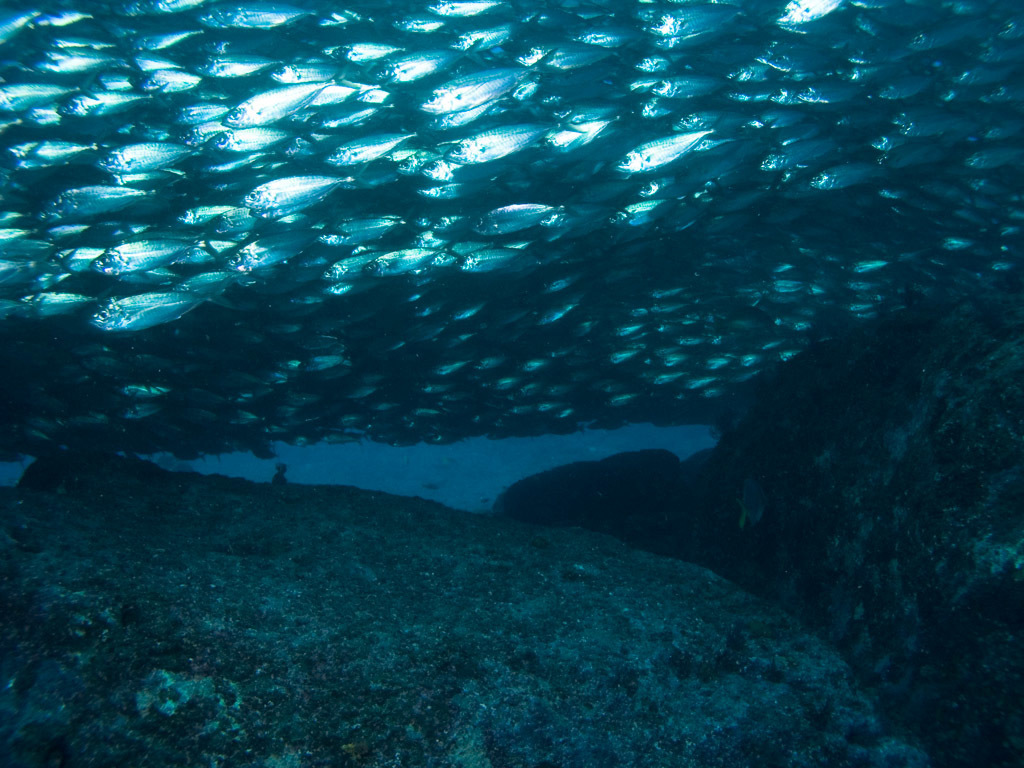
Fusiform, compressed, and about as plain as a jack outline gets. What separates it from its relatives is arithmetic: nine dorsal spines with 24 to 27 soft rays, three anal spines with 21 to 23 soft rays. The eye is large for the head and the names say so — Bigeye scad, goggle-eye, and the Chinese aliases and all describe the same feature. It belongs to the subfamily Caranginae, where several small species overlap in silhouette, so a photograph taken in bad light is worth less than a fin count. Locally, akule and halalū are age classes rather than taxa, and which name applies matters when a bag limit is written around one of them.
An island fish, not a coastal one
The range comes in four pieces: Indo-Pacific from East Africa to Rapa, north to southern Japan and Hawaii, south to New Caledonia; eastern Pacific from Mexico to Peru including the Galapagos; western Atlantic from Nova Scotia and Bermuda through the Gulf of Mexico and the Caribbean to São Paulo; eastern Atlantic from Cape Verde to southern Angola. The ecological note is more useful than the map. Adults prefer clear water around islands over ordinary neritic shelf and only occasionally enter turbid water. Depth is listed from the surface to 170 m, but the usual band is 2 to 10 m. That shallow figure is why a ledge, a harbour mouth or a fish-aggregating buoy can all be sensible starting points.
The school comes apart at dusk
No spawning months appear in the record, so a month-by-month table would be invention. Latitude runs from 47°N to 31°S, which puts subtropical and tropical water under one name; the same month is a different season at the two ends. What the record does give is behaviour. The fish are mainly nocturnal, holding compact groups by day and dispersing at night to feed — on small shrimps, benthic invertebrates and forams inshore, on zooplankton and fish larvae offshore. That one line sets the fishing clock better than any calendar. Maximum age is three years, so the stock turns over quickly and the size of fish you meet follows the strength of recent recruitment.
Find the group before choosing a rig
The groups are reported to hold hundreds of thousands of fish, which sounds like an advantage and is really a warning: miss the group and the water is empty. Work the light first. A lamp or a little chum holds a school alongside, and a sabiki string of small flies, flash or fish-skin strips is then fished down through the column until the depth is found. Light jigging with a micro jig or small metal spoon retrieved fast works once the fish have pushed up. Bait — small shrimp or cut fish on a light hook — drifts with the chum and is the slowest but most controllable option. Because the fish feeds by sight at night, illumination matters more than scent, and strong light drives the school down while a side light or a dimmer lamp usually keeps it higher. The species is itself a bait fish, which is worth remembering when the box is full.
Tackle sized to the fish in front of you
Seventy centimetres is the recorded maximum, and it is an outlier. Build the rig around the small fish you can see and still let it survive a surprise. A light boat rod or a long shore rod with a small spinning reel, fine braid and a short clear leader is enough; the fine leader matters under lights in clear water. Sabiki hook size should match the mouth rather than the ambition, because oversized hooks simply refuse fish. Sinkers are expendable around ledges and buoys, so carry light ones and accept the loss instead of fishing heavy to prevent it. If you switch to a micro jig, the rod tip should show the lure working; a stiff tip filters out the tap. Changing the depth of the rig is usually more productive than changing the lure.
Market fish, bait fish, and the net rules
The species is rated highly commercial and sold fresh, salted or dried, as well as being a gamefish and a usual bait. Hawaii's rules deal with akule and halalū specifically: from July through October, netting of fish under 8.5 inches is prohibited, and no more than 200 lb of akule under 8.5 inches may be held or sold per day. Handline recreational fishing is not caught by that net provision, but general rules and protected areas still apply. Non-residents need an NRMFL for recreational saltwater fishing, and commercial sale needs a CML. One safety point belongs in the same paragraph: ciguatera poisoning has been reported for this species, so a large reef-caught fish deserves a second thought about origin and size.
What the record leaves open
Four sources carry this entry: FishBase for classification and biology, iNaturalist for 782 observations and the two photographs, GBIF for checking that the species page exists, and the Hawaii Division of Aquatic Resources for the rules. The gaps are specific. No common length and no maximum weight are published, and the 70 cm figure is a reported maximum rather than a measured norm. No occurrence total came back from GBIF, so observation density cannot be compared between island chains. And with no spawning months at all, the season section discusses light and depth instead of a calendar.
How to catch it
Boat fishing
Fished with the listed approach, matched to the recorded depth and size.
Jigging
Fished with the listed approach, matched to the recorded depth and size.
Boat fishing
Fished with the listed approach, matched to the recorded depth and size.
Where these facts come from
Check these pages before you rely on a size, range or protection status.
- FishBase — Selar crumenophthalmus — FishBase · T2
- GBIF — Selar crumenophthalmus occurrence records — GBIF · T2
- IUCN Red List — Selar crumenophthalmus — IUCN · T1
- Photo record — iNaturalist — iNaturalist · T3
Fish in the same water
These fish live in the same place.

African pompano
- Family
- Carangidae
- Depth
- 60–100 m

Almaco jack
- Family
- Carangidae
- Depth
- 5–245 m

Atlantic horse mackerel
- Family
- Carangidae
- Depth
- 0–1050 m
- Season
- Jan, Feb, Mar, Apr, May, Jun, Jul, Aug, Sep, Oct, Nov, Dec
Guides for this water
Technique, gear and safety guides that fit Bigeye scad.