
Lookdown
Lookdown is a carangid of the western Atlantic, from Canada and Maine south through Florida, Bermuda and the Gulf of Mexico to Uruguay. It is a shallow subtropical fish from 1 to 53 m, reaches 48.3 cm TL and 2.1 kg with a common length of 35 cm, and is listed as a gamefish and a minor commercial species. Shore casting with lures, boat fishing and small hook rigs are the methods listed.
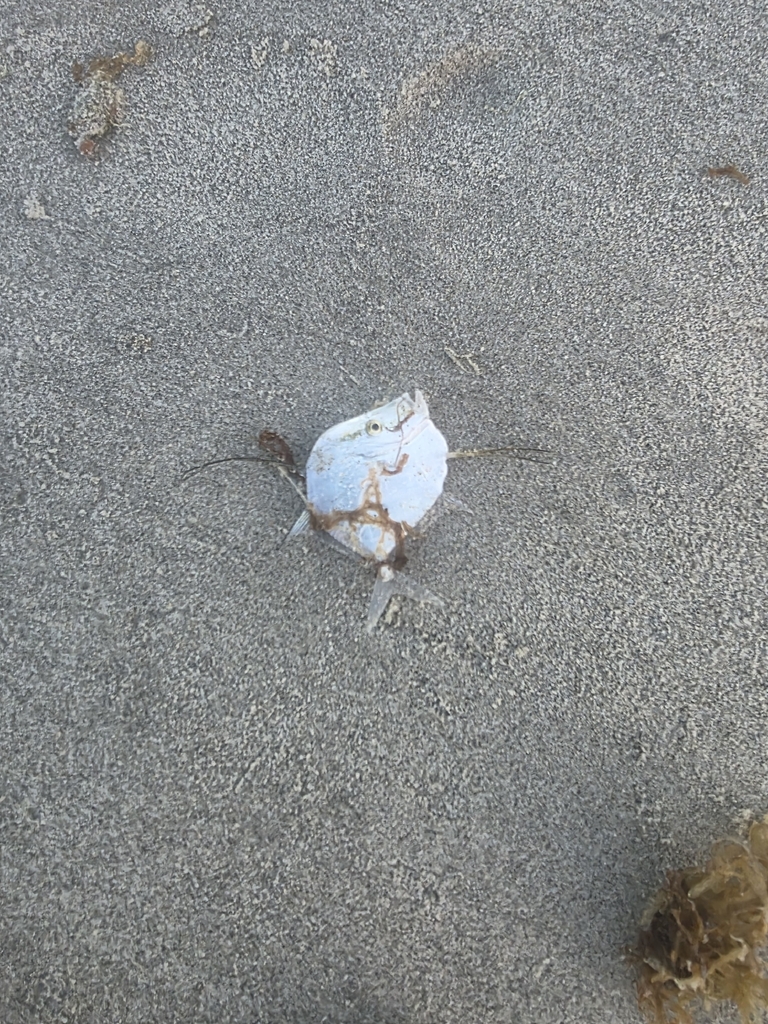
The lookdown is a carangid of the western Atlantic, recorded by FishBase from Canada and Maine south through Florida, Bermuda and the Gulf of Mexico to Uruguay; it is described as rare in the Greater Antilles. It reaches 48.3 cm TL and 2.1 kg, with a common length of 35 cm. It is a subtropical, shallow-water fish from 1 to 53 m, listed as a gamefish and as a minor commercial species.
Identification
The lookdown is unmistakable in silhouette: a deep, strongly compressed body with a steep forehead, a small mouth and a high-set eye. FishBase gives anal-fin counts but no body-shape field for the species, so identification rests on the profile and on photographs rather than on fin counts. The body is silvery in most images. Juveniles are similar in shape and are also seen in estuaries and off sandy beaches.
Habitat and distribution
Adults live in shallow coastal water, usually over hard or sandy bottom. Juveniles may be found in estuaries and off sandy beaches. The species schools, though it also appears in small groups or pairs. Adults feed on small crabs, shrimps, fishes and worms. The recorded depth range is 1 to 53 m.
The range is broad: Canada and Maine to Florida, Bermuda, the Gulf of Mexico, and the coasts of Central and South America to Uruguay. GBIF holds 4,122 occurrence records, led by the United States (2,681), Brazil (582) and Mexico (203).
Season and fishing approach
FishBase publishes no spawning table for the lookdown, so there is no month-by-month window to quote. It is a subtropical species, and at the northern end of its range it is a warm-season visitor rather than a year-round resident; in Florida and the Gulf it can be present for most of the year. Water temperature and the arrival of bait are better guides than the calendar.
The approved methods are shore casting with lures, boat fishing and a small-hook rig. The lookdown is a fast, sight-feeding fish of clear shallow water: small shiny lures, jigs and flies cast ahead of a cruising school work better than a static bait. Keep the offering small, because the mouth is small. From a boat, work the edges of sand flats and hard bottom and watch for the flash of turning fish.
Edibility and regulations
FishBase records the flesh as having excellent flavour and the fish as marketed fresh; it is also listed as a gamefish and as a public-aquarium species. The same entry records reports of ciguatera poisoning for the species. In areas where ciguatera occurs, that is a reason to be cautious with larger fish and to follow local health advice.
The IUCN Red List category is LC (Least Concern), assessed on 21 August 2012, with no CITES or CMS listing. Federal waters set no size, season or bag limit for lookdown; Florida and the Gulf states may, so check the rule where you fish.
How to catch it
Shore casting lure
Fished with the listed approach, matched to the recorded depth and size.
Boat fishing
Fished with the listed approach, matched to the recorded depth and size.
Small hook rig
Fished with the listed approach, matched to the recorded depth and size.
Where these facts come from
Check these pages before you rely on a size, range or protection status.
- FishBase — Selene vomer — FishBase · T2
- GBIF — Selene vomer occurrence records — GBIF · T2
- IUCN Red List — Selene vomer — IUCN · T1
- Photo record — iNaturalist — iNaturalist · T3
Fish in the same water
These fish live in the same place.

African pompano
- Family
- Carangidae
- Depth
- 60–100 m

Almaco jack
- Family
- Carangidae
- Depth
- 5–245 m

Atlantic horse mackerel
- Family
- Carangidae
- Depth
- 0–1050 m
- Season
- Jan, Feb, Mar, Apr, May, Jun, Jul, Aug, Sep, Oct, Nov, Dec
Guides for this water
Technique, gear and safety guides that fit Lookdown.