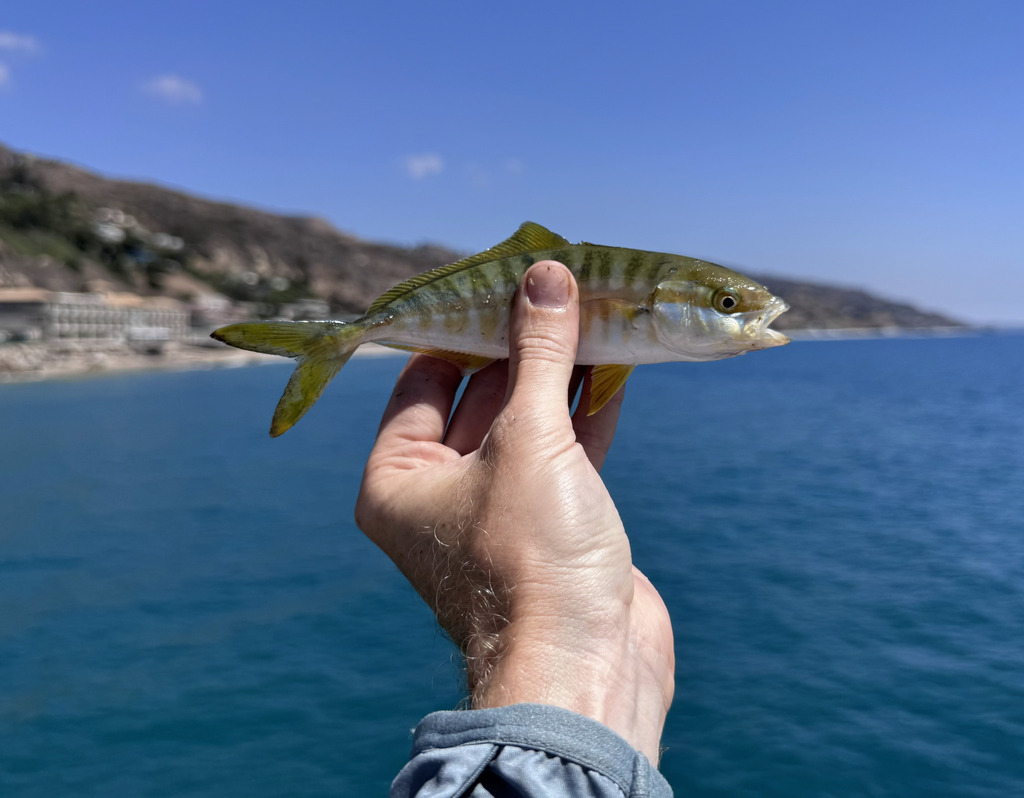
The California yellowtail's rule fits in one line and holds two numbers: ten fish a day, a 24-inch fork-length minimum, and no more than five of those ten may be shorter than 24 inches. Most arguments at the rail are not about tackle. They are about measuring to the fork instead of the tip, and about reading the five-fish exception as a guarantee rather than a ceiling.
No scutes on the caudal peduncle
The most reliable field mark sits on the tail. This is the only jack in its group without scutella, the hard ridge of modified scales running along the caudal peduncle. Run a thumb down the wrist of the tail and it is smooth. FishBase gives five to six dorsal spines and 33 to 35 soft rays, two to three anal spines and 20 to 21 soft rays. The back is dark blue, the belly almost white, and the border between them is sharp. A yellowish lateral band is often present and fades with age. Against S. lalandi the difference is geographic rather than visual.
A circumglobal range statement that overshoots the water
FishBase describes a circumglobal subtropical species built from disjunct populations, with the eastern Pacific running from British Columbia to Chile and including the Desventuradas and Juan Fernández islands. That sentence covers the whole yellowtail complex, so it is not a list of places to fish. Locally the fish shows on the outside edge of kelp, along current seams off rocky points, and over offshore banks and high spots. Adults run near the bottom or through midwater; juveniles school well offshore. The recorded depth range of 3 to 825 m belongs to the complex, and anglers almost never fish the deep end of it.
Warm water rather than the calendar sets the season
FishBase gives a preferred range of 18 to 24 °C and notes that the fish occasionally enters cooler water; no month-by-month spawning table is offered. In Southern California the fishery follows the warm water. Late summer into autumn is the steadiest stretch, and a warm year can carry fish into early winter. Blue water with bait close to the beach is a better indicator than any date. Through winter the schools move offshore or south and shore catches thin out, though fish still hold along the kelp. Treating a month as a promise ignores how far apart two neighbouring points can be.
Live bait along the kelp, iron over the rocks
Live bait is the main approach: a whole sardine or Pacific mackerel nose-hooked and slow-trolled just fast enough to keep it swimming, worked along the outside edge of the kelp. Iron splits into two jobs. A surface jig cast and retrieved fast when fish are up; a heavy jig dropped vertically onto the top of the rock and cranked back when fish are down. Around kelp, a live bait on a short leader and a single hook lets the bait sit in the gaps between stalks. The diet is fish, squid and crustaceans, so a dead bait only works when current gives it motion.
Fifty-pound braid because of the kelp, not the fish
An eight-foot medium-heavy conventional or heavy spinning rod, paired with a reel that holds 300 yards or more of 50-pound braid. Main line 50 to 65-pound braid, leader 30 to 40-pound fluorocarbon. The kelp and the rock edge cut line; the fish alone rarely does. Use 3/0 to 5/0 circle hooks on live bait and swap jigs to a single hook for easier release. Set drag to about seventy percent of the line rating and palm the spool when a fish turns for the kelp instead of locking down. A wide net matters, because yellowtail shake their heads at the surface.
Fork length, ten fish, and the five-fish exception
The flesh is dark and oily. Bleed and ice the fish and it slices well for sashimi, sears well and grills well; skip the bleeding and the flavour turns. California allows 10 fish a day with a 24-inch fork-length minimum, and no more than five of the ten may be shorter than 24 inches (14 CCR § 28.37). The measurement runs from the snout to the fork, not to the tip of the tail, and the two readings differ enough to matter on a fish near the line. State waters, generally 0 to 3 nautical miles, and federal waters from 3 to 200 can differ. Much of the Southern California reef and kelp lies inside marine protected areas. A licence is required from 16, plus the Ocean Enhancement Validation south of Point Arguello.
What the 250-centimetre figure does and does not cover
Taxonomy, the 3 to 825 m depth, the 18 to 24 °C preference, the fin counts, the distribution text and the diet come from FishBase. The 250 cm total length needs a caveat: it probably covers the whole complex, and California fish are far smaller. No source here gives a separate maximum for the California population, and FishBase lists neither a maximum weight nor a maximum age. IUCN rates the species Least Concern, assessed in 2015. GBIF treats S. dorsalis as a synonym, while this article follows the FishBase accepted name and the batch naming decision. Bag and size figures come from 14 CCR § 28.37; the month-by-month pattern is local experience.
How to catch it
Trolling
A whole sardine or mackerel nose-hooked and trolled just fast enough to keep it swimming, worked in a zigzag along the kelp edge.
Surf fishing
A bright jig cast well past the school and retrieved fast enough to leave a wake when fish are up.
Jigging
Drop the jig vertically to just above the structure, then crank and drop again for fish holding on the bottom.
Regulations before you keep it
These are the published regulations for this fish. Read the number first. The notice below it is the actual regulation.
Minimum size1
≥24 in fork length · up to 5 fish under 24 in may be kept
United States — California · US-CA
California requires yellowtail to be at least 24 inches fork length, but five fish below that size may be taken or possessed.
(b) Minimum size: Twenty-four inches fork length except that: Five fish less than twenty-four inches fork length may be taken or possessed.
Bag limit1
10 fish per person per day
United States — California · US-CA
California's daily bag limit for yellowtail is ten fish.
(a) Limit: Ten
Every record above names its source and the date it was retrieved. See the regulation register for the full list, or how to read these regulations.
Where these facts come from
Check these pages before you rely on a size, range or protection status.
-
FishBase — Seriola dorsalis
— FishBase · T2
-
GBIF — Seriola dorsalis occurrence records
— GBIF · T2
-
IUCN Red List — Seriola dorsalis
— IUCN · T1
-
Photo record — iNaturalist
— iNaturalist · T3