
Lesser amberjack
Lesser amberjack is a small western Atlantic carangid, common at 50 cm and reaching 67.5 cm fork length and 4.6 kg. Adults live near the bottom on outer reefs and deep structure from 55 to 348 m, while juveniles are pelagic offshore. It feeds on squid and fish and is often mistaken for a small greater amberjack.
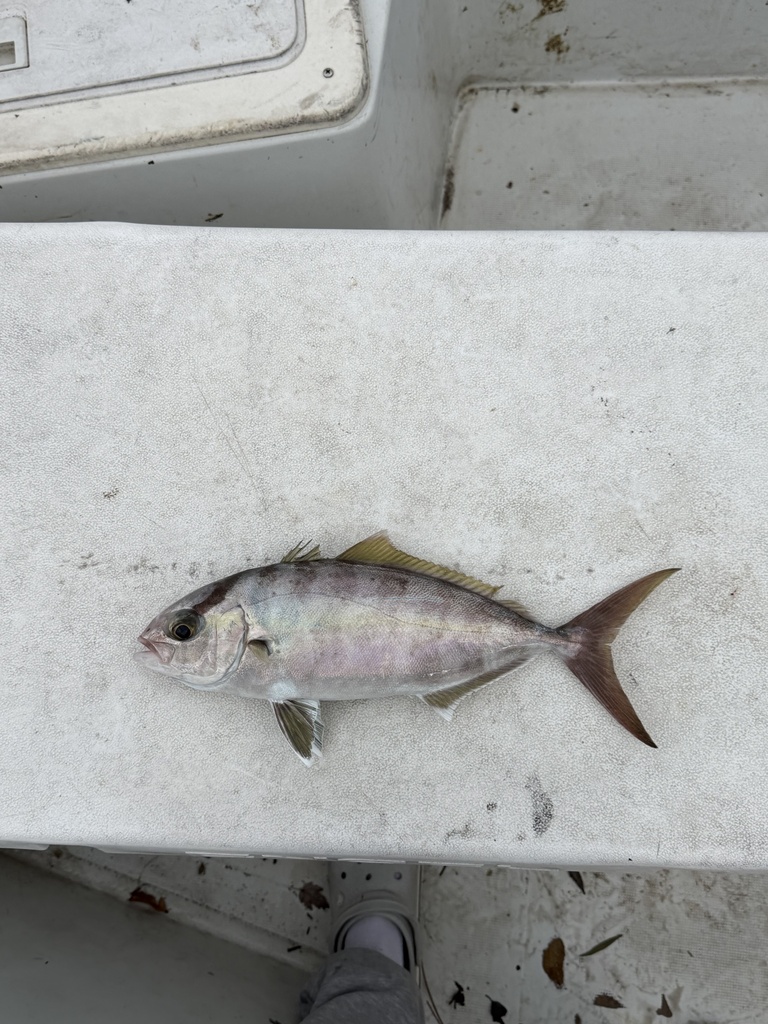
Lesser amberjack is a small western Atlantic carangid, common at 50 cm and reaching 67.5 cm fork length and 4.6 kg. Adults live near the bottom on outer reefs and deep structure from 55 to 348 m, while juveniles are pelagic offshore. It feeds on squid and fish and is often mistaken for a small greater amberjack.
Identification
Lesser amberjack is a small, deep-bodied jack with a large eye and a slightly protruding lower jaw. The body is olive to purplish brown above and paler below, and the dorsal soft rays number 28 to 33 while the anal soft rays number 17 to 20.
FishBase gives a maximum of 67.5 cm fork length, a common length of 50 cm and 4.6 kg. The large eye and deeper body separate it from a young greater amberjack, which is longer and heavier through the shoulder even at the same length.
Distribution and Habitat
The western Atlantic range runs from Massachusetts through the Gulf of Mexico and the Caribbean to Brazil. Records from Madeira and Turkey are complicated by past confusion with Seriola carpenteri, so the eastern Atlantic picture is less clear.
Adults are benthopelagic near the coast at 55 to 348 m, holding over deep reefs, ledges and wrecks. Juveniles are epipelagic in oceanic or offshore neritic water, which is why small fish turn up around floating debris far from land.
Habits and Diet
Adults feed on squid and fishes, taken near the bottom or just above structure. They are not a surface-schooling fish like rainbow runner, and a bait or jig has to reach the right depth before it is seen.
It is regularly landed by anglers deep-dropping for snapper and grouper, often without being identified as a lesser amberjack.
Fishing Methods
Vertical jigging is the most practical method: a 100 to 250 g slow-pitch jig dropped to the bottom, lifted two or three turns, then allowed to fall on a tight line. Most strikes come on the fall.
Bottom bait works when the current is too strong for jigging. A squid strip or fish chunk on a dropper loop above a heavy sinker keeps the bait just off the reef. Drifting across a deep ledge covers more depth than anchoring.
Gear and Approach
A 6 ft 6 in to 7 ft medium jigging rod with a 5000 to 8000 size reel, 30 to 40 lb braid and a 40 lb leader handles the size. Assist hooks on the jig reduce gut-hooking and make release easier.
Deep fish come up with barotrauma, so carry a venting tool or a weighted release device. If the fish is legal and kept, bleed it at once; if it is outside the 14 to 22 inch slot, send it back down rather than releasing it floating.
Seasonal Window
The fish are present year-round on deep structure, and warm months bring more consistent feeding and better weather to work the outer reefs. Cold fronts shut the deep bite down and make the ride out uncomfortable.
Current is the switch. A moderate drift over a ledge produces better than a dead calm, and the first hours of a building tide usually out-fish the slack.
Edibility and Handling
The flesh is pale, firm and moderately oily, good grilled, fried or in ceviche. FishBase notes ciguatera reports for the species, so large individuals from tropical reefs are a cautious choice.
Bleed and ice immediately, and keep the fish cool and covered on the ride in. Amberjack blood spoils the fillet quickly if the fish is left to thrash on deck.
Regulations and Conservation
Federal Gulf rules treat lesser amberjack and banded rudderfish together: 5 fish per person per day with a 14 to 22 inch fork-length slot, and fish under 14 or over 22 inches must be released.
Florida applies the same 5 fish combined limit and 14 to 22 inch slot. Mississippi also uses 14 to 22 inches and 5 fish combined. Alabama applies the slot and, where no bag is listed, the 20-fish reef-fish aggregate. Louisiana does not list the species, so the federal rule applies in federal water. Texas does not list it and warns anglers not to confuse it with greater amberjack, which is 1 fish at 38 inches.
The main management concern is release mortality: fish pulled from 100 m or more often come up with barotrauma, so venting or recompression matters more than the bag. The IUCN Red List lists lesser amberjack as Least Concern, assessed 21 August 2012. Rules change yearly, so measure fork length carefully and check the current notice before keeping fish.
How to catch it
Jigging
100 250
Boat bottom fishing
Drift fishing
Where these facts come from
Check these pages before you rely on a size, range or protection status.
- FishBase — Seriola fasciata — FishBase · T2
- GBIF — Seriola fasciata occurrence records — GBIF · T2
- IUCN Red List — Seriola fasciata — IUCN · T1
- Photo record — iNaturalist — iNaturalist · T3
Fish in the same water
These fish live in the same place.

African pompano
- Family
- Carangidae
- Depth
- 60–100 m

Almaco jack
- Family
- Carangidae
- Depth
- 5–245 m

Atlantic horse mackerel
- Family
- Carangidae
- Depth
- 0–1050 m
- Season
- Jan, Feb, Mar, Apr, May, Jun, Jul, Aug, Sep, Oct, Nov, Dec
Guides for this water
Technique, gear and safety guides that fit Lesser amberjack.