
Australian barracuda
The Australian barracuda is a metre-long predator of southern Australia's cool green water, caught from rocks and from boats. Its identity is settled by geography rather than by stripes or fin counts: if you are south of the range of the other barracudas, this is the one. Fish it with fast-retrieved lures or live bait along current edges.

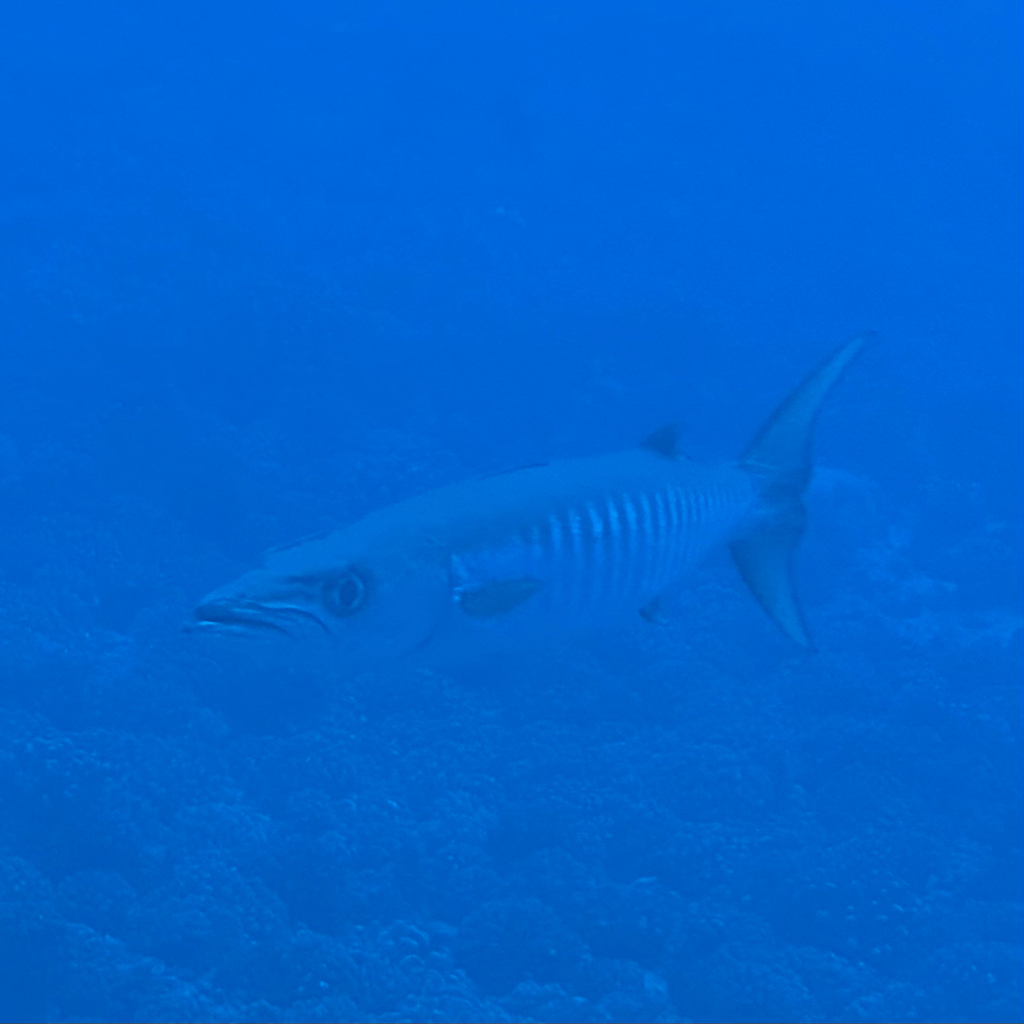
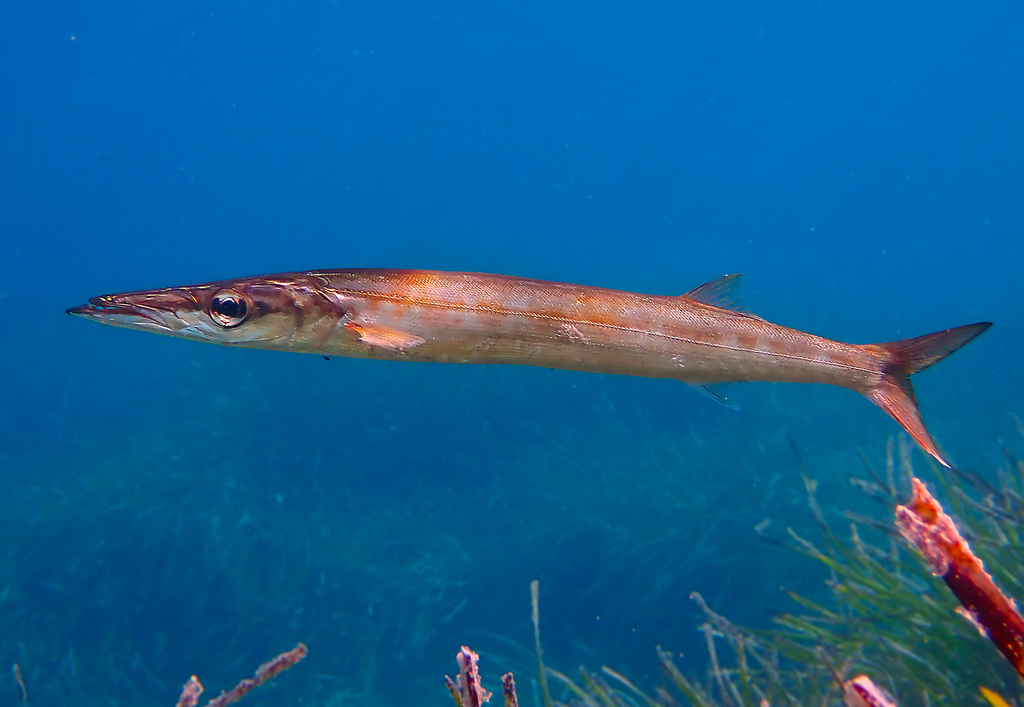
The Australian barracuda is the barracuda of the southern Australian coast: a metre-long, fish-eating predator of cool, green water that is caught both from the rocks and from a moving boat. It is one of the few barracudas whose identity can be settled by looking at a map before looking at the fish.
The barracuda of the southern coast
Sphyraena novaehollandiae is an accepted species in the family Sphyraenidae, the barracudas — a group built for acceleration, with an elongate body, a long pointed snout, a lower jaw that projects past the upper, and canine teeth that make a hand landing a bad idea.
Within that group this is a large fish rather than a small one. FishBase records a maximum of 100 cm total length. The common length, the weight at that length and the age are all unrecorded, so the only defensible statement about size is the ceiling: 100 cm is the largest measured fish, not a typical one, and most of what an angler meets will be well under it.
The morphology record is almost as thin: two anal spines and eight soft anal rays. No dorsal count, no lateral-line count, no colour description.
Reading the range as a field mark
Where the fish lives does more identification work here than any count. FishBase places it on the southern coast of Australia, between roughly 32°S and 46°S and between 113°E and 155°E — from Western Australia across the Bight to New South Wales and Tasmania.
The occurrence data agrees and adds a useful warning about strays: 890 of 960 GBIF records are Australian, with single-figure outliers from Japan, Fiji, New Zealand, India, Tonga and the United States. Those outliers are best read as records of wandering fish or of records filed under the wrong name, not as a range extension. For an angler in southern Australia, the range check is trivially satisfied. For anyone elsewhere, a "barracuda" that looks like this one needs a photograph and a second opinion, not a name.
A pelagic fish over a cool shelf
FishBase classifies the species as marine, pelagic-neritic, in temperate water, and gives no depth band at all. The absence matters: a pelagic fish without a recorded depth range is one whose vertical position is set by its prey rather than by the bottom, so the useful question is not "how deep" but "where is the bait".
The climate label — temperate — is the one ecological fact the source data states plainly, and it explains the distribution. This is not a tropical reef barracuda. It belongs to the cooler, more productive water of southern Australia, where the shelf is narrow, upwelling is seasonal, and the fish that barracudas eat move with water temperature rather than with a reef edge.
Fish as food, and what that changes about lure choice
The diet record is a single word: fishes. Sparse as it is, it is enough to rule out most of the tackle debate. There is no record of cephalopods, crustaceans or scavenging, so the lure or bait that makes sense is one that looks and moves like a small, fleeing fish.
Two consequences follow, and both are mechanical rather than stylistic. First, speed: a barracuda's attack is a strike, not a suck, and a lure that is retrieved too slowly gives the fish time to inspect it. Second, profile: a long, narrow, silver-bodied lure matches the shape of the prey a metre-long predator is built to chase, while a bulky lure with a wide wobble does not. Neither point depends on this species' unpublished details — both follow from the shape of the fish and the single recorded prey category.
FishBase marks the species as both a commercial catch and a gamefish. That combination is unusual enough to be worth stating: it is landed for sale and it is also targeted for sport, which is why local rules rather than biology usually decide what happens to a caught fish.
Snook, sea pike, shortfin: the name thicket
The English names attached to this fish are a warning about search results. FishBase lists "snook", "sea pike", "shortfin barracuda", "arrow barracuda" and a cluster of hyphenation variants of "short-finned sea pike". iNaturalist's preferred common name for the taxon is "snook".
The problem is that "snook" in most of the English-speaking world means a centropomid — a different family, a different shape, a different fishery — and "sea pike" is used for other barracudas and for garfish. Anyone searching by common name will find the wrong fish. The Chinese names and and the Japanese ホソカマス are more specific, and the scientific name is the only unambiguous key.
Shore, boat and the two ways to meet it
Two approaches account for most encounters. From the shore, the fish is met by casting from rock ledges and breakwaters into water within reach of the recorded inshore range, working a long silver lure across the surface or just under it. From a boat, trolling covers water and finds roaming fish; the same lure shape, moving faster, covers more ground.
The shore option is limited less by the fish than by the coast: much of southern Australia's barracuda water is exposed, and the ledges that produce fish are also the ledges that produce casualties. The boat option is limited by the absence of any published depth or structure association — there is no "fish the 20-metre line" advice to give, because the source data does not contain one. What it does contain points to following the bait, not the bottom.
Rules, food and status
The species is Not Evaluated by the IUCN, listed as harmless to humans, and absent from CITES and CMS. It is not a threatened species in any legal sense; it is simply unassessed.
Being unassessed does not mean unregulated. Because the fish is both commercially landed and a gamefish, southern Australian jurisdictions set their own bag limits, size limits and gear rules, and those rules change. No single number can be quoted for the whole range, and this page does not try. Check the current rules for the state you are fishing in before keeping a fish.
On the table, barracuda of this size are eaten, usually filleted and skinned. The genus is associated with ciguatera in tropical waters; this species lives in temperate southern Australia, where the risk profile is different, but the general caution about large predatory fish applies and local advice is worth more than a generic warning.
What the record does not contain
Age, growth rate, maturity length, spawning season, fecundity, larval description and population trend are all missing from the accessible record for Sphyraena novaehollandiae. There is also no depth range, no temperature range and no habitat description beyond "pelagic-neritic".
What remains is still enough to fish for it deliberately: a metre-long fish-eating predator, limited to southern Australia, caught on silver lures from shore or boat, regulated locally. Everything beyond that would be invention.
How to catch it
Trolling
Trolled from a moving boat; suits roaming or pelagic species.
Shore casting
Cast from shore or a breakwater, within reach of the recorded inshore range.
Where these facts come from
Check these pages before you rely on a size, range or protection status.
- FishBase — Sphyraena novaehollandiae — FishBase · T2
- GBIF — Sphyraena novaehollandiae occurrence records — GBIF · T2
- IUCN Red List — Sphyraena novaehollandiae — IUCN · T1
- Photo record — iNaturalist — iNaturalist · T3
Fish in the same water
These fish live in the same place.
Guides for this water
Technique, gear and safety guides that fit Australian barracuda.