
Blackfin barracuda
Open the page for this barracuda and two numbers sit next to each other: a maximum total length of 170 cm and a maximum published weight of 7.1 kg. No barracuda of that length weighs seven kilos. The record is not lying about either figure; it is showing that at least one of them belongs to a different fish, which is exactly what the same page warns about a few lines later.
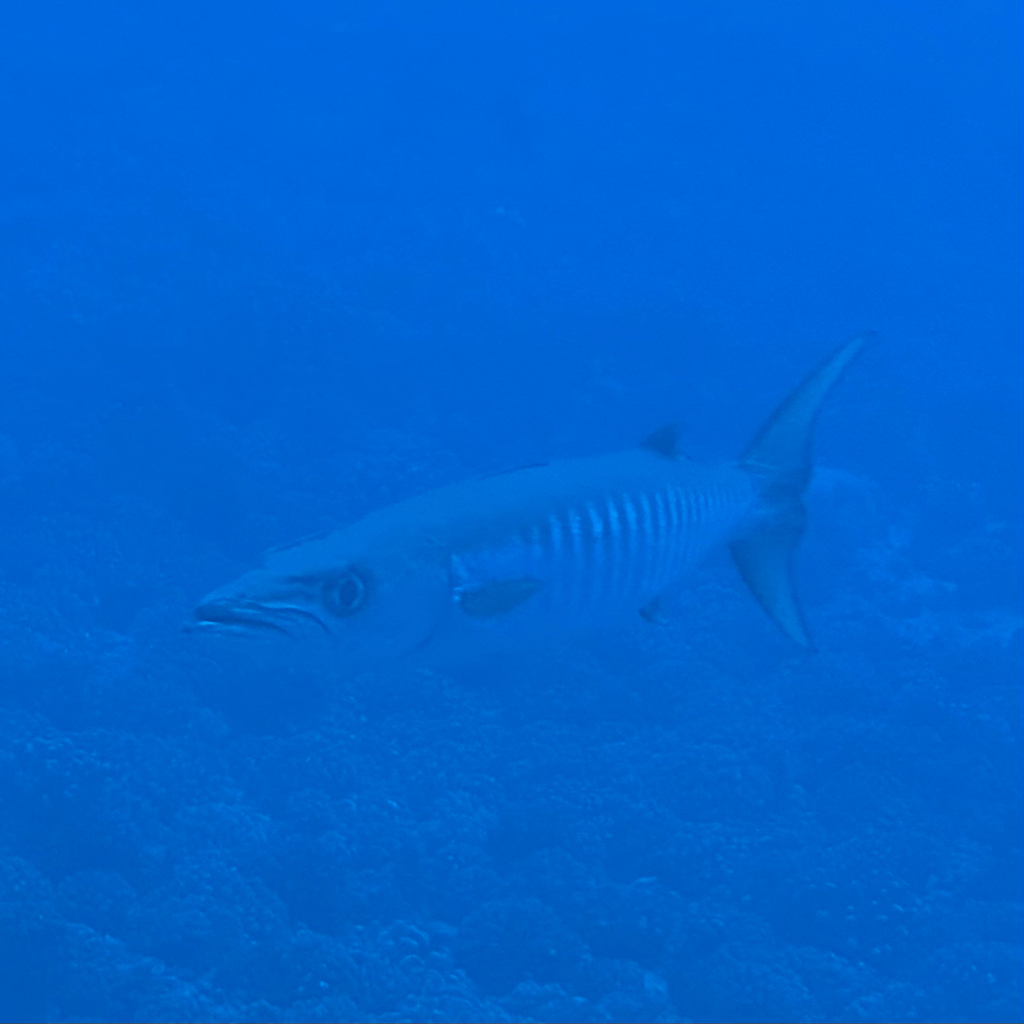
Open the page for this barracuda and two numbers sit next to each other: a maximum total length of 170 cm and a maximum published weight of 7.1 kg. No barracuda of that length weighs seven kilos. The record is not lying about either figure; it is showing that at least one of them belongs to a different fish, which is exactly what the same page warns about a few lines later. The species has been confused with Sphyraena jello and Sphyraena putnamae for long enough that the range itself is described as uncertain. Read the numbers as a warning label, not a target. What is left after you discount them is a fish of roughly 80 cm that behaves like a resident, and that is a much more useful animal to plan around.
Three barracudas behind one label
The morphological characters are real, and they are what you should carry: six dorsal spines and nine soft rays, two anal spines and seven to nine soft rays, many dark bars crossing the lateral line, oblique in the upper half and nearly vertical in the lower, and a caudal fin that is largely blackish. The first gill arch has no rakers at all; instead there are rough platelets on the upper and lower arches. A fish with a black tail and barred flanks is not automatically this species, because the other two are barred as well. The absence of gill rakers is the check worth making on a fish you intend to keep, because it survives a bad photograph and a bad memory.
The school that keeps its address
Behaviour is more reliable than the country list. By day, large semi-stationary schools hang near current-swept lagoons and seaward reefs, and the same school tends to occupy the same site for months or even years. That is unusual among pelagic-looking predators, and it turns the fish into a fixed feature of a dive site or a reef corner. For an angler, it means the mark is the asset, not the fish. Find a school once and you can return to it; find nothing and no amount of trolling will manufacture one. The fish disperses at night to feed, so the school you see at noon is not the one you will find after dark. Come back at the same tide next week and the odds are good that the same fish are holding the same corner.
Dusk, dawn, and a bait that drifts
FishBase notes the species is often hooked by trolling between dusk and dawn. That fits the behaviour: the school breaks up to feed at night, and moving lures meet scattered fish rather than a stationary wall of them. Troll slowly along the reef edge and across channel mouths, with a long minnow or a soft fish, and let the lure run a little further back than usual. During the day, work the edge of the school from the upstream side rather than driving through it. A live bait drifted into the current line is better than a cast into the middle, because the fish expect food to arrive with the flow. Keep the boat quiet and the engine low; a stationary school is easy to scatter and slow to regroup.
Ciguatera at the top of the chain
The threat-to-humans field names ciguatera poisoning. The mechanism is worth stating plainly: the toxin comes from benthic dinoflagellates, moves up the food chain, and accumulates, so larger and older predators carry more of it. A trophic level of 4.5 puts this fish close to the top of that chain. There is no reliable field test. Numbness around the mouth, nausea, vomiting or the reversal of hot and cold sensation after a meal are reasons to seek medical care immediately. Individual fish from the same reef vary enormously, so another angler's good experience says nothing about your fish, and the liver, head and viscera should not be eaten at all. A fish that is released does not remove the risk from the next one you keep.
Very low resilience, very high vulnerability
The stock data is the part that argues for restraint. Resilience is classed as very low, with a minimum population doubling time of more than fourteen years, and fishing vulnerability is 76 out of 100, the highest in this batch. Commercial fishing and gamefishing are both recorded, and the Red List category is Least Concern as of 14 August 2023. Least Concern describes the global picture, not the school in front of you. Four countries in this page's brief manage the same coastline under different rules, from national park closures in Thailand to state-level size limits in India and the recreational-sale ban in the Maldives, and a site-faithful school is easy to overfish under any of them. A single school can be visited by several boats in a week, and the fish have no way to replenish from outside because the same animals come back to the same corner. That is how a healthy-looking reef loses its barracuda quietly.
How to catch it
Trolling
Fished with the listed approach, matched to the recorded depth and size.
Lure fishing
Fished with the listed approach, matched to the recorded depth and size.
Handline
Fished with the listed approach, matched to the recorded depth and size.
Where these facts come from
Check these pages before you rely on a size, range or protection status.
- FishBase — Sphyraena qenie — FishBase · T2
- GBIF — Sphyraena qenie occurrence records — GBIF · T2
- IUCN Red List — Sphyraena qenie — IUCN · T1
- Photo record — iNaturalist — iNaturalist · T3
Fish in the same water
These fish live in the same place.

Guides for this water
Technique, gear and safety guides that fit Blackfin barracuda.