
Permit
Permit is a carangid of the western Atlantic, from Massachusetts to southeastern Brazil, including the Bahamas and many West Indian islands. It lives from the surface to 36 m in subtropical water, reaches 122 cm FL and 36 kg, can live 23 years, and feeds on fish. Its season runs from May to December.
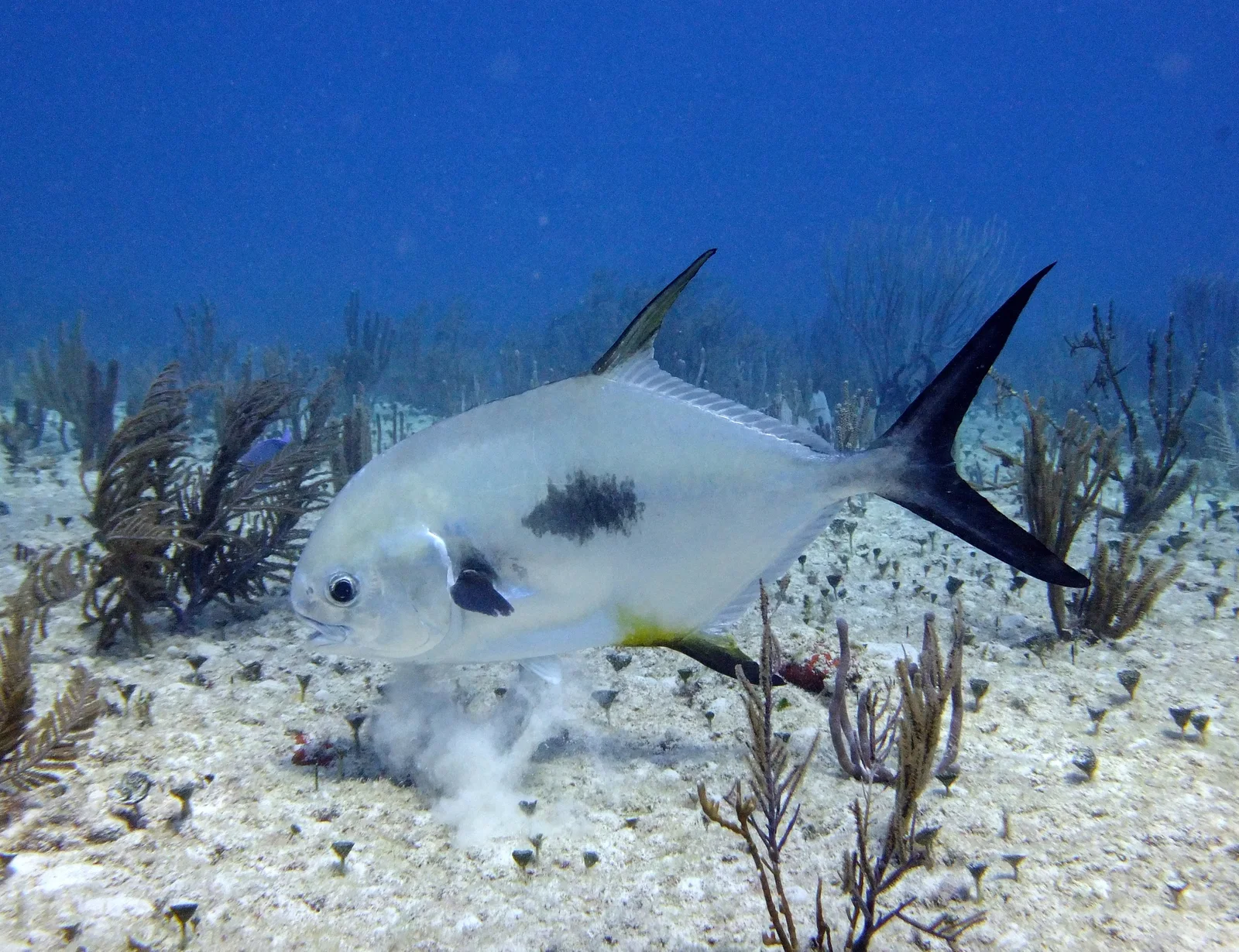
Permit (Trachinotus falcatus) is a fish of the family Carangidae. FishBase gives its range as: Western Atlantic: Massachusetts, USA to southeastern Brazil, including Bahamas and many of the West Indies. Reports from Africa are based on misidentifications, mostly referring to T. It is recorded from 0 to 36 m, in subtropical water. The recorded maxima are 122 cm FL, 36 kg, 23 years. Diet includes fishes. IUCN status: Least Concern (LC). Chinese name: .
Three FL numbers on one page
FishBase puts the record at 122 cm FL, the everyday fish at 94 cm FL, and the maturity length as Lm 54.7 cm, with a range starting at 48 cm. The heaviest published specimen is 36 kg, and the maximum reported age is 23 years. The three lengths sit on one scale and can be compared directly: 122 cm maximum, 94 cm common, 54.7 cm at maturity.
That consistency is useful, but it is also a trap for anyone comparing this page with a fishing report. A report that says "94 cm permit" usually means total length, because that is what a tape run along the fish gives. The page's 94 cm FL is a different, shorter measurement. The two numbers can describe the same fish and still part company over the tail fork.
What the fork leaves out
On a permit the tail is deeply forked and its lobes are long, so the two length standards diverge in a way that is not trivial. Total length runs to the tip of the longer lobe, while fork length ends at the fork; a 94 cm FL fish is therefore longer than 94 cm TL, and a 122 cm FL record is longer again.
The practical consequence is at the release or the weigh station. If the rule is written in TL and the tape is read in FL, a legal fish can be recorded as short, or a short fish as legal, depending on which direction the conversion is botched. The page gives both the FL figures and the age, but no TL equivalent, so a tape read in FL and a rule written in TL have no bridge here. The safe move is to state the measure with the number: "94 cm FL", not "94 cm".
The 36 kg record and the 23-year fish
The 36 kg weight belongs to the 122 cm maximum, not to the 94 cm common fish. No figure is given for a typical weight. The 23-year maximum age sits at the other end: the species can live 23 years, and the page does not tie that age to the 122 cm fish.
A 23-year lifespan changes what a "trophy" means. The page does not say how old a 122 cm fish is, and it does not place the 94 cm fish on an age scale either. The page omits both a growth curve and a maturity age, so the number of years between a 54.7 cm fish and a 94 cm fish is not on the page. It can say that 23 years is possible, and nothing more.
The long dark lobes
The morphology section is specific: dorsal spines 6–7, dorsal soft rays 18–21, anal spines 2–3, anal soft rays 16–18; the dorsal and anal fins have very long, dark anterior lobes; there are no scutes; a broad orange-yellow patch sits on the abdomen in front of the anal fin; the pectoral fins are blackish.
Those marks separate the permit from the other pompanos at the same dock. The long dark lobes show at distance, the orange-yellow belly patch shows in good light, and the blackish pectorals show when the fish is shaded. It carries no scutes, a trait that separates it from the scuted jacks in the same family.
Sand flats and holes
The habitat text is a map of the shallow bank: adults are frequently in channels or holes, over sandy flats, around reefs, and sometimes over mud bottoms; they are usually solitary or in small schools; smaller fish tolerate brackish water. During summer, juveniles form large schools, especially in the surf zone along sandy beaches.
That is a depth story rather than a season story. The adult fish is in the channels and holes that cut the flat, not on the flat itself; the juvenile is in the surf. The 0–36 m range, with a usual 0–30 m, is the outer envelope of those positions. A boat that drifts the open flat and ignores the channels is fishing beside the fish, not over it.
Spawning offshore
The spawning table gives two records: Florida in May–August, and Ceará, Brazil, in December. The biology text adds that the species spawns offshore. The two records sit in opposite hemispheres and different months; the page keeps them apart rather than averaging them into one season.
For a trip plan, the Florida record is the northern one and the Ceará record is the southern one. Neither is a guarantee for the other, and the offshore note is the part that carries across: the spawn is not a beach event, even though the juveniles later appear in the surf.
The records that do not fit
The occurrence data is weighted toward the United States: GBIF returns 3,894 present records, 2,063 of them from the United States, 406 from Brazil, 405 from Mexico, 112 from Belize, 57 from the Virgin Islands, 49 from Puerto Rico, 47 from Kentucky and 43 from Nigeria. iNaturalist adds 1,549 observations.
Two of those entries need to be stated without being resolved. The distribution text says the species ranges from Massachusetts to southeastern Brazil and that reports from Africa are misidentifications, mostly of Trachinotus teraia. GBIF still lists 43 Nigerian records. The page and the occurrence database disagree, and neither side outranks the other here. Kentucky is also outside the marine range, and the page gives no explanation.
Measuring at the boat
The measurement rule follows from the pages. Read fork length, say "fork length" when the number is written, and do not convert to total length without a source. The three FL figures — 122, 94 and 54.7 cm — are internally consistent; a TL number from a dock report is not on the same scale.
The 54.7 cm maturity point and the 48 cm lower bound are the biological floor, and the 36 kg / 23-year record is the ceiling. The fish in the middle, at 94 cm FL, is the common adult. Measure that one at the fork, release it if the rule is a TL rule and the conversion is uncertain, and keep the record out of the routine.
The name has its own history: WoRMS accepts Trachinotus falcatus (Linnaeus, 1758) and lists Labrus falcatus and Chaetodon rhomboides as unaccepted. A catch logged under either older combination does not surface when the present name is searched.
Where these facts come from
Check these pages before you rely on a size, range or protection status.
- FishBase — Trachinotus falcatus — FishBase · T2
- GBIF — Trachinotus falcatus occurrence records — GBIF · T2
- IUCN Red List — Trachinotus falcatus — IUCN · T1
- Photo record — iNaturalist — iNaturalist · T3
Fish in the same water
These fish live in the same place.

African pompano
- Family
- Carangidae
- Depth
- 60–100 m

Almaco jack
- Family
- Carangidae
- Depth
- 5–245 m

Atlantic horse mackerel
- Family
- Carangidae
- Depth
- 0–1050 m
- Season
- Jan, Feb, Mar, Apr, May, Jun, Jul, Aug, Sep, Oct, Nov, Dec
Guides for this water
Technique, gear and safety guides that fit Permit.