
Pompano
Pompano is a carangid of the eastern Atlantic and Mediterranean, from the Bay of Biscay and, rarely, British and Scandinavian waters to Angola. It lives from 50 to 200 m in subtropical water, reaches 70 cm TL and 2.8 kg, and feeds on crustaceans and fish. Its season runs from February to November.
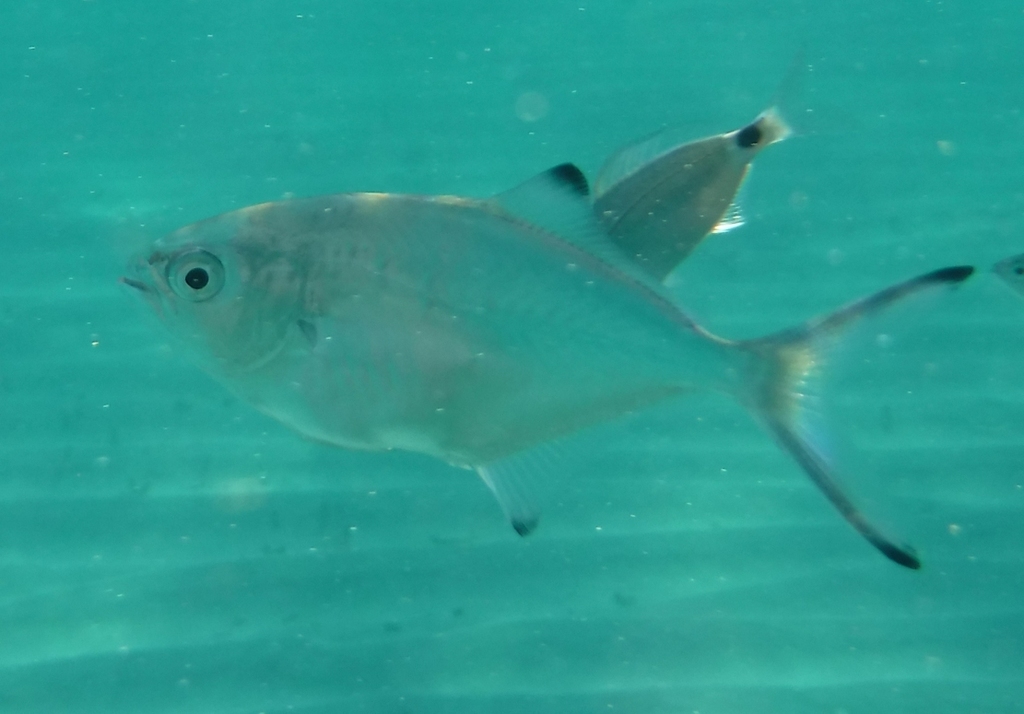
Pompano (Trachinotus ovatus) is a fish of the family Carangidae. FishBase gives its range as: Eastern Atlantic: Bay of Biscay, British and Scandinavian waters (rare vagrant) to Angola, including the Mediterranean Sea and offshore islands. It is recorded from 50 to 200 m, in subtropical water. The recorded maxima are 70 cm TL, 2.8 kg. Diet includes crustaceans and fishes. IUCN status: Least Concern (LC). Chinese name: .
Derbio on the page, pompano in the water
FishBase accepts Trachinotus ovatus and gives the English common name "Pompano". The site's own display name is "Derbio". The alias list includes Australian dart, silverfish, derbio and pompano. A pompano in Europe and a dart in Australia can be the same fish; the names collide with species used elsewhere.
The collision matters because "pompano" is a market name, not a species name. A recipe, a size limit or a price quoted for "pompano" is ambiguous until the scientific name is attached, and the scientific name attached to this page is Trachinotus ovatus.
The synonym that ran for a century
WoRMS lists Lichia glauca, Lichia glaucus, Caesiomorus glauca, Caesiomorus glaucus, Caranx glaucus, Gasterosteus ovatus, Centronotus binotatus, Centronotus ovalis, Glaucus rondeletii and Lichia tetracantha as unaccepted combinations for this fish. The "glaucus" names are the important ones: for a long period the species was widely known as Trachinotus glaucus, and that is the name in many older books and landing statistics.
The synonym list is not a historical curiosity. A search for one name will miss records filed under the other. When two sources disagree about how common a fish is, the first thing to check is whether they are using the same name.
Two Chinese names, one fish
The site's Chinese name sits beside the alias . The two names describe different things: one is the standard aquaculture and market name, the other is an older or regional name. The page does not mark either as official.
What the page does show is why the Chinese name matters. GBIF returns 265 records from China for a species whose native distribution is the eastern Atlantic and Mediterranean. The page records commercial aquaculture for the species, but it does not say where the farms are or whether the Chinese records are farm escapes. The name and the map are connected; the page does not explain how.
"Pompano" on two menus
Two species sit behind the label: Trachinotus carolinus, and Trachinotus ovatus, the second of which is this eastern Atlantic and Mediterranean fish. A menu that says "pompano" without a scientific name or an origin is not identifying the fish.
For a buyer, the practical check is the spots. This species has three to five black spots along the anterior half of the lateral line, a greenish-grey back, silvery sides and black-tipped fin lobes. The name on the menu does not settle the identification; the fish itself does.
The depth line that contradicts the text
The environment box gives a depth range of 50–200 m. The biology text says adults are moderately common in shallow water in areas of surge, in clear water over sand or mud bottoms, occasionally entering lagoons and river estuaries, and that small specimens are regularly caught at night from steep rocky shores. Those two statements do not describe the same depth.
The page leaves the two unreconciled. It does not say the 50–200 m is a typo, and it does not say the shallow-surge fish are a separate population. "50–200 m, occasionally shallow" would be a third statement that neither the box nor the biology text makes. Both are on the page; both are reported here; the conflict is left standing.
Three to five spots
The morphology section is detailed enough to settle an identification: dorsal fin with 7 spines and 23–27 soft rays, anal fin with 3 spines and 22–25 soft rays, small cycloid scales partly embedded in the skin, a lateral line very slightly arched over the pectoral fins and straight thereafter, no scutes, and 3–5 vertically elongate black spots on the anterior half of the lateral line. The back is greenish-grey, the sides silvery, and the dorsal, anal and caudal fin lobes are black-tipped.
The combination is more useful than any single mark. The spots separate it from the Florida pompano; the lack of scutes excludes the scuted jacks; the black-tipped lobes are visible on a fresh fish and often survive on ice. A market label can be wrong, but the spot count and the fin formula are on the animal.
St Helena in February–March, Ceará in October–November
Two spawning entries appear: St. Helena in February–March and Ceará, Brazil, in October–November. They sit in different oceans and different hemispheres — St. Helena is a South Atlantic island, Ceará a point on the Brazilian coast. The page leaves the two entries standing on their own.
Seen from a boat, the two entries stand alone. Neither is a range-wide spawning calendar, and neither can be carried to the Mediterranean, where the page records no spawning at all. The correct reading is local: a February–March spawn around St. Helena and an October–November spawn off Ceará, with the rest of the range unrecorded.
Which name to search when checking rules
The rule that applies to this fish depends on the country, and the country's rule is indexed under a local name. In the Mediterranean, the name may be derbio, palometa or pompano; in China, it may be ; in an older record, it may be Trachinotus glaucus. A search that uses only one of those names will miss part of the record.
The size figures are equally name-dependent. The maximum is 70 cm TL, the common length is 35 cm with no length type given, and the maximum weight is 2.8 kg. There is no maturity length and no age. A rule written in fork length cannot be checked against a 35 cm figure whose length type is "NG", so the two measures stay apart. The name and the measure have to be resolved before the rule means anything.
The distribution adds the last piece. The native range starts at the Bay of Biscay, takes in British and Scandinavian waters, where it is a rare vagrant, and reaches Angola, including the Mediterranean and offshore islands. GBIF's top countries are Spain 755, China 265, Greece 240, Portugal 161, Italy 126, Angola 106, Turkey 89 and France 80. iNaturalist adds 1,672 observations under the common name "Pompano". The map is Mediterranean and eastern Atlantic, with a Chinese block that belongs to the aquaculture name rather than the native range.
Where these facts come from
Check these pages before you rely on a size, range or protection status.
- FishBase — Trachinotus ovatus — FishBase · T2
- GBIF — Trachinotus ovatus occurrence records — GBIF · T2
- IUCN Red List — Trachinotus ovatus — IUCN · T1
- Photo record — iNaturalist — iNaturalist · T3
Fish in the same water
These fish live in the same place.
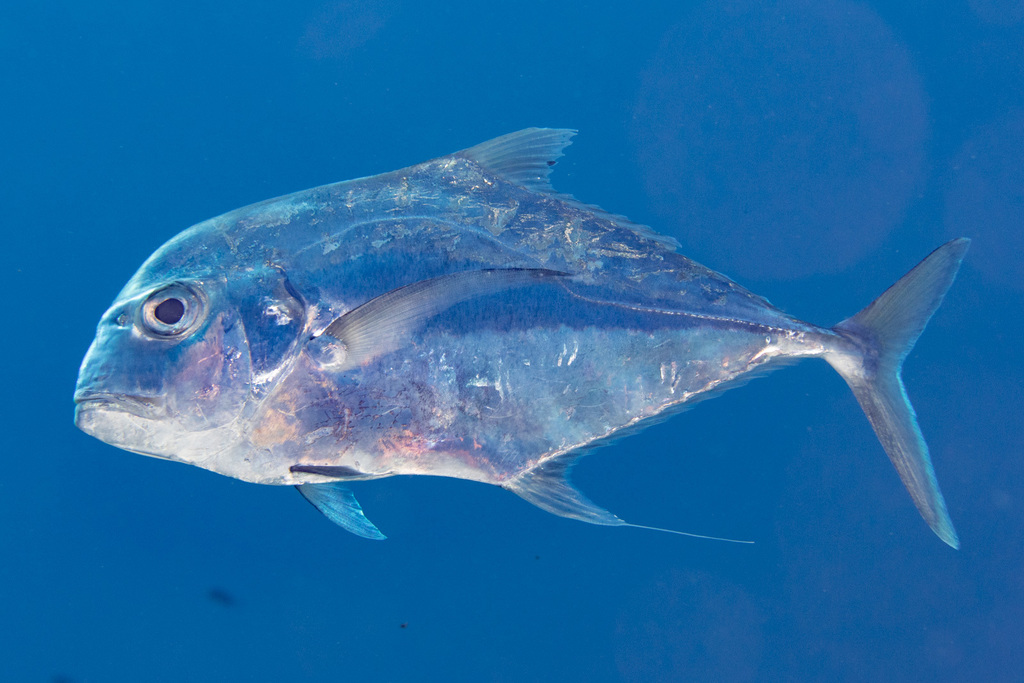
African pompano
- Family
- Carangidae
- Depth
- 60–100 m
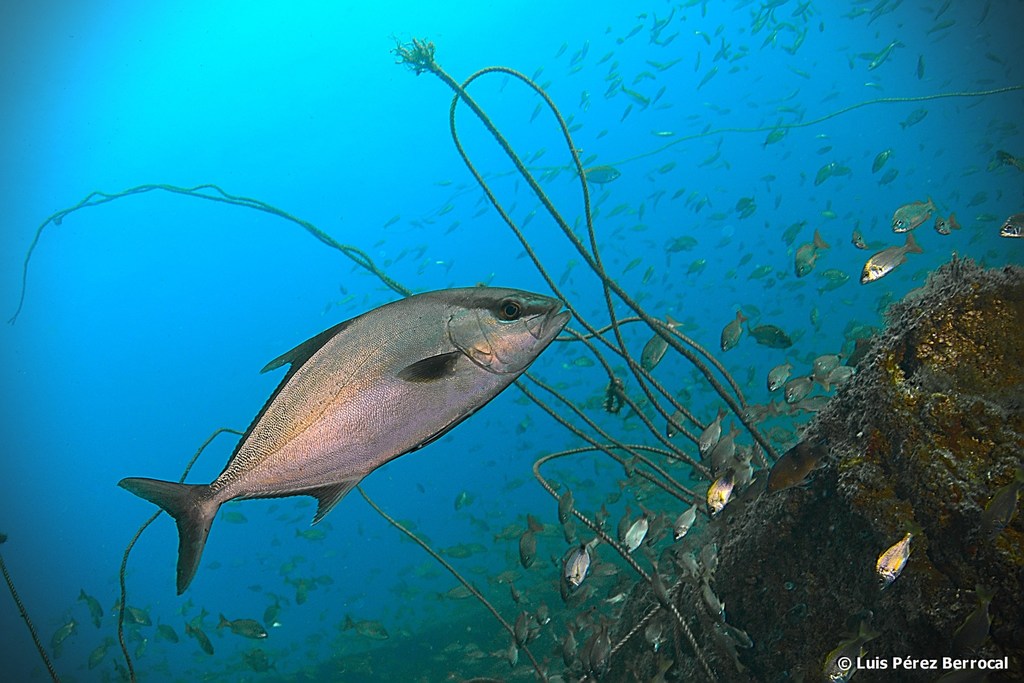
Almaco jack
- Family
- Carangidae
- Depth
- 5–245 m
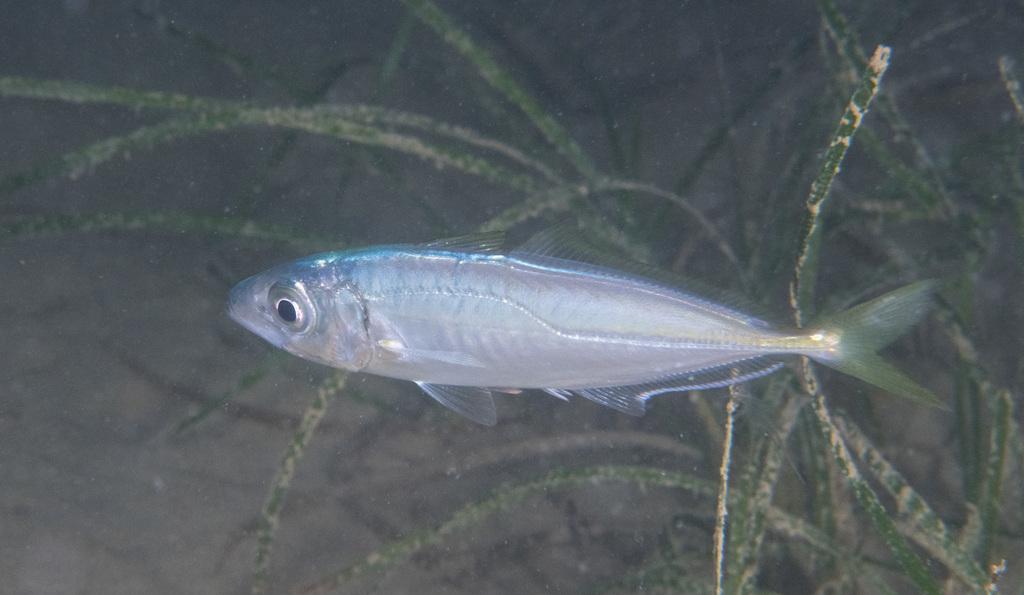
Atlantic horse mackerel
- Family
- Carangidae
- Depth
- 0–1050 m
- Season
- Jan, Feb, Mar, Apr, May, Jun, Jul, Aug, Sep, Oct, Nov, Dec
Guides for this water
Technique, gear and safety guides that fit Pompano.